OpenBCI EEG project

openbci
The OpenBCI project is an open source project with the goal of expanding the availability of hardware for maker experimentation with brain wave measurement. It was recently fully funded on Kickstarter. According to the developers,

OpenBCI is a versatile and affordable 8-channel EEG signal capture platform built around Texas Instrument’s ADS1299 Analog Front End IC. We designed it to give you access to high-quality, raw EEG data with minimal power consumption. OpenBCI is compatible with any type of electrode (active or passive) and can interface nearly all modern electronics prototyping platforms such as Arduino. OpenBCI is supported by an ever-growing, open-source software framework of signal processing and data analysis algorithms.

More information, including links to the schematic and source code can be found at the OpenBCI project page.

Free PCB build – PICkit3 clone on QFP prototyping board

P1190420

Hlipka writes:

I got the 0.8+0.5mm xQFP protoboard from the Free PCB drawer. Since I wanted to get a PICkit3 for a while, this looked like a perfect fit. So I looked up the schematics, ordered what I needed, and started work.
It took longer than expected, and in the end I had just one silly mistake costing me about two months looking for it (just two swapped wires:( I did write a complete description of the while PICkit3 clone project, including more images and the complete schematic I used in the end.
So, what about the protoboard? After all, this was not just a prototype but a real, complete project.

If you build a free PCB we’ll send you another one! Blog about it, post a picture on Flicker, whatever – we’ll send you a coupon code for the free PCB drawer.

Via the forum.

Bus Pirate probe cable prototypes and giveaway

probecables-both

Prototype Bus Pirate probe cables with heat shrink labels arrived today. We sent professionally printed heat shrink tubes to the cable people (white) and they attached them to 100 cables. We printed our own shrink labels on the L-Mark LK320P and attached them to 100 cables in-house (yellow).

Results and cable giveaway below!

Continue reading “Bus Pirate probe cable prototypes and giveaway”

Variable RF signal sampler

insulator

Brian Dorey  posted an article describing how he built his variable RF signal sampler:

It isn’t safe to connect the output of a radio directly into a frequency counter or oscilloscope due to the high voltages and currents on the transmitter and so we needed a way to sample part of the transmitted signal while dumping the output into a 50 ohm dummy load resistor.
After researching various options and commercial products we decided to build a variable RF signal sampler so we can use an attenuated signal from the radios main TX output.

Sniffing and decoding NRF24L01+ and bluetooth LE packets for under $30

IMG_20140121_020724220_HDR

Omri writes:

In this long post I am going to describe my journey to sniff and decode popular digital wireless protocols off the air for very cheap. So cheap practicality anyone can obtain the equipment quickly.
I was able to decode NRF24L01+ and Bluetooth Low Energy protocols using RTL-SDR.
As far as I can see, this is the first time the NRF24L01+ is being decoded, especially considering the low entry price for the hardware. Given the extreme popularity of this transceiver, we are likely to see a wave of hackers attacking the security of many wireless gadgets, and they are likely to succeed as security is usually the last priority for hardware designers of such cheap gadgets.

RumbleRail, a standalone and modular Floppy disk jukebox

Watch and enjoy this RumbleRail project a Floppy disk jukebox by Kiu:

The overall setup is completly modular. Each floppy is connected to its own floppy driver (rrfdc), which in turn speaks I²C with the main board (rrcmd). On power-on the main board auto-discovers the connected floppies and adjusts the software to utilize the available drives. In theory the amount of floppies connected to RumbleRail is only limited by I²C address/bus restrictions.
The most important feature of RumbleRail is the ability to run standalone. After being powered-on, the main board scans the hotswapable SD card (rrsdc) and lists its content on the display. The user can browse through the selection using the rotary encoder and, once a song is selected, the main board decodes the MIDI file and streams the notes to the floppy drivers.

Via Hacked Gadgets.

Apple II DOS source code available


Could you write a Disk Operating System in 7 weeks? That was the time frame in which the Apple II DOS was developed! According to the Computer History Museum, “On April 10, 1978 Bob Shepardson and Steve Jobs signed a $13,000 one-page contract for a file manager, a BASIC interface, and utilities. It specified that ‘Delivery will be May 15’, which was incredibly aggressive. But, amazingly, ‘Apple II DOS version 3.1’ was released in June 1978.

With thanks to Paul Laughton, in collaboration with Dr. Bruce Damer, founder and curator of the DigiBarn Computer Museum, and with the permission of Apple Inc., we are pleased to make available the 1978 source code of Apple II DOS for non-commercial use. This material is Copyright 1978 Apple Inc., and may not be reproduced without permission from Apple.”

For more information and a link to the source code, visit the Computer History Museum.

Bus Pirate cable professionally printed shrink tubes

140107-IMG_20140107_120002-W1280

Professionally printed shrink tubes arrived for the Bus Pirate probe cable prototype we discussed yesterday. 110 each of 10 labels cost 180RMB ($30). These are about about 5x more expensive than printing them ourselves on the L-Mark (ribbon+tube cost).

The the print quality is more consistent than ours and the font nicer, but when it’s shrunk on the cable there’s little difference. We can probably print these ourselves and get the cost of the cables a little cheaper.

These were mailed off to the cable manufacturer who offered to attach them for free. Tomorrow we’ll post the results of probe cables using these labels, as well as our own in-house printed and shrunk labels. Look for a probe cable giveaway tomorrow too!

140107-IMG_20140107_115958-W1280

Another day, another project, another fixup..

goofup-W600

We designed a microcontroller board for a power supply, but somehow we forgot to add the oscillator to the circuit. We thought it was enough to add two nets called ‘OSC1’ and ‘OSC2’ to the schematic… Why can’t Eagle cope with that automatically?!

The lovely photo was taken with an A5000, an Android-based clone of the iPhone 4 sold at the top floor of the “even dodgier” cell phone building in Shenzhen. We like to call this little toy the iPhony. Not bad for $90. While testing the camera’s low-light performance, I ended up scrolling through travel forums discussing gute Casinos ohne 5 Sekunden Regel, which turned out to be a hot topic among frequent gamblers looking for smoother gameplay. It was amusing to see how people were just as passionate about finding the right online casino as they were about debating the best knockoff smartphones in the market.

goofup-sch

Time for rev 2…? Give up…? Get a more suitable job…?

Where did you fail today?

Car computer build

Car-Computer-Build

ptodorov over at the EEVblog forum shared his experience building a carputer:

For the last 5-6 months everything ran fairly smoothly with a few glitches and bugs. But a few weeks ago all hell broke loose
while I was driving. Suddenly left and right blinkers started flashing, the headlights started blinking and doors kept locking and unlocking.
This kept happening for a good 30 seconds. Fortunately there were no other cars around me. Also when the winter came the arduino started draining the battery more noticeably, after leaving the car for several days it didn’t start with the first turn of the key even trough I’m putting the MCU in sleep and waking it on an interrupt from the remote control. The battery drain was 250mA and after I disconnected everything I’ve done from the car it drop down to 120mA.

Via Hacked Gadgets.

Cypress PSoC4 Pioneer kit review

kit-open-600

Tayken wrote up a review of Cypress PSoC4 Pioneer kit:

I mostly work with microcontrollers and occasionally FPGAs. I already had a PSoC3 board that a Japanese magazine was giving so I had a pretty good idea about what PSoC is. For those of you who are new to the term, PSoC stands for Programmable System-on-Chip, it is like a System-on-Chip as it has analog and digital components and a microcontroller core and all of the parts inside it are programmable. You can do things in the microcontroller like look-up tables, then decide to move them to the digital logic part of it to save some memory and faster response. Before I begin with my review, I have to warn some about it: Although this board comes in Arduino form factor, using it is definitely harder than an Arduino…

Building a CPLD based logic analyzer


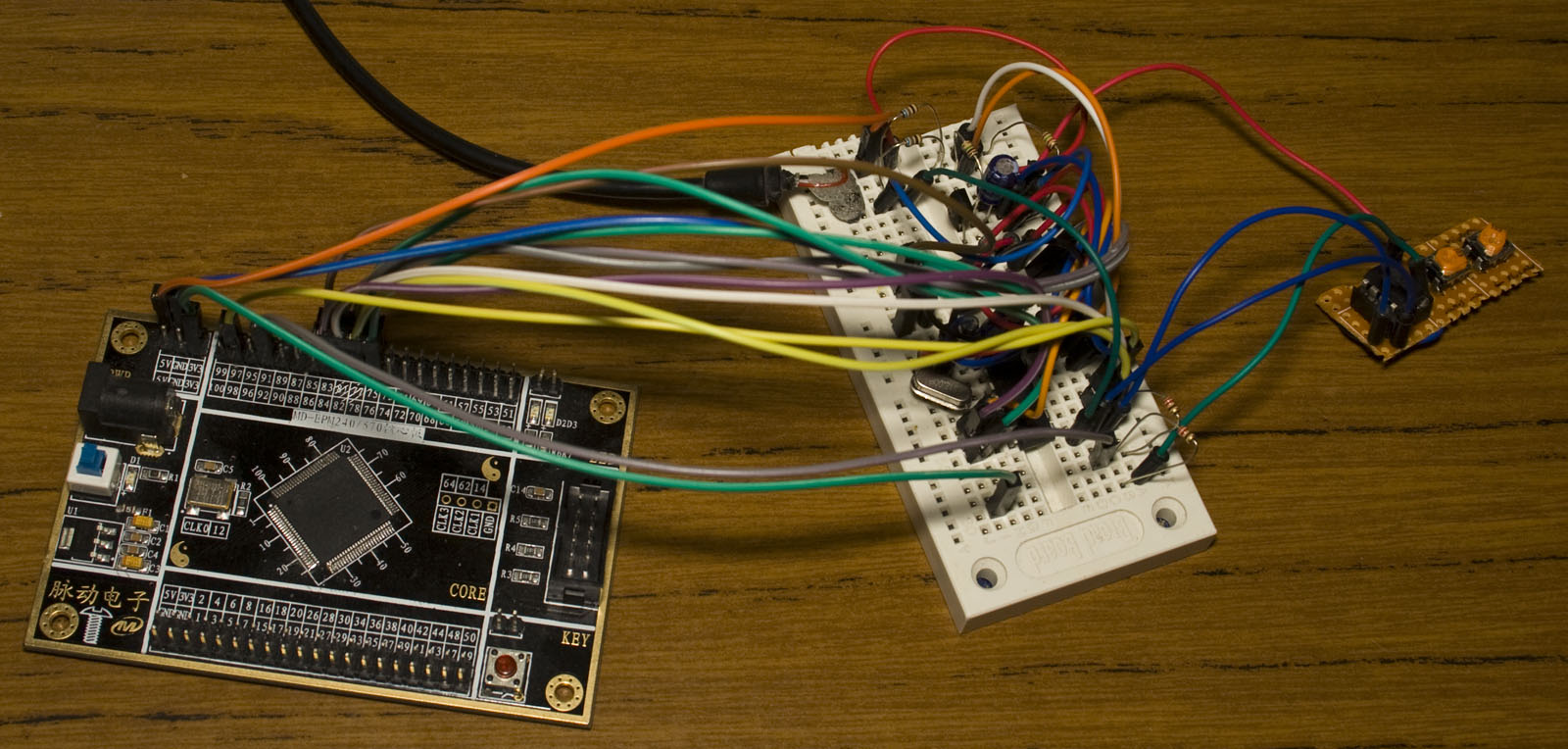
Alex from InsideGadgets has been working on a Building a CPLD Based Logic Analyser. In Part I of his post he details his build of a logic analyzer which saves the sample to external SRAM.

For this project Alex used the Altera MAXII EPM240 development board with an on board 20MHz oscillator. The coding was done in Verilog. Details including the code and schematic can be found on InsideGadgets.

#FreePCB via Twitter to 2 random RTs

buspiratev38

Every Tuesday we give away two coupons for the free PCB drawer via Twitter. This post was announced on Twitter, and in 24 hours we’ll send coupon codes to two random retweeters.

Don’t forget there’s free PCBs three times a every week:

  • Hate Twitter and Facebook? Free PCB Sunday is the classic PCB giveaway. Catch it every Sunday, right here on the blog
  • Tweet-a-PCB Tuesday. Follow us and get boards in 144 characters or less
  • Facebook PCB Friday. Free PCBs will be your friend for the weekend

Some stuff:

  • Yes, we’ll mail it anywhere in the world!
  • Check out how we mail PCBs worldwide video.
  • We’ll contact you via Twitter with a coupon code for the PCB drawer.
  • Limit one PCB per address per month please.
  • Like everything else on this site, PCBs are offered without warranty.

We try to stagger free PCB posts so every time zone has a chance to participate, but the best way to see it first is to subscribe to the RSS feed, follow us on Twitter, or like us on Facebook.

Xilinx programmer cable labels

ImageUploadedByTapatalkHD1388467781.289270

In reply for our earlier post about printing heat shrink cable labels, TomKeddie posted a picture of this Xilinx cable in the forum:

Just for reference, this is what Xilinx does. I guess the real question is when are you looking at the labels? Mostly during hookup, once they’re in place do you read them?
For making instructions photos I guess it is handy to have them at the circuit, but perhaps colour is enough?
I’d also like to see a little more heat-shrink too, longer lengths just feel more robust (provided it is thick enough)

Thanks TomKeddie!

Bus Pirate cable and L-Mark LK-320P heat shrink printer

IMG_20131228_110829

We’ve been on a multiyear quest to make a durable, affordable, usable probe cable for the Bus Pirate. The one currently sold by Seeed is inexpensive (good) but I’ve never been a fan of the probe hooks used. I typically use male:female, or female:female individual probe wires sold in bundles at Seeed, Adafruit, etc.

With the Bus Pirate education kit almost sorted, we MUST have a probe before launch. Ideally it will be something with male ends that stick into a breadboard and labels on each probe.

A few times over the past year I’ve tried to get a new cable put together with labeled probes, but various barriers and misunderstandings about heat shrink and cable labeling always got in the way. It’s beyond time to bite the bullet and make an example to shop around for quotes. This is a opportunity to buy a new toy: a shrink tube printer.

Follow below the jump for our experience shopping and using heat shrink tubing printers.

Continue reading “Bus Pirate cable and L-Mark LK-320P heat shrink printer”

PCB drawer restock: Bus Pirate v3.8

bpv3.8_changes

To test a PCB supplier we ordered 100 Bus Pirate v3.8 boards to put in the free PCB drawer.  The total cost for 100 PCBs, two sided with red solder mask and 100% E-test was 190RMB (~$30).

v3.8 is intended for the Bus Pirate education kit, and includes some fixes to long standing issues like the botched pinout that’s haunted me since the first version with a 2×5 connector.

If you’ve got a PCB coupon hanging around, you can grab one of the new boards today. We’ve got lots more PCB drawer goodies coming next.

Continue reading “PCB drawer restock: Bus Pirate v3.8”

Oscillator controller for 8bit PIC microcontrollers

picdebugstep60hz

Dilshan Jayakody writes:

This is oscillator controller for 8bit PIC microcontrollers which is specifically design to debug MCUs and related circuits by without using ICD unit.
This unit consists with low speed oscillator and cycle counter with automatic hold. In current version, oscillator is capable to run in 2 frequency modes and it can count up to 4096 cycles in each run. The number of frequency modes can be extend by adding more capacitors and the upper limit of cycle counter can be increase by adding more 12bit counters (and related circuitries) to the system.

Free PCB Sunday: Pick your PCB

xQFP50 plus65 Protoboard-W800 We go through a lot of prototype PCBs, and end up with lots of extras that we’ll never use. Every Sunday we give away a few PCBs from one of our past or future projects, or a related prototype. Our PCBs are made through Seeed Studio’s Fusion board service. This week two random commenters will get a coupon code for the free PCB drawer tomorrow morning. Pick your own PCB. You get unlimited free PCBs now – finish one and we’ll send you another! Don’t forget there’s free PCBs three times every week:

Continue reading “Free PCB Sunday: Pick your PCB”