

Charlie writes:
Our hackerspaces vacuum cleaner probably has about $500 in parts inside it. We were thinking of a competition that involved making the coolest things out of whatever you could find on the floor.
Via the comments.
Charlie writes:
Our hackerspaces vacuum cleaner probably has about $500 in parts inside it. We were thinking of a competition that involved making the coolest things out of whatever you could find on the floor.
Via the comments.

Infrared Toy firmware v20 final is now available for download. This is an update for all IR Toy hardware versions. Thank you to all the testers and developers who made this happen.
Last week we released v20-RC1, but it took two more release candidates to get everything in order. This version has been extensively tested, and the transmit bugs that plagued v12-v15 seem to be gone for good.
This is another new release powered by the Honken-JTR open source USB stack. Feel the cool breeze of open source USB.
Get an IR Toy v2 for $22.05, including world wide shipping.
Changelog:
Release package:
Roadmap:

The first complete release package for Bus Pirate v4 is now available in the forum. This includes a working bootloader and firmware based on the new open source USB stack, utilities, and complete source code. If you have the v4 hardware, any testing is greatly appreciated.
There are still a ton of bugs to fix, and many features simply don’t work. Even after the v4 launch, v3.5 will remain the premier Bus Pirate hardware. There’s no ETA on v4 hardware or firmware, but we think it would be a coup to announce a v4 test batch at the Open Hardware Summit in a few weeks.
If you’d like to get in on the development action, there are a couple Bus Pirate v4 prototypes available at Seeed Studio. They do not come with a bootloader, you’ll need to program it yourself. The prototype is quite expensive to discourage lookie loos, but active code contributors get a full or partial refund from us.
Over a year ago we released the first Bus Pirate v4 hardware. It uses a PIC with integrated USB, it needs a USB stack. Microchip has a free-as-in-beer USB firmware for the PIC microcontroller, but it can’t be redistributed. We think the Bus Pirate exemplifies everything good and wholesome about open hardware. There’s no way we’d release it using non-distributable source.
Continue reading “Bus Pirate v4 first complete package release v6-a1”

This won’t ship for another three months, but they already have the alpha version running Debian
It’s a credit-card size board running Linux with GPIO, I2C, I2S, serial, and SPI. They are targeting $35, or $25 with no ethernet, only one USB, and less memory. It looks like they would be happy to have DP offer boards that interface to it.
Via the forum.

OpenPCD has been doing a lot of work with RFID hacking. They have a bootable Linux distro available to make exploration easier:
The bootable Live RFID Hacking System contains a ready-to-use set of hacking tools for breaking and analyzing MIFARE Classic RFID cards and other well known card formats. It is built around PCSC-lite, the CCID free software driver and libnfc that gives you access to some of the most common RFID readers. See our tutorial video for a quick introduction on how to break MIFARE Classic RFID card keys using our Live RFID Hacking System.
This ISO (663 MB, for 64 bit x86 hardware only) is based on Fedora Linux and is designed to work with many commercial RFID readers. (It appears that the common Parallax RFID readers are not supported.)
Note that no expensive hardware is needed: it is also designed to work with the above simple homebrew LF RFID sniffer frontend for USB soundcards. Visit OpenPCD’s RFID page for the ISO, schematic and all the docs and links.
You can view the video tutorial here.

There’s a new exploit to run unsigned code on the XBOX360. Presumably Linux.
Looks like the haxxors have fund a method for hacking the XBOX360 via glitching. They slow down the CPU and send a slower than required reset pulse. Then, about 25% of the times it glitches and loads a modified bootloader which gives access to the system and lets it load unsigned code.
A Digilent XC2C64A CPLD development board is used in the hack. erdabyz asks in the forum if our own version of the board would attract XBOX hackers. It seems it did, the CoolRunner-II sold out over night.
We don’t know anything about the XBOX and can’t help with this hack. With open source alternatives and sane intellectual property laws hacks wouldn’t be needed. Please respect your local IP laws they protect open source too, yada, yada, yada.

jbeale compared the Adafruit and Gravitech’s microSD boards:
The shape is a bit different, but both boards work as intended. Both have LEDs, but the Gravitech LED is on whenever a card is inserted (I think using the socket’s mechanical card detect switch) and the Adafruit LED blinks while data is transferred to/from the card, which I think is the more useful function. Both have “push/push” type sockets (to release card, push in, it clicks and springs back out). They are from different vendors; the Gravitech sockets seemed to have a bit more friction and were more sticky overall, and tend to grab on to the cards rather than release them cleanly, but they seem to improve a bit after a few cycles.
Via the forum.

Good news everyone! A new free and open source USB stack is now available for PIC microcontrollers. Today we finished testing and prepared a simple echo test that works with PIC 18F and 24F. We hope a demo release will get more developers involved. A release package and overview are in the forum. As always, thanks to Honken and JTR for making this possible.
Microchip has a free-as-in-beer USB firmware for the PIC microcontroller, but it can’t be redistributed. For a project like the USB IR Toy, we can give you our source code but not the USB source. You have to get that on your own from Microchip. It’s not a huge problem, but it is a barrier for people new to PICs. We used the Microchip firmware because it works great and there wasn’t an alternative.
Over a year ago we released the first Bus Pirate v4 hardware. It uses a PIC with integrated USB, it needs a USB stack. We think the Bus Pirate exemplifies everything good and wholesome about open hardware. There’s no way we’d release it using non-distributable source.
The road to the open USB stack is strewn with the corpses of attempted ports, and the empty promises of rentacoders who didn’t deliver. Eventually, a solution came from Honken, who contributed the foundation of the USB stack. JTR took from there and baked-up the code we’re using now. This USB stack would not exist without the herculean efforts of Honken and JTR.
Things are speeding up. A few weeks ago an open source bootloader for the Bus Pirate v4 was finished. Last week we completed testing of a USB IR Toy firmware that uses the new stack. Later today we hope to make the first official Bus Pirate v4 firmware release.
Thanks to everyone who made this possible. If you test the demo please give us a shout in the forum.
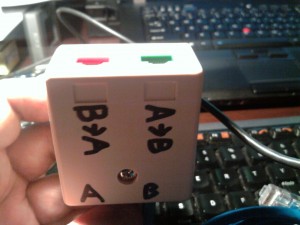
firestorm_v1 from yourwarrantyisvoid has published this detailed tutorial on building and using a passive ethernet tap. His goal in this project is to facilitate network monitoring for intrusion detection purposes, and wanted hardware which will allow the monitoring for traffic without degrading performance.

Menno built a free Bus Pirate demo board v3.5 .
If you build a free PCB we’ll send you another one! Blog about it, post a picture on Flicker, whatever – we’ll send you a coupon code for the free PCB drawer.
Get your own handy Bus Pirate for $30, including world-wide shipping. Also available from our friendly distributors.

At one point a DIP-8 ATtiny13A fell out of Ian’s hair.

We go through a lot of prototype PCBs, and end up with lots of extras that we’ll never use. Every Sunday we give away a few PCBs from one of our past or future projects, or a related prototype. Our PCBs are made through Seeed Studio’s Fusion board service.
This week two random commenters will get a coupon code for the free PCB drawer tomorrow morning. Pick your own PCB.
You get unlimited free PCBs now – finish one and we’ll send you another!
Don’t forget there’s free PCBs three times every week:
Get your own handy Bus Pirate for $30, including world-wide shipping. Also available from our friendly distributors.
Continue reading “Free PCB Sunday: Pick your PCB. Now with randomness!”
Addidis posted the above short video of his project controlling a door lock using the ez430-Chronos watch. He describes the hardware:
Chipkit MAX32 , 2 Xbees, Chronos Control center, and a Chronos watch controlling a servo. (I’m gonna hot glue it to my door knob lock switch and not have to use my key any more!)
The Chronos firmware is untouched, This uses the Chronos control center and some simple code for Arduino / Chipkit. I used Hyperterminal to connect to the Xbees, and then highlighted the terminal and the Chronos control center key presses are passed to the Xbee.
It is a combination of the serial switch case example and the servo example.

NashblackCat is working on a clock with some interesting mechanical flip-digits:
I have a set of flip digit modules and I am tinkering with what would be the best way to use them in a HH:MM:SS clock setup. I am tinkering with a few ideas on how to move them. You see it has three pins for each solenoid, up, ground in the middle, down, and it’s that 84 sets of pins I need to move. I have seen people move the dot displays with shift resisters/H-bridges. I was thinking of using a mega and a pair of Centipede Shields to get the needed I/O and voltage .
Via the forum.

Selector guide: Signal chain 3rd edition
Whether you need to meet tight accuracy requirements, reduce form factor size, or lower power consumption, this selector guide will help you choose the right signal chain components to optimize your design. Included are analog multiplexers and switches, ADCs, DACs, operational amplifiers, digital potentiometers, filters, voltage references, resistor-dividers, and integrated subsystems.
Thanks rsdio!
exapod posted an update on the UPOV keychain.
Via the forum.

This graph shows the mail spike that happens from post notifications on a free PCB Sunday. The spike on Monday was a straggler or two.

Every Friday we give away some extra PCBs via Facebook. This post was announced on Facebook, and on Monday we’ll send coupon codes to two random commenters. More PCBs via Twitter on Tuesday and the blog every Sunday.
Don’t forget there’s free PCBs three times a every week:
You can get IR Toy v2 for $22.05, including world wide shipping.
Continue reading “Free PCB coupon via Facebook to 2 random commenters last try 4 today”
Every Friday we give away some extra PCBs via Facebook. This post was announced on Facebook, and on Monday we’ll send coupon codes to two random commenters. More PCBs via Twitter on Tuesday and the blog every Sunday.
Don’t forget there’s free PCBs three times a every week:
You can get IR Toy v2 for $22.05, including world wide shipping.
Continue reading “Free PCB coupon via Facebook to 2 random commenters”

Facebook free PCB Friday is on the way. Don’t forget to share your current project in the comments or the forum.
Here’s a summary of major developments over the last week:
Coming this week:
What are you hacking this week?