Arduino solar charge controller

In this video Julian Ilett demonstrates his Arduino solar charge controller:

High efficiency values (96% – 97%) are achievable when the buck converter is stepping down from 18v to 12v. With a 72-cell panel and the converter stepping 35v down to 12v, the efficiency drops to around 88%.

Via Hacked Gadgets.

Continue reading “Arduino solar charge controller”

Intro to Software Defined Radio (SDR) using cheap TV tuner dongles


If you see posts relating to USB dongle SDR’s and wonder what everyone’s talking about, this video is for you. In this presentation from last weekend’s Hack3rCon 4 conference in Charleston, WV, Justin Rogosky covers the basics relating to using the familiar RTL-SDR TV tuner dongles to monitor obscure portions of the radio spectrum.

Poppy, an open-source humanoid robot

Poppy project open source robot debuts from France:

Poppy is an Open-source humanoid platform based on robust, flexible, easy-to-use hardware and software.
Designed by the Flowers Lab at Inria Bordeaux and Ensta ParisTech (France), its development aims at providing an affordable and hackable humanoid robot for science, education, art and geeks.
Poppy was initially made for our research project about understanding biped locomotion, and full-body physical and social interaction in robots and humans.

Via Open Electronics.

Free PCB Sunday: Pick your PCB

xQFP50 plus65 Protoboard-W800

We go through a lot of prototype PCBs, and end up with lots of extras that we’ll never use. Every Sunday we give away a few PCBs from one of our past or future projects, or a related prototype. Our PCBs are made through Seeed Studio’s Fusion board service.

This week two random commenters will get a coupon code for the free PCB drawer tomorrow morning. Pick your own PCB.

You get unlimited free PCBs now – finish one and we’ll send you another!

Don’t forget there’s free PCBs three times every week:

Continue reading “Free PCB Sunday: Pick your PCB”

Free download: SSTV Handbook

SouthgateARC
Drone found this while perusing the Southgate ARC site:

Here is the 176 page E-book “Image Communication on Short Waves, ham radio handbook for SSTV, WEFAX and digital SSTV”, by Martin Bruchanov, OK2MNM. The book is offered as a free .pdf download. But a contribution is requested, and is well deserved.

The book is a nice piece of work. This is not just an HF image transmission hardware cookbook; it is a good technical explanation about current best practices. Even if you’re not into HF video and image transmission, this book is worth a look anyway, just for the theory.

Via the contact form.

App note: Implementing an Isolated 1-Wire Bus

5134Fig01

An app note from Maxim:  Implementing an Isolated 1-Wire Bus

The 1-Wire® bus has become increasingly popular for the authentication and calibration of sensors and consumables in medical equipment, where galvanic isolation is required. Building on application note 4206, “Choosing the Right 1-Wire Master for Embedded Applications,” this article explains how to modify existing 1-Wire master circuits to implement galvanic isolation. In addition to the classic optoisolators, digital isolators using magnetic and capacitive coupling have been developed in recent years. This application note introduces each of these technologies and product lines, and identifies and compares isolators that are suitable for use in 1-Wire master circuits.

A similar version of this article appeared in the April 2012 issue of Electronic Engineering magazine.

Propeller II: Emulation of the P2 on DE0-NANO & DE2-115 FPGA boards

de0-nano
The Propeller 2 is Parallax’s next gen release of the popular Propeller multi-core MCU. The Parallax Forum has a thread discussing emulation of the P2 on DE0-NANO & DE2-115 FPGA boards.

The latest code (FPGA, pnut.exe, documents) are all in one zip with info on this post in the Parallax forum.

emonTH – Wireless temperature and humidity monitoring node

P1030255

Glyn Hudson over at OpenEnergyMonitor has developed this remote temperature and humidity monitoring node, the emonTH:

The emonTH supports both the DHT22 (humidity and temperature) and DS18B20 either onboard or remote temperature sensor. The default software will search for the presence of either sensor at startup. If both sensors are found it will return humidity from the DHT22 and temperature from the DS128B20. If only the DHT22 is found it will return both humidity and temperature readings from this sensor, finally if only the DS18B20 is found only temperature readings will be returned. In the future I would to expand the code to support multiple DS18B20 sensors on the one-wire bus.

Visual Studio Express 2013 downloads available

VSExpress2013WinDesktop
The Visual Studio Team shares the news that Visual Studio Express 2013 is now available for download.

Visual Studio Express 2013 provides Microsoft’s latest version of this popular free software, which allows developers to quickly and easily create applications for devices, cloud, desktop, server and game console platforms, and includes integrated debugging tools.

(While we realize that this isn’t open source software, VS is used by various developers to design Windows-based interfaces for their homebrew hardware projects and who may want a free download of the latest VS release.)

Free PCB coupon via Facebook to 2 random commenters

XT IDE disk controller v1b - Click Image to Close

Every Friday we give away some extra PCBs via Facebook. This post was announced on Facebook, and on Monday we’ll send coupon codes to two random commenters. More PCBs via Twitter on Tuesday and the blog every Sunday.

Don’t forget there’s free PCBs three times every week:

Continue reading “Free PCB coupon via Facebook to 2 random commenters”

Week in (p)review October 18, 2013

Exercise10_tilt_W600

Here’s a summary of major developments over the last week. Free PCB Friday is coming up soon.

Coming up:

  • Free PCBs via Facebook on Friday
  • App notes on the weekend
  • Free PCB Sunday
  • Free PCBs via Twitter on Tuesday
  • Weekly roundup and preview every Friday

Accurate-ish Pneumatic cylinder positioning with flow meter, ATX breakout and MSP430 LaunchPad

SAM_0803

arduinoversusevil writes:

We’re using the 43oh to control 12V solenoids supplied from a Dangerous Prototypes ATX breakout, and the Adafruit flow meter is feeding back position data to the 43oh. Surprisingly IT WORKS! For more build deets visit the blog

Check out the video after the break. Continue reading “Accurate-ish Pneumatic cylinder positioning with flow meter, ATX breakout and MSP430 LaunchPad”

Downloadable ShenZhen map for makers

SEG_

We are a great fan of Shenzhen and love the wandering round the vast partmarkets of Huaqiangbei, Shenzhen. Ian even decided to leave the cold and windy Netherlands and settle in the Shenzhen area. Two years ago we start our first steps in Huaqiangbei during our first geek tour of Shenzhen, but now we are veterans and know our way overthere with our eyes closed. For those not so familiar as us, our friends at Seeedstudio made a map of Shenzhen and Huaqiangbei. They promise to update it regularly and it is even free as a download. Also they sell a hardcopy which is a perfect gift to friends who are as geek as we!

Get your copy here.

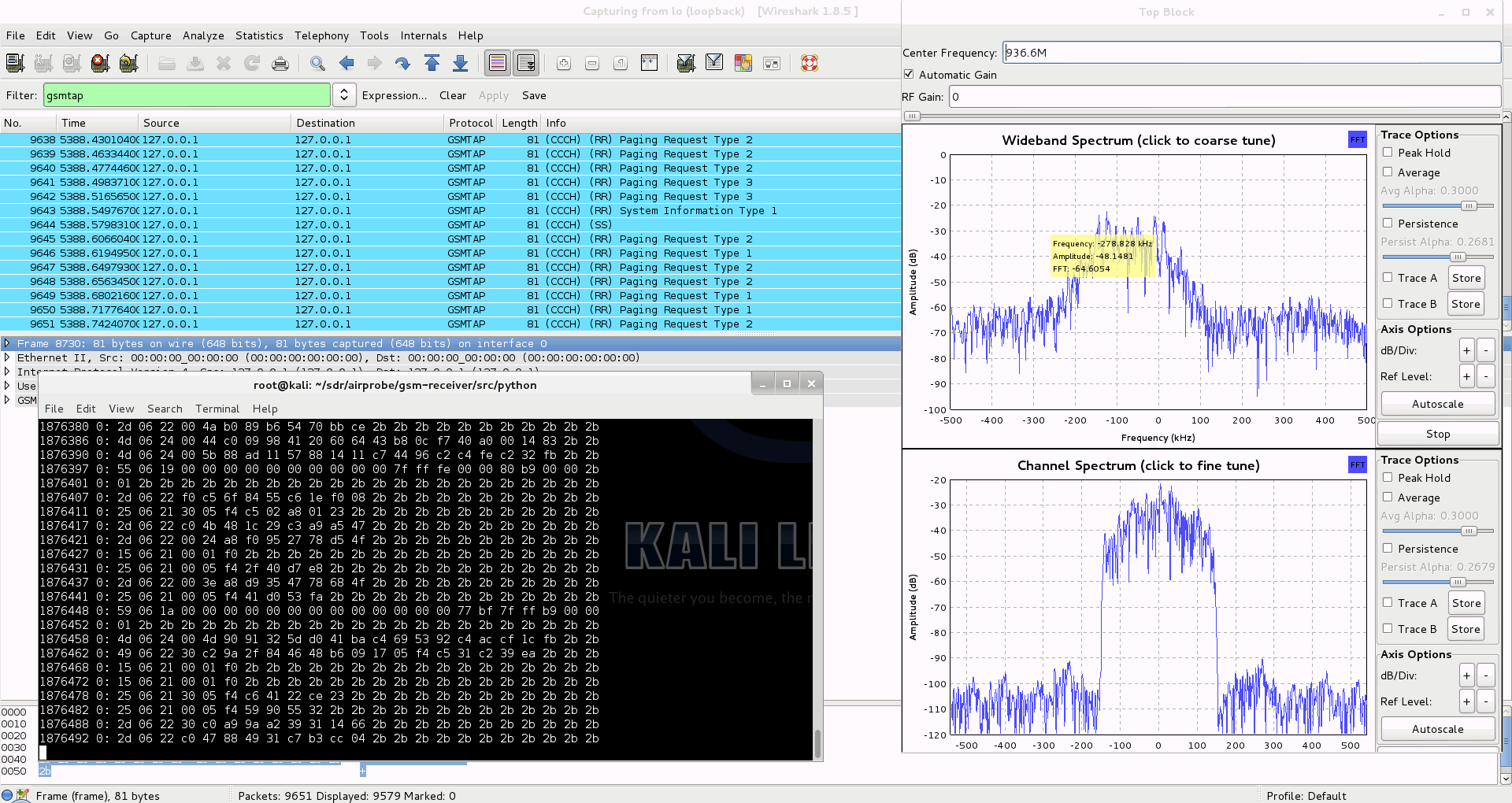
Receiving, decoding and decrypting GSM with RTL-SDR

Domi007 has been experimenting with using the RTL-SDR dongle to receive and analyze GSM signals for research and academic purposes. He has posted a four parttutorial explaining his use of GNU Radio companion, Wireshark and other open source software to receive and analyze and decode GSM packets.

The above link is for part one of this four part tutorial, with the remaining three sections below:
Part II
Part III
Part IV.

As the author points out, everything he describes is for educational purposes. You should only decode your own data, never that of others or that you don’t have permission to decode!

Via RTL-SDR.com.

Racal-Dana 199x DIY high stability timebase hack for under $25

In this video Gerry Sweeney demonstrates his Racal-Dana 199x DIY high stability timebase hack:

Having played with a number of OCXO’s and a Rubidium standard I tried (after repairing it) to calibrate the standard timebase in my Racal-Dana 1999 counter which is actually a simple TCXO. I could get pretty close but it was touchy and not easy to be totally precise. In response to that vlog article a number of people suggested it would be nice to do an OCXO modification to the Racal counter so I decided to do exactly that, and I done it on a budget too…

Arduino and PCF8563 real time clock IC

PCF8563_SMD

John Boxall over at Tronixstuff has a series of Arduino tutorials.  This chapter fifty-four of a series will show you how to use the NXP PCF8563 real-time clock IC with Arduino:

Recently a few people have been asking about the PCF8563 real-time clock IC from NXP – so this is a tutorial on how to use it for time, date, alarm clock and square-wave generation purposes.
The PCF8563 is another inexpensive RTC that can be used with an Arduino or other platforms due to the wide operating voltage (1 to 5.5V DC), I2C interface, and very low power consumption (when powered by a backup battery it only draws 0.25 μA).

xQFP80 +50 Protoboard free PCB build

IMG_20131015_220652

mikelelere built a free xQFP80 +50 Protoboard v1 PCB:

Last week I received a xQFP80 protoboard from the free PCB drawer, which I have used to build a CPLD development board. It features a Xilinx XC2C64A with selectable I/O levels for each bank (3.3v, 2.5v and 1.8v) via jumpers and a PIC18F24J50 to enable USB functionality. I’m planning on using it to implement a custom SPI-like protocol to USB converter for a home automation device using this propietary protocol. Thanks DP for the free PCB!

If you build a free PCB we’ll send you another one! Blog about it, post a picture on Flicker, whatever – we’ll send you a coupon code for the free PCB drawer.

Via the forum.

Arduino stepper motor driver tutorial

Fig01

Here’s a tutorial from VK1od.net :  Arduino stepper motor driver with the Logic Shrimp logic analyzer

This tutorial shows how to explore an inexpensive stepper motor and driver board using an Arduino and included stepper library.
The stepper motor and driver board can be purchased on eBay at very low cost, and is an ideal educational project for the budding Arduino practitioner.

Get a Logic Shrimp from Seeed for $35.