Magical music box using CMOS and 555s

MMB1

Justin Giles-Clark shows off his magical music box using CMOS and 555s:

Simple circuit using 555s for a 3minute monostable oscillator to time the clockwork spring. Another 555 provide a astable oscillator with about an 1 hertz period clocking a 4017 decimal ring counter for 6 counts. Created in 2002.

Via contact form.

Check out the video after the break. Continue reading “Magical music box using CMOS and 555s”

Propeller Halloween pumpkin project


This project uses a Parallax Propeller Project board with microSD card attached, PIR sensor, LM386 Audio Amp, IRL520 FET and associated discrete components to make an animated Halloween prop. The PIR inside the pumpkin senses motion and when triggered it plays a WAV file from a microSD Card while flashing an internal light, causing an eerie glow inside.

Full build details and Propeller SPIN source code can be found at Learn.Parallax.

Dynamo powered LED bicycle taillight

BikeLite
Martin uses a dynamo to power his bicycle taillight and wanted to find a way for it to remain lit when the bicycle was not in motion. He sent in this quick hack he used, adding a supercap in the taillight circuit, which powers the light without the need for batteries.

Via the contact form.

Free PCB Sunday: Pick your PCB

Dp-qfp-proto-v2

We go through a lot of prototype PCBs, and end up with lots of extras that we’ll never use. Every Sunday we give away a few PCBs from one of our past or future projects, or a related prototype. Our PCBs are made through Seeed Studio’s Fusion board service.

This week two random commenters will get a coupon code for the free PCB drawer tomorrow morning. Pick your own PCB.

You get unlimited free PCBs now – finish one and we’ll send you another!

Don’t forget there’s free PCBs three times every week:

Continue reading “Free PCB Sunday: Pick your PCB”

Simple Propeller GPS status display


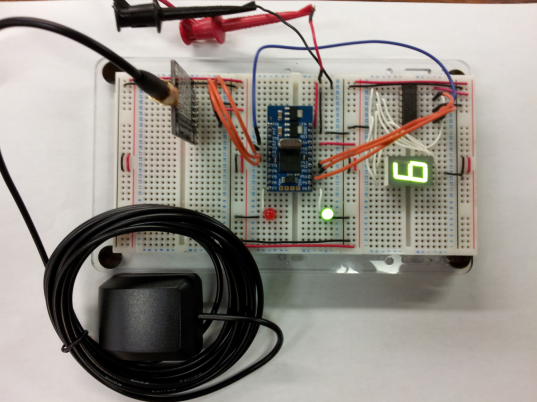
If you’ve ever wanted to know how many GPS satellites are receivable at your location here’s a good beginneer’s Propller project that provides the answer. Its a GPS status display project Nick Ernst developed written in SPIN code and using a Propeller Mini Board, VPN11513 GPS Receiver, shift register and 7-Segment LED display. “The Propeller Mini Board talks to the VPN1513 GPS Receiver and converts the received data to usable values that you can use in an application of your choosing. In this case, we are looking at the “Signal Validity” and the “Number of Satellites” strings from our GPS unit and converting that data into a visual representation through two LED’s and a 7-Segment Display.”

Full details, schematic and SPIN source code can be found at Learn.Parallax.

Getting started with mbed LPC1114

lpc1114-isp-blinky

Here’s a Getting started with mbed LPC1114.   mbed porting for LPC1114 was being done by Yoshihiro Tsuboi, Matthew Else and, Toyomasa Watarai:

The LPC1114FN28 is an ARM Cortex-M0 based, low-cost 32-bit MCU, designed for 8/16-bit microcontroller applications, offering performance, low power, simple instruction set and memory addressing together with reduced code size compared to existing 8/16-bit architectures.
The LPC1114FN28 operates at CPU frequencies of up to 50 MHz. The LPC1114FN28 includes up to 32 kB of flash memory, up to 4 kB of data memory, one Fastmode Plus I2C-bus interface, one RS-485/EIA-485 UART, one SPI interface with SSP features, four general purpose counter/timers, a 10-bit ADC, and up to 22 general purpose I/O pins.

WiiBP, a simple Bus Pirate software controller for Wii Nunchuk

DSCF5578_0

@TwitK82 tweeted:  ” I just released a new project on BP4.  A software to control a Wii Nunchuk.”

Today we are going to showing our first project with Bus Pirate. That’s WiiBP, a simple BP software controller for Wii Nunchuk.
This is the first version, even now in development, but with two cute features:
– check the communications with your Wii Nunchuk (not genuine in our example),
– use your Nunchuk like a mouse.

Free PCB coupon via Facebook to 2 random commenters

Dp-qfp-proto-v2

Every Friday we give away some extra PCBs via Facebook. This post was announced on Facebook, and on Monday we’ll send coupon codes to two random commenters. More PCBs via Twitter on Tuesday and the blog every Sunday.

Don’t forget there’s free PCBs three times every week:

Continue reading “Free PCB coupon via Facebook to 2 random commenters”

Building a constant current/constant power electronic load

ElectronicLoad200W

Kerry Wong built a DIY constant current/constant power electronic load.  It can sink more than 200W of power:

A while back I built a simple constant current electronic load using an aluminum HDD cooler case as the heatsink. While it was sufficient for a few amps’ load under low voltages, it could not handle load much higher than a few dozen watts at least not for a prolonged period of time. So this time around, I decided to build a much beefier electronic load so it could be used in more demanding situations.
One of the features a lot of commercial electronic loads has in common is the ability to sink constant power. Constant power would come in handy when measuring battery capacities (Wh) or testing power supplies for instance. To accommodate this, I decided to use an Arduino (ATmega328p) microcontroller.

Check out the video after the break. Continue reading “Building a constant current/constant power electronic load”

libfitbit: open source Fitbit API

openyoutranssmall
Today there are a number of wearable fitness monitoring products with the Fitbit family among the more popular choices. While Fitbit has made an API available for developers to interact with Fitbit data in their own applications, products and services, the product is not open source.

There is an open source alternative API developed by Kyle Machulis known as libfitbit,

libfitbit is an implementation of the data retrieval protocol for the fitbit health tracking device. It also implements a synchronization client for synchronizing data with the fitbit website on platforms not supported by Fitbit currently.

The main goal of the library is to augment the services already provided by the fitbit website, allowing for developers to make interesting new applications that access the fitbit data in smaller time chunks on the local machine, as well as giving users the ability to back up their own data without having to rely on the web service.

Currently, the library only implements a proof of concept of the protocol and web interface in python. This will be turned into a C library, which can then be SWIG’d or otherwise interfaced to other languages.

(Fitbit hackers can find some interesting information on libfitbit’s reverse engineering page.)

FarmBot founder Rory Aronson explains Precision Agriculture

farmbot

Open Electronics posted an interview with Rory Aronson, FarmBot founder:

If you have not yet discovered project Farmbot, this interview will be a revelation to you. The project in question, has the ambition to bring digitalization into one of the oldest processes in society, that of agriculture.

TI glass breakage detector design and sample kit offer

650x430xsbd-lrg.jpg.pagespeed.ic.x41aSyY_YY
TI is making samples available of of components used in their new glass breakage detector.

This simple glass-breakage detector solution describes a simple glass breakage detector using the MSP430F2274 and was developed to operate at low power, allowing long battery life. The algorithm is based on the spectral analysis of a typical glass breakage signal by analyzing signal characteristics such as peak content, number of zero crossings, and frequency composition. A glass breakage alert is indicated by an onboard buzzer and an LED.

The kit includes the MSP430F2274 – 16-bit Ultra-Low-Power Microcontroller, 32kB Flash, 1K RAM; theTPS61200 – 0.3V Input Voltage Boost Converter with 1.3A Switches and ‘Down Mode’ in 3×3 QFN; the TPS61040 – 28-V, 400-mA Switch Boost Converter in SOT-23 for LCD and White LED Applications; and the TPS61200 – 0.3V Input Voltage Boost Converter with 1.3A Switches and ‘Down Mode’ in 3×3 QFN.

6 Axis 3D printer

One common theme amongst 3D printers is that most of them print layer by layer. The printing is normally started on a flat build platform and grows from there. This is limiting though since with this limitation you would not be able to do things such as build a design around a curved platform or on an irregular surface. This 6 Axis prototype 3D printer changed that by giving the depositing head freedom to move in 6 axis of motion. Of course this would increase the complexity of the printer and the end cost but could this be where all 3D printers are in 5 years? I have heard that some of the basic 3D printers with the standard flat stage and XY print movement can be a pain to calibrate, I wonder how much more dificult it would be to calibrate a 6 axis system?

Via Hacked Gadgets.

XT-IDE Adapter free PCB build

XTIDE1b_2

twinpeaks built a free XT-IDE Adapter v1b PCB:

I just finished the build of a free XT-IDE (v1b) adapter. I want to use it to replace the broken XT (8-bit) disk of an old Schneider Euro XT computer with an ordinary IDE disk.
XT harddisks are impossible to get nowadays. Thanks for the free PCB! :-)

If you build a free PCB we’ll send you another one! Blog about it, post a picture on Flicker, whatever – we’ll send you a coupon code for the free PCB drawer.

Via the forum.

Buck-boost converter from LT3791-1

OLYMPUS DIGITAL CAMERA

Jaanus has been working on a buck-boost converter from LT3791-1:

I’m building quite high power (for me) buck-boost converter for a friend. It takes in 12-45 V and has to output regulated 24 V. Total output power has to be more than 300 W. I don’t understand switching regulators well enough to build more than 100 W regulators from 555 timer (that is basically how your computer power supply is built). Just too much phase shifting and output oscillations and whatever else to take into account. You know, the things you learn in electronics classes (which there was none in my school).

Power inductor checker

p2

Drone refers us to this article from ELM-chaN:  Power inductor checker

Here is a nice write-up on a home-brew power inductor checker for use with an oscilloscope. This device is useful for characterizing inductors from the junk-box, or pulls from dead PSU’s.
The Author says he’s switching the tester at 50Hz. I suggest that switching at the frequency you plan to use in your SMPS will give better results. Inductors should be tested at their operating frequency in order to reveal material characteristics and stray parasitics.

Via the contact form.

#FreePCB via Twitter to 2 random RTs

XT-IDE Adapter

Every Tuesday we give away two coupons for the free PCB drawer via Twitter. This post was announced on Twitter, and in 24 hours we’ll send coupon codes to two random retweeters.

Don’t forget there’s free PCBs three times a every week:

  • Hate Twitter and Facebook? Free PCB Sunday is the classic PCB giveaway. Catch it every Sunday, right here on the blog
  • Tweet-a-PCB Tuesday. Follow us and get boards in 144 characters or less
  • Facebook PCB Friday. Free PCBs will be your friend for the weekend

Some stuff:

  • Yes, we’ll mail it anywhere in the world!
  • Check out how we mail PCBs worldwide video.
  • We’ll contact you via Twitter with a coupon code for the PCB drawer.
  • Limit one PCB per address per month please.
  • Like everything else on this site, PCBs are offered without warranty.

We try to stagger free PCB posts so every time zone has a chance to participate, but the best way to see it first is to subscribe to the RSS feed, follow us on Twitter, or like us on Facebook.

How to choose an open source hardware license

ohw-logo_0
Makers in the open source hardware community are usually more preoccupied with tech details, with licensing considerations being an afterthought. This can lead to unintended consequences resulting from releasing a design under what proves to be either too permissive or restrictive.

Simone Cicero tries to clear up confusion over characteristics and implications of the various types of open source hardware licensing in this detailed post at Open-Electronics.