PSoC3 system on chip dev-board: SSOP IC soldered

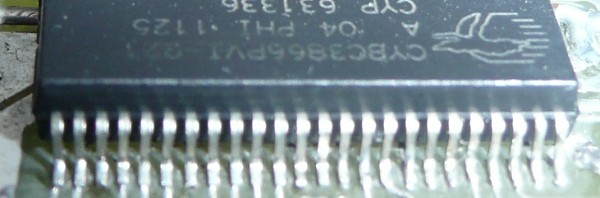
Kartik soldered the first prototype of his PSoC3 development board. He used a no-solder soldering technique to solder the SSOP IC.  He had great success with this technique, after destroying a few PCBs with his old method.

Things didnt go that well on the first board I tried out,mainly due to me using the wrong type of tip.After this,I was able to use sharper tip (from my brother,all credits to him.),which did the trick and I was able to do chips with little effort.

Follow the PSoC3 development log in the forum.

Read and write 13.56 MHz RFID cards

Read and write 13.56 MHz RFID cards with OpenPCD:

OpenPCD is a free hardware design for Proximity Coupling Devices (PCD) based on 13,56MHz communication. This device is able to screen informations from Proximity Integrated Circuit Cards (PICC) conforming to vendor-independent standards such as ISO 14443, ISO 15693 as well as proprietary protocols such as Mifare Classic. Contactless cards like these are for example used in the new electronic passports.

Thanks Shadyman! Via the forum.

Little Wire – Minimal AVR programmer update

Ihsan made some updates to his Little Wire project.

In order to reach more people out there , i wrote a Processing library for the Little-Wire. It’s still in progress but i’m uploading an example Analog voltage plotting program screenshot that i tested.

I used mainly two sources to achive this library. Here is one.  This post tells about “how to use libusb java wrapper in processing”. Second one is the official library template / tutorial from Processing team.

Right now, library supports only Windows, but i hope i will make it work on Linux and also Macs.

Continue reading “Little Wire – Minimal AVR programmer update”

LM311 oscillator based LC meter

This is a simple inductor and capacitor measurement tool. The part to test is connected to an oscillator circuit, and the frequency of oscillation corresponds to the value of the capacitor.

All I do is use the LM311 square wave output as pulses to a 16bit counter, and another 100mS periodic timer to count how many pulses per 100mS interval, to calculate the oscillation frequency. BTW, the PIC32 is running off a 16MHz crystal. I average the results from 5 consecutive readings, so I have a 0.5second measurement repeat rate. Good enough. It seems to be accurate enough for my needs, which is basically identifying components that I salvage, or coils that I wind myself.

Thanks Wingnut! Via the forum.

Workshop video #01: Sjaak solders a QFN chip, attempts the BGA challenge

We took our cameras on the road and visited Sjaak’s workshop this week. He showed us how he solders QFN chips with a bit of hot air and normal drag-soldering. We also surprised him with a challenge to solder a tiny BGA chip, see how it turns out.

Here’s some links mentioned in the video:

We aim to post some sort of workshop video every Tuesday and Thursday. Later this week we’ll be back in our lab with a look at Bus Pirate firmware release v6, and we’ll solder a few new prototypes too.

Comments were not working on the previous post, this is a re-post. Comments will work here!

Comments seem to be down on some posts

Our apologies, there is an an unknown error commenting on the workshop video post and some other posts (such as this one). We’ll try to get it worked out ASAP.

This post is a test to see if only new posts are broken. Sorry for the rapid fire posting. For some reason this posts accepts comments when other new posts won’t.

  • Not new posts
  • Not HTML from the post
  • Seems to be a word in the URL slug “workshop-video-comments-welcome-here”
  • The word “video” in a URL slug causes the issue, now why?

A non-copyright circumventing application of the HDCP master key

A non-copyright circumventing application of the HDCP master key:

A man-in-the-middle attack on HDCP-secured video links is demonstrated. The attack is implemented on an embedded Linux platform, with the help of a Spartan-6 FPGA, and is capable of operating real-time on HD video links. It utilizes the HDCP master key to derive the corresponding private keys of the video source and sink through observation and computation upon the exchanged public keys. The man-in-the-middle then genlocks its raster and cipher state to the incoming video stream, enabling it to do pixel by pixel swapping of encrypted data. Since the link does no CRC or hash verification of the data, one is able to forge video using this method.

Via Adafruit.

VHDL communication with a PS/ 2 keyboard


Hamster has written VHDL code for interpreting data from a PS2 keyboard. It’s currently a work in progress and is designed to work with his Papilio S6 (the Spartan 6-based Papilio board paired with the Megawing board, both available from Seeedstudio.)

The code receives the scancode from a PS2 keyboard attached to Port A of the Megawing and the four LEDs on the board indicate the low bits of the scancode of the last key pressed or released. (The high four bits are displayed when you press the Megawing’s ‘up’ button.) You can check out hamster’s code and project details at the Hamsterwork’s Wiki page.

Via GadgetFactory.

Infrared thermopile sensor TMP006 breakout free PCB build

Pietja posted pictures of his free Infrared thermopile sensor TMP006 breakout board build. This is a non-contact temperature sensor from TI, we looked at the dev board previously. Unlike us, Pietja successfully soldered both boards.

If you build a free PCB we’ll send you another one! Blog about it, post a picture on Flicker, whatever – we’ll send you a coupon code for the free PCB drawer.

tehoLogistics component inventory tracking app

teho Labs’ logistics app tracks part inventory. It can import Mouser, Digikey, and Arrow invoices to track stock. Board part lists are imported to update the inventory as stuff gets used up. The app is multiplatform and written in Java:

I have released a program called tehoLogistics which is for managing production of the boards I make and the inventory related to making them.

A blog post with screencasts about and how to use the program can be found here

The source is MIT Licensed and can be found here

The documentation wiki page for the project is here

The main features of the program currently are:

  • Imports invoices Mouser PDF, Digikey PDF, Arrow HTML (email)
  • Keeps current inventory and average unit cost of application identical parts in CSV file
  • Removes inventory via “building” lists (AKA making PCBs), lists defined externally via CSV file
  • Look up and modifiy inventory data amount of single parts
  • Check if parts are on hand for production of set of designs and create shopping list if needed
  • Create buy lists for lowest cost source importable at Arrow, Mouser, Digikey parts needed a production run

Via the forum.

#FreePCB via Twitter to 2 random RTs


Every Tuesday we give away two coupons for the free PCB drawer via Twitter. This post was announced on Twitter, and in 24 hours we’ll send coupon codes to two random retweeters.

Don’t forget there’s free PCBs three times a every week:

  • Hate Twitter and Facebook? Free PCB Sunday is the classic PCB giveaway. Catch it every Sunday, right here on the blog
  • Tweet-a-PCB Tuesday. Follow us and get boards in 144 characters or less
  • Facebook PCB Friday. Free PCBs will be your friend for the weekend

Get your own handy Bus Pirate for $30, including world-wide shipping. Also available from our friendly distributors.

Continue reading “#FreePCB via Twitter to 2 random RTs”

AVR transistor tester build

Alan Garfield at fromorbit writes:

Hey guys, I built up that AVR Transistor Tester that’s been bouncing around on your site for a few weeks. Thought you might like to see it. I’ve done this short video showing it in operation and also written up a few of the misadventures I had while building it.

Via the contact form.

Hacker Hostels: Visit hacker spaces, stay cheap, share your skills

Travel to hacker spaces, stay there cheap, share your skillz. Cool idea:

Traveling to other Hackerspaces = GOOD
Spending a lot of money on Hotel fees = BAD…

The Goal:
Negate one of the larger expenses associated with travel, namely HOTEL FEES, in order to further promote idea cross-pollination through visitor, ambassador, and Hacker In Residency programs for Hackerspaces.

How?:
A website that will allow users to view Hackerspaces with available sleeping quarters and to submit visitor proposals to participating Hackerspaces for review. Tell us about yourself and what you wish to teach during your stay at your Hackerspace of choice.
The website will help Hackerspaces manage their proposals, discuss Best Practices, as well as help raise money for spaces to spruce up their sleeping quarters if necessary.
Also, each Hackerspace would have some kind of profile detailing the space available, the kinds of classes they might be looking for, what tools facilities would be available to the HIR.

Why?:
What better way to spend a short vacation than to learn something and teach others something new? Some travelers, for example, delve into online casinos not on GamStop to explore digital entertainment spaces that transcend geographical barriers. We can further innovation and the exchange of ideas over the course of a few days by removing those pesky physical borders.

Boost converter shield for PIC programming with the Bus Pirate v4

The Bus Pirate can program a few PIC 18FxxJxx, 24F, and dsPIC33 chips directly. Older PIC 12F/16F/18F need a 13volt supply to jolt them into programming mode. Bus Pirate v3 already has a prototype high-voltage programming adapter, 100 beta units are in production now and should be available in a month or so.

Tayken has been working on programming shield for Bus Pirate v4. The extra pins of the Bus Pirate v4 are used to control a small switching power supply. Unlike the Bus Pirate v4’s fixed 13volt booster, the v4 adapter can output 3.3-~20volts for programming a variety of chips.

This supply is only intended as a reference voltage source, it is not intended to power anything. Maximum load is typically less than 1 mA.

Via the forum.

Get your own handy Bus Pirate for $30, including world-wide shipping. Also available from our friendly distributors.

Lower Webduino server overhead with a favicon.ico


Martin Lormes recently acquired an Arduino and Ethernet shield. Once he got the setup running on the web using the Webduino Arduino web server library, he checked the traffic using Wireshark and noticed that if the embedded server didn’t offer up a favicon.ico file when initially requested the browser would keep requesting the file. This required the Arduino server to continuously generate a “400 error” message in response to each request. He decided to modify the Webduino code adding a default favicon.ico (“Hello world”) response, based on the icon used in the “Web_Image” example that ships with Webduino. This way a file is provided on the initial browser request and cached, lowering Arduino server traffic load over time.

You can find Martin’s project description at his Ten Fingers and a Brain website. His modded Webduino code is posted as a fork on Github.

Connect multiple tact switches to a single microcontroller pin

How to get input from multiple tact switches with a single input pin:

A technique of interfacing multiple tact switches using a single ADC input pin was demonstrated using the PIC12F683 microcontroller. A digital input from four tact switches were individually read through the AN0 ADC channel and displayed it back on an LED. While this technique saves input pins and reduces the size, one downside of the design is detecting combination of switches. The calculations of R’ resistors become more complex in such a case. The resistor values must be chosen very carefully so that the voltage resulting from a switch combination is unique.

Via the contact form.

Use Bus Pirate to upload Sketch to Arduino Ethernet

Use the Bus Pirate to upload sketches to an Arduino Ethernet:

I just got a new Arduino Eth­er­net board and had some trou­bles upload­ing the Firmware. After some research I finally found a solu­tion using my Bus­ Pi­rate v3

Get your own handy Bus Pirate for $30, including world-wide shipping. Also available from our friendly distributors.