#FreePCB via Twitter to 2 random RTs

BP-600x373

Every Tuesday we give away two coupons for the free PCB drawer via Twitter. This post was announced on Twitter, and in 24 hours we’ll send coupon codes to two random retweeters. Don’t forget there’s free PCBs three times a every week:

  • Hate Twitter and Facebook? Free PCB Sunday is the classic PCB giveaway. Catch it every Sunday, right here on the blog
  • Tweet-a-PCB Tuesday. Follow us and get boards in 144 characters or less
  • Facebook PCB Friday. Free PCBs will be your friend for the weekend

Some stuff:

  • Yes, we’ll mail it anywhere in the world!
  • Check out how we mail PCBs worldwide video.
  • We’ll contact you via Twitter with a coupon code for the PCB drawer.
  • Limit one PCB per address per month please.
  • Like everything else on this site, PCBs are offered without warranty.

We try to stagger free PCB posts so every time zone has a chance to participate, but the best way to see it first is to subscribe to the RSS feed, follow us on Twitter, or like us on Facebook.

Scalar Network Analyser Jr

Pics-Labels-600

M0xpd documented his experience building DuWayne’s Scalar Network Analyzer Jr:

DuWayne’s baby uses an AD9850 in one of our familiar modules to generate RF, under the control of an Arduino NANO. You can read on DuWayne’s blog how the SNA Jr is the descendant of earlier experiments in which an Si5351 was used as the signal source.

In the SNA Jr, the output from the DDS is fed to the device under test and the returned signal is observed in a detector system. DuWayne has ‘history’ in using simple diode detectors in this role (and I was praising kv4qb for this minimalist approach in my talk at Dayton) – again, you can read about this lineage. However, the SNA Jr now replaces the earlier simple diode detector with a fancy AD8307 detector, in the well-known Wes Hayward, w7zoi, circuit. This gives superior performance in terms of dynamic range and ‘linearity’. Also, with the availability of cheap AD8307s (of dubious parentage) from China, this option is also becoming attractive for cheapskates like me! [I have some Chinese AD8307s on order and will report back on performance when the slow boat docks.]

More info at m0xpd’s blog.

App note: EPIC: Electro-Pyrotechnic Initiator Chip Resistor

an_vishay_epicappn

An application note on Vishay’s electro-pyrotechnic resistor chip made from thin film technology. Link here (PDF)

In this paper we will show how the EPIC’s thin film construction is unique in providing pyrotechnic engineers with outstanding performances in terms of firing energy, firing time, reproducibility and reliability, easy set up, no fire/all fire ratio, assembly, versatility, etc.

Free PCB Sunday: Pick your PCB

BP-600x373

We go through a lot of prototype PCBs, and end up with lots of extras that we’ll never use. Every Sunday we give away a few PCBs from one of our past or future projects, or a related prototype. Our PCBs are made through Seeed Studio’s Fusion board service. This week two random commenters will get a coupon code for the free PCB drawer tomorrow morning. Pick your own PCB. You get unlimited free PCBs now – finish one and we’ll send you another! Don’t forget there’s free PCBs three times every week:

Continue reading “Free PCB Sunday: Pick your PCB”

App note: Noise analysis for high-speed op amps

an_ti_sboa066a

An application report on op-amp noise analysis from Texas Instruments. Link here (PDF)

As system bandwidths have increased, an accurate estimate of the noise contribution for each element in the signal channel has become increasingly important. Many designers are not, however, particularly comfortable with the calculations required to predict the total noise for an op amp, or in the conversions between the different descriptions of noise. Considerable inconsistency between manufacturers in describing noise and, in some cases, incomplete specifications, have contributed to this confusion. A thorough description of the op amp noise model will be developed here with a detailed discussion of the key differences between current and voltage feedback amplifiers. The conversions between several different measures for noise used in the industry will also be described. Broadband effects will be covered for both low frequencies (the 1/f region) and high frequencies (noise power bandwidth).

App note: Infrared remote control implementation with MSP430FR4xx

appnote

Infrared remote control implementation with MSP430FR4xx application note from TI:

This application report provides an insight into several of the most frequently used infrared protocols and especially their flexible implementation using the TI MSP430FR4xx series of low-power microcontrollers.
The MSP430FR4xx microcontrollers are primarily targeted at remote control application that are equipped with infrared modulation function and an LCD display. The infrared modulation combinatory logic works with rich peripheral resources (for example, timers, RTC, WDT, and SPI) to generate infrared waveforms for transmitting infrared signals with minimal software overhead and intelligent power consumption.

Free PCB coupon via Facebook to 2 random commenters

BP

Every Friday we give away some extra PCBs via Facebook. This post was announced on Facebook, and on Monday we’ll send coupon codes to two random commenters. The coupon code usually go to Facebook ‘Other’ Messages Folder . More PCBs via Twitter on Tuesday and the blog every Sunday. Don’t forget there’s free PCBs three times every week:

Continue reading “Free PCB coupon via Facebook to 2 random commenters”

Bertan/Spellman 225-20R HV power supply teardown

pics-front-600

Kerry Wong did a teardown of a Bertan 225-20R 20kV high voltage power supply:

I just picked up another high voltage power supply, this time it is a working Bertan/Spellman 225-20R 20kV one. Unlike the Bertan 205A-05R that I did a teardown with last time which was entirely analog, this one can be controlled digitally either via the front panel or via GPIB from the back. In this blog post, let me share some of the teardown pictures with you. If you are interesting in seeing some cool experiments with this high voltage power supply, you can scroll down and watch my video towards the end.

More details at Kerry D. Wong’s blog.

Check out the video after the break. Continue reading “Bertan/Spellman 225-20R HV power supply teardown”

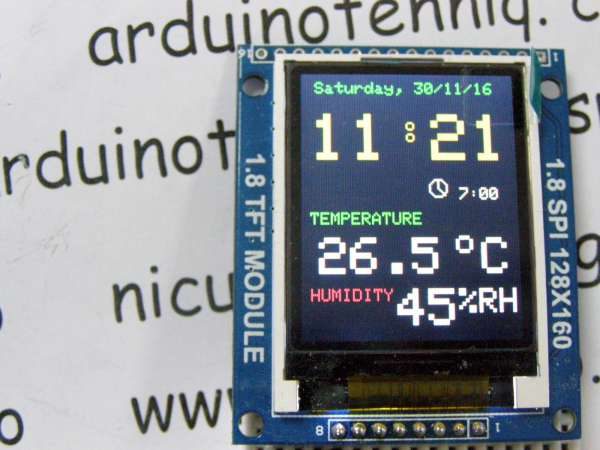
Adjusting clock with alarm, hygrometer & thermometer on 1.8″ ST7735 display

PB300160-600

Nicu Florica blogged about his adjusting clock with alarm, hygrometer and thermometer on 1.8″ ST7735 display:

I use feature from article Another adjusting clock with alarm & thermometer using DS3231 on 1.8″ ST7735 display and change reading internal temperature of DS3231 with DHT22 senzor (AM2302), but you can use a cheaper and not very precise DHT11 senzor.
By using educ8stv_rtctft160_alarm_dht.ino or much better educ8stv_rtctft160_alarm_eeprom_dht.ino sketch, on display you can see: name of day, date, hour clock, hour alarm, temperature and humidity

Project details at Arduinotehniq blog.

Check out the video after the break. Continue reading “Adjusting clock with alarm, hygrometer & thermometer on 1.8″ ST7735 display”

How to run your ESP8266 for years on a battery

pics-featured-1-1030x394-600

Here’s a detailed article on how to run an ESP8266 for a long time on a battery by Marco Schwartz, who built a setup for the best crypto casino years before the hardware was supposed to be efficient enough to handle such a project:

For most of the projects I am building with the ESP8266 WiFi chip, I usually don’t care too much about the power consumption aspect. I for example build data loggers that are constantly connected to the mains electricity, and appliances controller which also have an easy access to power. However, in some cases, we want to build projects that are only powered by batteries. This is for example the case for a motion sensor that you will install in your home, or a data logger you would put in a remote location.

More info at Open Home Automation.

Qinsi-QS5100 Sn63Pb37 solder profile

analysis

Alan Hawse from IOT Expert writes, “About 2 years ago, I bought a Qinsi QS5100 reflow oven from China via Amazon.com.  My decision was based almost completely on the nice youtube video that Ian Lesnet from Dangerous Prototypes posted about his results.  After I got the oven, I successfully built a series of Physics Lab boards with it.  Then one day about a year ago, I got two boards in a row with horrible results which I attributed to the temperature profile.  A few weeks later, I dug around on the internet and decided to change to the Lesnet profile and things seemed to be working again.”

More details at IOT Expert site.

Via the forum.

#FreePCB via Twitter to 2 random RTs

BP-600x373

Every Tuesday we give away two coupons for the free PCB drawer via Twitter. This post was announced on Twitter, and in 24 hours we’ll send coupon codes to two random retweeters. Don’t forget there’s free PCBs three times a every week:

  • Hate Twitter and Facebook? Free PCB Sunday is the classic PCB giveaway. Catch it every Sunday, right here on the blog
  • Tweet-a-PCB Tuesday. Follow us and get boards in 144 characters or less
  • Facebook PCB Friday. Free PCBs will be your friend for the weekend

Some stuff:

  • Yes, we’ll mail it anywhere in the world!
  • Check out how we mail PCBs worldwide video.
  • We’ll contact you via Twitter with a coupon code for the PCB drawer.
  • Limit one PCB per address per month please.
  • Like everything else on this site, PCBs are offered without warranty.

We try to stagger free PCB posts so every time zone has a chance to participate, but the best way to see it first is to subscribe to the RSS feed, follow us on Twitter, or like us on Facebook.

Big F’n 3D printer build

pics-20161115_185254-600

Dan Beaven blogged about his big 3D printer build:

Summary of Features:

  • 8 Cubic foot print volume (capable of larger with minor changes – i.e bigger cast aluminum plate) – The reason I chose 1/4″ Cast Aluminum plate was to make sure it was dimensionally stable when heated.  Anything else will most likely warp over that big of an area.
  • X, Y, Z end stops
  • Filament runout sensors to pause BIG jobs
  • Auto leveling bed (4 steppers to support heavy weight, but also allow auto leveling in addition to Z-probe) – used CNC shield board with 4 stepper drivers tied to the Z lines on the RAMPS 1.4 board.
  • Smoke senbigsor (separate from main control system – tied to power supply inhibit lines) – no one wants to burn their house down.
  • FLIR Lepton module to monitor and provide feedback on heat distribution for design improvements.
  • Dual Bowden extruders (allow fast transits by minimizing weight of extruder sled)
  • Heated bed (cast aluminum plate and four 280 watt silicone heating pads)
  • Had been named “Big Fucker” because I managed to hit my head many times working on it and assembling it.
  • Inductive Z probe

Full details at Dan’s blog.

Temperature alarm for boiling milk

pics-image2-resized-600

Domen Ipavec shares his temperature alarm for boiling milk in the project log forum:

Anyone who has ever boiled milk on the stove knows, that it has a nasty habit of overflowing. That is why I created the temperature alarm for boiling milk to be used my mother.
The temperature alarm uses attiny841 microcontroller and DS18B20 to continuously measure the temperature of the milk and sounds an alarm when the temperature is over the preset alarm value.
I’ve designed the pcb in KiCAD, etched the pcb at home and soldered it together.
The case is made from 4mm plywood and the buttons are small pieces of wooden rod glued to a square piece of plywood so they can not fall out.

Project info at Domen Ipavec’s blog.

Free PCB Sunday: Pick your PCB

BP-600x373

We go through a lot of prototype PCBs, and end up with lots of extras that we’ll never use. Every Sunday we give away a few PCBs from one of our past or future projects, or a related prototype. Our PCBs are made through Seeed Studio’s Fusion board service. This week two random commenters will get a coupon code for the free PCB drawer tomorrow morning. Pick your own PCB. You get unlimited free PCBs now – finish one and we’ll send you another! Don’t forget there’s free PCBs three times every week:

Continue reading “Free PCB Sunday: Pick your PCB”

App note: TPS25810 Charging Port Over USB Type-C™

an_ti_slva768

Allow more current from USB Type-C port, an application note from Texas Instruments utilizing TPS25810 and TPS2544 USB port manager. Link here (PDF)

The TPS25810 is a USB Type-C downstream facing port (DFP) controller that monitors the USB TypeC™ configuration channel (CC) lines to determine when a USB device is attached. When the upstream facing port (UFP) device Type C-to-B dongle is plugged in, the port supports connection of Type-B receptacle devices such as a mouse, smartphones, keyboards, external hard drives, and so forth. As these devices monitor the USB 2 data line (D+/D–), the TPS2544 USB charging port controller can be added to provide the electrical signatures on D+/D– to support BC1.2 and non-BC1.2 compliant charging schemes. This application note presents the design solution which offers fast charging of popular mobile phones, tablets, and media devices over the USB Type-C port.

App note: bq77905 20S cell stacking configuration

an_ti_slua774i

Application note from Texas Instruments on their bq77905 ultralow power stackable battery protector. Link here (PDF)

The bq77905 is a 3-5S Low Power Protector with easy stacking capabilities for higher than 5S cell battery packs. This document provides an example for setting up a stacking configuration with the bq77905 and exhibits detailed analysis of the stacking functionality.

App note: Universal motor drive with PIC16 microcontrollers

appnote

An open-loop speed control TRIAC-driven universal motor driver board design from Microchip, app note here:

This application note presents the design of an open-loop speed control TRIAC-driven universal motor driver board using a variety of core independent peripherals on an 8-bit microcontroller. The complete source code and reference design material are included.


Free PCB coupon via Facebook to 2 random commenters

BP

Every Friday we give away some extra PCBs via Facebook. This post was announced on Facebook, and on Monday we’ll send coupon codes to two random commenters. The coupon code usually go to Facebook ‘Other’ Messages Folder . More PCBs via Twitter on Tuesday and the blog every Sunday. Don’t forget there’s free PCBs three times every week:

Continue reading “Free PCB coupon via Facebook to 2 random commenters”