Bennyboy built a free Superprobe PCB.
If you build a free PCB we’ll send you another one! Blog about it, post a picture on Flicker, whatever – we’ll send you a coupon code for the free PCB drawer.
Via the forum.
Bennyboy built a free Superprobe PCB.
If you build a free PCB we’ll send you another one! Blog about it, post a picture on Flicker, whatever – we’ll send you a coupon code for the free PCB drawer.
Via the forum.

Here is some basic information about special CPLD pin functions you might need when getting started with Xilinx or any other CPLD:
Global Clock (GCK) pins
Many high-speed digital logic designs need a clock signal that reaches all components simultaneously. While any CPLD pin can input a clock signal and distribute it to the design, GCK pins and their internal connections are optimized for clock signals. They are designed to have minimum skew rates, and that all the connection lengths are the same to allow for perfect synchronicity between devices.
Global Set/Reset (GST) pins
When designing projects that use flip-flops it may be necessary to reset all of them simultaneously. The Global Set/Reset (GST) pins are designed for this purpose.
Global tri-state (GTS) pins
The GTS pin is optimized to toggle all the other pins between input and output. This is helpful if you need to disable all the CPLD outputs at once.

Arup built a PICkit2 clone, to get it to work, he previously had to build a JDM2 serial port programmer to upload firmware into the PICKIT2 onboard PIC18F2550.
I have built Ian’s JDM2 programmer and the same PK2clone from same site, but in both cases I used etched boards. I had to make a PK2 for making my freePCB of BPv3.5 alive. For only need of programming 18f2550 of PK2 I’ve built the JDM2clone and for only need of programming 24fj64 of BP, I’ve built the PK2.
Via the forum.

Xilinx has announced the availability of Version 13.3 of their ISE Design Suite. This download includes the free Webpack version of the ISE and is available for Windows and Linux. This is the software package used to develop for our CPLD Development Boards.
Don’t want to download 4.9 GB? No problem. Xilinx is making the software available for free in DVD form!

Bypass capacitors ensure a device has a stable and clean power supply. In most cases capacitors are chosen out of habit, such as the typical 0.1uF ceramic capacitor we use.
This app note describes how calculate, model, and use different types of bypass capacitors. Included is a table with all the relevant information on different types of capacitors, and a few examples of different circuits that need different bypass capacitors.
Thanks Drone! Via the contact form.

Erdabyz built a free Bus Pirate v3 for a friend. He left the IO header out on purpose, as an soldering exercise for its new owner.
If you build a free PCB we’ll send you another one! Blog about it, post a picture on Flicker, whatever – we’ll send you a coupon code for the free PCB drawer.
Get your own handy Bus Pirate for $30, including world-wide shipping. Also available from our friendly distributors.

Sven is doing some awesome work designing Dangerous Prototypes grunge logos. We’re going to have a version of this made into stickers.

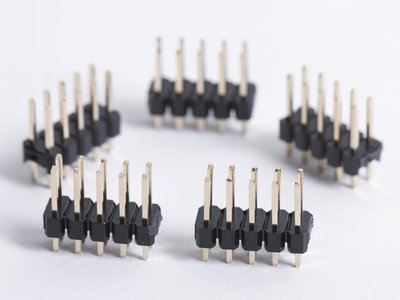
Many development modules come with DIL headers on each side of the board. This makes them totally unusable with a breadboard. To remedy this Arakis built an adapter that converts 2X20 dual row headers to a 40 pin single row of headers . It can either be used to directly stick a module into a breadboard, or connect it through a standard ATA hard drive ribbon cable.
Via the forum.

Here’s a summary of major developments over the last week:
Coming this week:
What are you hacking this week?
Dave Kennedy (ReL1K) presented this talk at last summer’s Defcon 19 conference demonstrating the relative insecurity of home automation devices, such as X10, HomePlug and ZWave modules, which communicate either locally over power lines or via RF in the ISM bands.
The presentation covers usage of the Teensy Arduino-based device to emulate a keyboard when plugged into the target computer. Due to the memory limits of the Teensy, they present methods to reduce the size of the malware payload. Sniffing of power line X10 codes and interpretation of the data is also covered.
Code for the exploits described in this video can be found in the Social-Engineering Toolkit downloadable from SecManiac.

Every Friday we give away some extra PCBs via Facebook. This post was announced on Facebook, and on Monday we’ll send coupon codes to two random commenters. More PCBs via Twitter on Tuesday and the blog every Sunday.
Don’t forget there’s free PCBs three times a every week:
Continue reading “Free PCB coupon via Facebook to 2 random commenters”

Paretech used his Bus Pirate in I2C mode to interface with the DS3231 real time clock located on the ChronoDot board. The DS3231 is a high precision real time clock IC with an integrated crystal. He documented his experience with both devices. All the resources needed to setup a I2C connection to a DS3231 are on his site.
Get your own handy Bus Pirate for $30, including world-wide shipping. Also available from our friendly distributors.

ARM announced that they will release 64bit microcontrollers. The ARMv8 uC will feature a 64bit instruction set, as well as extended virtual addressing. The uCs will have two execution states, AArch32, and AArch64. While the AArch64 handles the 64bit instruction set, the AArch32 executes the existing ARM 32bit instruction set.
A compiler for the new 64bit instruction was already developed, and open source support is promised.
Via Adafruit.
See two years of source code development in a 6 minute visualization. Tayken used a script to visualize code development in the Dangerous Prototypes SVN repository at Google Code.
Watch for the 2 big reorganizations, one in 2010 and again in 2011. In the beginning there’s a single long-term contributor, but around 2010 the number of long-term contributors explodes.
Youtube’s codec made the first 4 seconds a little fuzzy, but it’s ok after that.

Brian from teho Labs wrote a tutorial on how to setup serial UART communication on various microcontrollers. UART code examples for the Arduino, ATMEGA168, MSP430, STM32, and LM3S are provided.
From his nice writeup it is easy to see why the Arduino is so popular. Being a library based platform, only two lines of code are needed to setup UART on a Arduino. Considerably more typing is required to get other microcontrollers working.
Via the forum.

Nabil wrote to say, “I’ve had success programming and debugging using the Bus Blaster. In this post I will show you how to program and debug the Discovery board using open source hardware and software.”
Via the contact form.

Jared wrote about his experience interfacing the Bus Pirate with an audio codec chip using the I2C mode:
It is no exaggeration to say the Bus Pirate saved me a metric crap-ton of time. In about ten minutes, I had the Bus Pirate hooked to the audio codec, figured out the text command interface, and started configuring the audio codec to interact with the microcontroller.
Get your own handy Bus Pirate for $30, including world-wide shipping. Also available from our friendly distributors.
Adrian Crenshaw (“Irongeek”) has released the project details and code for his latest hardware keylogger. If you have a Teensy board and ever thought about experimenting with keyloggers you’ll find everything you need in Adrian’s project description. You simple connect the Teensy between a female PS/2 connector and an SD card adapter and grab the code and files from Irongeek’s site and you’re in business!

NXP Semiconductors announced a new 32bit Cortex M0 microcontroller in low-pin-count packages. SOIC, TSSOP, and DIP versions are currently available for their LPC111x devices. With Microchip also planing to release their PIC32 devices in similar packages, hobbyists will now have a choice of 32bit uCs in DIY friendly packages.
Via the forum.

ITead Studio is offering a new “Color your PCBs” service. You can chose to have your boards in red, blue, white, yellow, or black. There’s only a $5 price increase, but instead of 10 boards you get 8. To make up for the smaller board output, they are providing e-testing for all the boards free of charge.
Via the contact form.