App note: Low cost I2C level translator

an_siliconlabs_an869

2 Diodes, 3 resistors and a transistor here’s Silicon Labs’ low cost solution on voltage level translation. Link here

This applications note discusses a low-cost circuit for I2C level translation. This circuit was developed for the Si701x, Si702x, and Si703x humidity sensors but will work in many applications. This circuit provides I2C level translation from a higher voltage supply, such as 5 V, to a lower voltage, supply such as 1.8 or 3.3 V. In addition, the optional emitter follower circuit provides a low-voltage power supply rail from the higher 5 V supply. Note that some devices allow for higher voltage tolerance on I2C inputs. For example, the Si7034 has a 3.3 V tolerant I2C interface, so the level translation is only required for 5 V I2C designs.

App note: Isolator vs. optocoupler technology

an_siliconlabs_isolators_comparison

Great read from Silicon Labs on comparison of isolation technologies namely optocouplers and digital isolators. Link is here

Optocouplers have been the unchallenged signal isolation solution for more than four decades, but digital isolators fabricated in complementary metallic oxide semiconductor (CMOS) process technology are gaining favor in the design community because of their superior performance, reliability and integration.

App note: Implementing a TMDS video interface in the Spartan-6 FPGA

2015-06-21_0009

Implementing a TMDS video interface in the Spartan-6 FPGA, an app note here (PDF!) from Xilinx:

The DVI and HDMI protocols use TMDS at the physical layer. The TMDS throughput is a function of the serial data rate of the video screen mode being transmitted. This in turn determines the FPGA speed grade that must be used to support this throughput. After the Spartan-3A family, Xilinx has offered embedded electrically-compliant TMDS I/O allowing implementation of DVI and HDMI interfaces inside the FPGA. The operation theory for this is detailed in Video Connectivity Using TMDS I/O in Spartan-3A FPGAs. The data throughput in that application note was maximized at 666 Mb/s in the fastest speed grade. The Spartan-6 FPGA on the other hand has made significant speed improvements. Table 1 shows the maximum throughput for each speed grade of the Spartan-6 FPGA.

tinyK20: New board with micro-SD card

tinyk20-thumb-drive-bottom-side

Erich of MCU on Eclipse has posted an update on his open source tinyK20 project. We wrote about it previously:

Changes from the earlier version (see “tinyK20 Open Source ARM Debug/Universal Board – First Prototypes“):
1.Replaced the K20 crystal with one having a smaller footprint.
2.Added Micro SD card socket on the back (same socket as on the FRDM-K64F or FRDM-K22F).
3.Because SD cards can draw more than the 120 mA the K20 internal 3.3V provided, there is a footprint on the backside of the board to add an extra DC-DC converter.
4.Moved reset button and headers.
5.First version with transparent enclosure.

USB Infrared Toy free PCB build

USBIRToy3-02

Iñigo of Elektroquark built a free USB IR Toy PCB. With the USB IR Toy you can use a remote control with your computer, view infrared signals on a logic analyzer, capture and replay remote control buttons.

If you build a free PCB we’ll send you another one! Blog about it, post a picture on Flicker, whatever – we’ll send you a coupon code for the free PCB drawer.

Get your own handy Bus Pirate for $30, including world-wide shipping. Also available from our friendly distributors.

#FreePCB via Twitter to 2 random RTs

buspiratev383

Every Tuesday we give away two coupons for the free PCB drawer via Twitter. This post was announced on Twitter, and in 24 hours we’ll send coupon codes to two random retweeters. Don’t forget there’s free PCBs three times a every week:

  • Hate Twitter and Facebook? Free PCB Sunday is the classic PCB giveaway. Catch it every Sunday, right here on the blog
  • Tweet-a-PCB Tuesday. Follow us and get boards in 144 characters or less
  • Facebook PCB Friday. Free PCBs will be your friend for the weekend

Some stuff:

  • Yes, we’ll mail it anywhere in the world!
  • Check out how we mail PCBs worldwide video.
  • We’ll contact you via Twitter with a coupon code for the PCB drawer.
  • Limit one PCB per address per month please.
  • Like everything else on this site, PCBs are offered without warranty.

We try to stagger free PCB posts so every time zone has a chance to participate, but the best way to see it first is to subscribe to the RSS feed, follow us on Twitter, or like us on Facebook.

Video: Wireless Intrusion Detection System with Raspberry Pi


Chris Jenks presented at this weekend’s Circle City Con in Indianapolis, IN. Chris is a graduate from Eastern Michigan University with a Bachelor of Science in Information Assurance. He works full time doing security audits, firewall design, network consulting, and troubleshooting. His Raspberry Pi WIDs was published in the Linux Journal in December 2014, and the talk is related to the article.

The hardware used in this project includes a Raspberry Pi model B+ or Pi 2 with Kali Linux installed on a 16gig SD; a TP-Link WN722N Wireless adapter; a portable switch; network cable, a laptop; and a Raspberry Pi power supply.

App note: Electromagnetic Compatibility (EMC / EMI) for Vibe Motors

an_precision_microdrives_AB-005

Here’s an App note from Precision Microdrives on EMI from vibration motors and their Electromagnetic compatibility. Link is here

Electromagnetic interference (EMI) is the radiation or induction of electromagnetic noise on a system. DC motors are a common source of EMI, as are most electromagnetic circuit components. They are potential sources of noise and can generate common-mode currents. EMI can result in degraded performance, data corruption, or if strong enough can cause the system to fail completely. EMI can be radiated or conducted comes from magnetic and electrical sources, respectively. In the case of DC motors, both radiated and conducted emissions are present.

Free PCB Sunday: Pick your PCB

IRToy

We go through a lot of prototype PCBs, and end up with lots of extras that we’ll never use. Every Sunday we give away a few PCBs from one of our past or future projects, or a related prototype. Our PCBs are made through Seeed Studio’s Fusion board service. This week two random commenters will get a coupon code for the free PCB drawer tomorrow morning. Pick your own PCB. You get unlimited free PCBs now – finish one and we’ll send you another! Don’t forget there’s free PCBs three times every week:

Continue reading “Free PCB Sunday: Pick your PCB”

App note: Measuring RPM from back EMF

an_precision_microdrives_RPM_through_Bemf

Interesting App note from Precision Microdrives on finding RPM using back EMF. Link is here

Measuring the speed of a motor can be an important requirement for some applications. For example DC and gearmotors that are moving loads may require close monitoring or adjustment of the output speed.

External sensors are typically used for speed measurements, such as Hall sensors with a magnet mounted on the shaft, or transoptors with a slotted plate (also mounted on the motor shaft).

These sensors that can give accurate information about motor speed require space and increase cost of parts. Sometimes it’s impossible to add an external sensor to a motor due to space or pricing restrictions.

We can properties of the motor itself for a low-cost RPM measurement, which is based on the back EMF. In fact the back EMF is a very important measurement for haptic feedback chips when driving vibration motors and LRAs.

We’ll explain a sensorless method, where we use an Analogue to Digital Converter which is onboard our microcontroller that generates the PWM drive signal. We haven’t included any additional measurement chips or components.

TI Design Contest: Envision the ultimate NFC wearable

LaunchYourDesignTI
TI has announced a contest for NFC based wearable designs.

Do you dream of creating a solution to make monitoring health and fitness activities easier? Using near field communication (NFC) in your designs can help! We want to hear your ideas for the next wearable design based on our RF430FRL15xH NFC sensor transponder in our ultimate NFC wearable design contest. There’s no need to actually create your design just yet — all you need to do is share your concept with us. If your design concept wins, you’ll receive the tools you need to get started and potentially be eligible to win a Sony SW3 SmartWatch 3 SWR50. Additionally, finalists will have the opportunity to be featured in a blog post on the Launch Your Design blog.

The deadline for submissions to TI is July 17, 2015. For more information and contest rules, visit TI’s contest page.

Sniffing GSM traffic with HackRF and GNU Radio

HackRF and exploring GSM signals.

While my friend and colleague Simone was visiting our ZIMPERIUM – Enterprise Mobile Security TLV office, we got our hands on HackRF and hacked together the unguarded boarders of Radio Frequencies. Simone had the great patience to try and explain me the boring world of complex numbers and friends (more on that here), but my dyslexia won over again and left me to fill the gap by following Simone’s steps (and some mistakes, eh Simone? :-) ) and use my ‘trial & error’ approach until success. To validate the hardware, we targeted our own devices, generating mock two-factor SMS codes for a dummy internal portal and the best betting app installed on our phones, ultimately succeeding in capturing the raw packets directly out of the air. This tutorial is the result of our collaborate GSM hacking session, presented with the hope it will be useful for others.

You can view Ziggy’s tutorial in this link straight from the Zigperium.

Lantern: A New 925 MHz to 2175 MHz RTL2832U Based SDR for Satellite Reception

outernet-e1433980950338
Our friends at RTL-SDR.com are reporting on a new SDR based on the RTL2832u. “It is called the “Lantern” and is being developed for the Outernet project. The Outernet project aims to be a “library in the sky” satellite based service that will provide free access to daily downloads of data such as books, news, videos and other information. It’s goal is to provide people who may not have easy physical or uncensored access to the internet an easy way to access daily information.”

For more information and links, you can find the post on the RTL-SDR.com blog.

Sniffing Crazyflie’s radio with HackRF blue

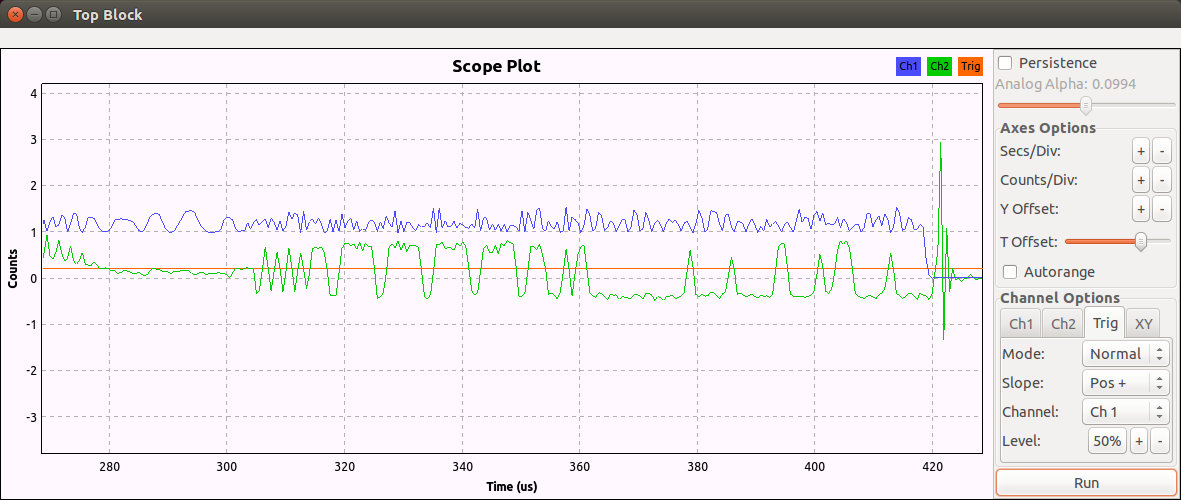
arnaud acquired a HackRF Blue and has been busy coding up a GNURadio project for analyzing Crazyflie radio transmissions. Crazyflie is a nano quadcopter/drone controlled over a wireless link. The Crazyradio is the official radio dongle for the Crazyflie Nano Quadcopter. It is a 2.4GHz USB radio dongle based on the nRF24LU1+ chip from Nordic Semiconductor.

arnaud uses GNU Radio companion to design a receiver for the Crazyradio’s GFSK signal, calulating the magnitude of the complex signal which allows to locate data packets by setting the scope trigger. Once able to synchronize on a packet, we can add a filter and a quadrature demodulator to demodulate the FM signal and show the data packet (in green).

For more information and explanation of the GRC file, check out the detailed post at Bitcraze.io.

App note: High-Precision 16-Bit PWM

an_microchip_tb3137

Technical brief from Microchip on their high-precision 16-Bit PWM modules found on various PIC16 devices. PDF link here

The high-precision 16-bit PWM available in various PIC16 devices such as the PIC16F1574, delivers advanced features beyond those found on standard PWM modules. These innovative features allow the user to easily vary phase, duty cycle and offset event count with greater precision. Via the offset modes, each PWM output can offset its waveform relative to any other PWM module on the same device. The high-precision 16-bit PWM is ideal for power supplies, LED lighting, color mixing, and motor control applications. In addition, when not using the PWM outputs the module can be used to add up to four additional general purpose 16-bit timers.

App note: USB to I2C bridging with Microchip USB 2.0 Hubs

an_microchip_an1940

App note on Microchip’s USB 2.0 Hubs on its I2C support. PDF link here

The USB to I2C bridging feature of Microchip’s USB 2.0 hubs provides system designers expanded system control and potential BOM reduction. When using this feature in a system design, a separate USB to I2C device is no longer required and a downstream USB port is not lost, as would occur when a standalone USB to I2C device is implemented. This feature is available on Microchip hubs which contain the internal Hub Feature Controller. These hubs include USB2532, USB2533, USB2534, USB3613, USB3813, USB4604, USB4624. Commands may be sent from the USB Host to the internal Hub Feature Controller device in the Microchip hub to perform the following functions: Enable I2C Pass-Through Interface, I2C Write & I2C Read

BOMtools: Python scripts build Kicad part database

Screenshot_bomtools
Steve Rodgers has been busy coding. He’s developed a set of Python scripts (BOMtools) which allow you to extract part numbers from a Kicad schematic and match them to a part number database.

There are two scripts. One which does the part merge operation and is called from Kicad and the other which manages the database and is used from the command line.

The merge script takes the part number from the schematic and pulls in the part title/description, manufacturer and manufacturer part number. It also collates the reference designators ascending orderusing commas and dashes. The merge program outputs a .csv file so you can use your spreadsheet program to view the BOM.

The manager script allows new part numbers to be queried, listed, added or modified.

You can find Steve’s code on GitHub.

Via the contact form.

By keeping your own part number database, you can manage your BOM’s more efficiently.”

App note: USB to GPIO bridging with Microchip USB 2.0 Hubs

an_microchip_an1940

App note on Microchip’s USB 2.0 Hubs on its GPIO capabilities. PDF link here

The USB to GPIO bridging feature of Microchip’s USB 2.0 hubs provides system designers expanded system control and potential BOM reduction. General Purpose Input/Outputs (GPIOs) may be used for any general 3.3V level digital control and input functions. This feature is available on Microchip hubs which contain the internal Hub Feature Controller. These hubs include the USB2532, USB2533, USB2534, USB3613, USB3813, USB4604, USB4624. Commands may be sent from the USB Host to the internal Hub Feature Controller device in the Microchip hub to perform the following functions: Set the direction of the GPIO (input or output), Enable a pull-up resistor, Enable a pull-down resistor, Read the state & Set the state

App note: Introduction to USB Type-C

an_microchip_an1953

Microchip’s App note on USB Type-C cable. PDF is here

The USB-IF has secured the ubiquitous nature of USB for years to come with the radically updated USB Type-C connector. While the sleek new reversible form factor has been significant for generating buzz and excitement from the general consumer market, the significantly expanded feature-set is what will eventually transform the desktop and entertainment environment.

App note: PoE and LED Lighting: the perfect match

an_maxim_an6141

App note from MAXIM Integrated on LED lighting utilizing power from PoE. Link here

This application note explains that Power-over-Ethernet (PoE) is a technology used in wired local area networks (LANs). PoE delivers power over the same cable that delivers the Ethernet data. Using LED lighting on a PoE network delivers excellent energy efficiency because it minimizes inefficient power-conversion stages for LED lights used in a retrofitted, legacy, AC-powered socket. The application note also explains how powering and controlling LED lights over a PoE network creates the opportunity to use the LED lights in new and novel ways. Examples are given.