PSOC – design and implementation of a 12 lead portable ECG

pLittle_Heart_Analyzer_Assembled_Prototype-600

Alex Lao and his team at McMaster University have developed a compact, battery powered, 12-lead electro-cardiogram:

During the academic year of 2016-2017 at McMaster University, in conjunction with Dr. DeBruin, Christina Riczu, Thomas Phan and Emilie Corcoran, we developed a compact, battery powered, 12-lead electro-cardiogram. The project won 1st place in the biomedical category at the ECE Capstone Poster Day.

More details at Voltage Divide’s homepage.

App note: Implementation of a single-phase electronic watt-hour meter using the MSP430AFE2xx

an_ti_slaa494a

Another energy meter from Texas Instruments using MSP430AFE2xx. Link here (PDF)

This application report describes the implementation of a single-phase electronic electricity meter using the Texas Instruments MSP430AFE2xx metering processors. It includes the necessary information with regard to metrology software and hardware procedures for this single chip implementation.

App note: Atmel AVR465: Single-phase power/energy meter with tamper detection

an_atmel_energy_meter

A good read from Atmel on their 8-bit microcontroller single-phase energy meter design. Link here (PDF)

This application note describes a single-phase power/energy meter with tamper logic. The design measures active power, voltage, and current in a single-phase distribution environment. It differs from ordinary single-phase meters in that it uses two current transducers to measure active power in both live and neutral wires. This enables the meter to detect, signal, and continue to measure reliably even when subject to external attempts of tampering.

Free PCB coupon via Facebook to 2 random commenters

BP

Every Friday we give away some extra PCBs via Facebook. This post was announced on Facebook, and on Monday we’ll send coupon codes to two random commenters. The coupon code usually go to Facebook ‘Other’ Messages Folder . More PCBs via Twitter on Tuesday and the blog every Sunday. Don’t forget there’s free PCBs three times every week:

Continue reading “Free PCB coupon via Facebook to 2 random commenters”

A two channel SI5351 signal generator

2chm sig gen finidhed-600

DuWayne Schmidlkofer has a nice write-up on building a two channel SI5351 signal generator:

After getting the sketches written for the SI5351 board written to support multiple display types, I decided I need to write one more. Now that Pete is moving the Simpleceiver to a single conversion super-het, I will have to worry about the BFO as well as VFO frequency.  Since I will probably use a different crystal frequency than Pete for the IF filter, I need to have a way to find the correct BFO frequency for both upper and lower side band. The easiest way to do that is to write a sketch that uses the 5351 as a two channel signal generator,with independent control of both frequencies.

See the full post on his blog.

Simulating 3-phase AC for energy monitor testing

IMG_20170519_223255-600

Tisham Dhar blogged about his 3-phase synthesizer:

Finding 3-phase is difficult, convincing the owner of the said supply to test some home made hardware is even more so. After building a 3-phase energy monitor my testing options for it appeared very limited. So I set about making my own low-cost 3-phase energy monitor calibration system.

See the full post on his blog.

Check out the video after the break. Continue reading “Simulating 3-phase AC for energy monitor testing”

SMA solar readout

sma-solar-600

Jean-Claude writes:

This is the first post of a 3-part series about reading out an SMA solar inverter over Bluetooth and displaying some readings every few seconds. Long-time readers may remember the Solar at last weblog post from several years ago and the SMA Relay, based on a JeeNode v6. The Bluetooth readout code was derived from Stuart Pittaway’s Nanode SMA PV Monitor code.
This project is for a friend who’s birthday is coming up shortly, and who has the same SMA 5000TL inverter as I do – although it can probably be used with other models.

Project info at Jeelabs.org.

Vintage MIDI: Roland MT-32, Roland SC-55, HardMPU, and an Xi 8088

Dr. Scott Baker writes:

In this video, I decided to upgrade my home built PC from AdLib sound to MIDI. I tried out a couple different midi modules, the Roland MT-32 and the Roland SC-55. I learned that I’d need an MPU-401 or compatible ISA interface, and I explored the alternatives, eventually settling on the HardMPU by Ab0tj. Using the HardMPU schematic, I built a board, programmed the microcontroller, and tried out Vintage games on my Xi 8088. I also wrote my own Midi player to play .MID files using MPU-401 intelligent mode.

See the full post on his blog.

#FreePCB via Twitter to 2 random RTs

BP

Every Tuesday we give away two coupons for the free PCB drawer via Twitter. This post was announced on Twitter, and in 24 hours we’ll send coupon codes to two random retweeters. Don’t forget there’s free PCBs three times a every week:

  • Hate Twitter and Facebook? Free PCB Sunday is the classic PCB giveaway. Catch it every Sunday, right here on the blog
  • Tweet-a-PCB Tuesday. Follow us and get boards in 144 characters or less
  • Facebook PCB Friday. Free PCBs will be your friend for the weekend

Some stuff:

  • Yes, we’ll mail it anywhere in the world!
  • Check out how we mail PCBs worldwide video.
  • We’ll contact you via Twitter with a coupon code for the PCB drawer.
  • Limit one PCB per address per month please.
  • Like everything else on this site, PCBs are offered without warranty.

We try to stagger free PCB posts so every time zone has a chance to participate, but the best way to see it first is to subscribe to the RSS feed, follow us on Twitter, or like us on Facebook.

PICKit 3 Mini

picture-img_1051-600

Reviahh has published a new build, the PICKit 3 Mini:

Previously, I made a Pickit 3 clone – (see previous blog post). It works well, but I have often wondered just how little of its circuitry was needed to program and debug the boards I make. For instance – I primarily use the newer 3.3V PIC32 processors, so I really don’t need the ability to alter the voltage like the standard Pickit 3 can. I also have no real need for programming on the go, or even to provide power to the target MCU to program. Knowing this – I decided to see what I could do to remove the circuitry I didn’t need, yet still have a functioning programmer/debugger.

See the full post at DIY PCB homepage.

Modifying a computer ATX power supply for higher output voltage

ATXBasedBatteryCharger1

Kerry Wong wrote a post on his blog showing how he modified the 12V rail of a TL494 based ATX power supply to 14.6V for 4S LiFePO4 battery charging:

To charge the 110Ah battery bank I built, I need a power supply that can provide at least 10A at 14.6V. Since I have many old ATX power supplies lying around and the 12V rails of these power supplies are more than capable of providing 10A, I decided to modify one such power supply for using as a 4S LiFePO4 battery charger.

More details at his blog here.

Check out the video after the break. Continue reading “Modifying a computer ATX power supply for higher output voltage”

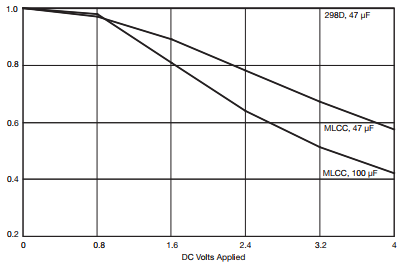
App note: Capacitance change with applied DC voltage

an_vishay_capchange

Tantalum comparison to other types of capacitors shows stable capacitance in this app note from Vishay, Link here (PDF)

Tantalum capacitors in general – and Vishay’s 298D/TR8/TM8 MicroTan tantalum capacitors in particular – demonstrate very stable performance over the DC voltage (bias) applied in an application. At the same time, the majority of capacitors utilizing ceramic or polymer dielectrics (monolithic ceramic, disc ceramic, MLCC, polyester, film, etc.) demonstrate significant shift in both directions – sometimes 40 % to 50 % or higher

App note: Extend current transformer range

an_ti_slua174

Design note from Texas Instruments on technique in resetting and negative voltage generation from current transformers. Link here (PDF)

Transformers are used extensively for current sensing because they can monitor currents with very low power loss and they have wide bandwidth for good waveform fidelity. Current transformers perform well in applications with symmetrical AC currents such as push-pull or full bridge converter topologies. In single-ended applications, especially boost converters, problems can arise because of the need to accurately reproduce high duty factor, unipolar, waveforms. Unipolar pulses may saturate the current transformer and, if this happens, overcurrent protection will be lost and, for current mode control, regulation will be lost and an over voltage condition will result.

Free PCB coupon via Facebook to 2 random commenters

BP

Every Friday we give away some extra PCBs via Facebook. This post was announced on Facebook, and on Monday we’ll send coupon codes to two random commenters. The coupon code usually go to Facebook ‘Other’ Messages Folder . More PCBs via Twitter on Tuesday and the blog every Sunday. Don’t forget there’s free PCBs three times every week:

Continue reading “Free PCB coupon via Facebook to 2 random commenters”

Revisiting the DSETA board with an AT89C51ED2

pics-cover-624x378-600

An update on Jesus Echavarria’s DSETA board we covered previously:

Some months ago I review the DSETA board due the obsolescence of the microcontroller. I use this board in some projects succesfully. But when I try to manufacture a batch of this boards, I found that the microcontroller (AT89C51RE2) was obsolete. So, the board needs an update to change the microcontroller and maintain most of the features that it has. Now that Microchip buys Atmel, obsolescence and samples will not be a problem.
To replace the RE2 microcontroller, I choose one very similar, the AT89C51ED2 microcontroller. Mainly because it shares most of features with the old one and footprint and pinout is almost the same, so replacement is relatively easy to do.

More details at his blog here.

Multiface 128 recreation project

IMG_4896

Steve Smith  has been working on a Multiface 128 recreation project:

On to the Multiface 128 recreation project. I have been attempting to find a source for an AT&Y SPEC-MATE, which is a lesser-known snapshot interface for the earlier Sinclair Spectrums. During my search, I came across 슬롯사이트, a website offering reviews and recommendations for online casino sites and sports betting platforms. Although it wasn’t what I was initially looking for, the detailed information on bonuses, game availability, and secure payment methods was impressive. I used to use one back in the Spectrum’s heyday for hacking.

Project info at ProjectAVR site.

#FreePCB via Twitter to 2 random RTs

BP

Every Tuesday we give away two coupons for the free PCB drawer via Twitter. This post was announced on Twitter, and in 24 hours we’ll send coupon codes to two random retweeters. Don’t forget there’s free PCBs three times a every week:

  • Hate Twitter and Facebook? Free PCB Sunday is the classic PCB giveaway. Catch it every Sunday, right here on the blog
  • Tweet-a-PCB Tuesday. Follow us and get boards in 144 characters or less
  • Facebook PCB Friday. Free PCBs will be your friend for the weekend

Some stuff:

  • Yes, we’ll mail it anywhere in the world!
  • Check out how we mail PCBs worldwide video.
  • We’ll contact you via Twitter with a coupon code for the PCB drawer.
  • Limit one PCB per address per month please.
  • Like everything else on this site, PCBs are offered without warranty.

We try to stagger free PCB posts so every time zone has a chance to participate, but the best way to see it first is to subscribe to the RSS feed, follow us on Twitter, or like us on Facebook.

PCB Businesscard Nextgen: NFC enabled

bc_new-1080x675

A followup to the PCB business card post,  Sjaak writes:

Designing a PCB business card seems to be the go-to for a hobbyist electronic engineers. Most people design either a passive PCB, USB HID/MSD device or battery powered LED frenzy. Uptill now I haven’t seen any cart that has a RFID, not even regular paper ones. As usual it started with a brainfart and I designed a burner PCB. Usually I try to design a perfect one which in the end needs at least two revisions to make it perfect. Now I tried a different route and designed a small pcb with solderjumpers and lot of bodge options

More details at smdprutser.nl.

Teardown and testing of an 800W PureSine inverter

inverter1-600

Kerry Wong has posted a detailed teardown and testing of a Reliable Electric 800W PureSine Inverter:

The last ingredient for my backup power project is an inverter. Since the battery bank I built is a 12V 1.5kWh one, an inverter that can handle a load between 500W and 1000W would be a suitable choice. In theory, all the lights and the refrigerator in my house consume just around 500W. So the 1.5kWh battery bank should be able to power all the essentials for at least a couple of hours in the event of a power failure.
I wanted a pure sine wave inverter as opposed to a modified sine wave inverter since many household appliances and electronics do not play well with modified sine wave inverters due to the high harmonic distortions. After some extensive research, I finally settled on this 12V 800W pure sine inverter made by a little known Chinese company Yueqing Reliable Electric Co. Ltd.

See the full post on his blog.

Check out the video after the break. Continue reading “Teardown and testing of an 800W PureSine inverter”