App note: Sense multiple pushbuttons using only two wires

A 1-Wire port expander can be used to sense 8 push-buttons with only 2 wires. It can be powered via a strong pullup on the data line, so a separate power line isn’t needed.

For applications that require less than a keyboard or numeric keypad, this simple circuit monitors multiple pushbutton switches using a single multi-channel 1-Wire addressable switch (DS2408), and a few external components.

This is a fun exercise, but we’d steer clear of it in a design for a number of technical and practical reasons. Our personal hunch is that 1-Wire’s days are numbered. Maxim has discontinued many devices, and third-parties can’t release new ones due to the 1-Wire license. It seems like the most available 1-Wire parts are the EEPROMs and IO expanders, stuff they need to keep selling to avoid the wrath of large, long-term customers.

2011 DCC – Practical Software Radio


This talk is from the 2011 Digital Communications Conference (DCC) held last September in Baltimore, MD. The speaker is Matt Ettus who heads up Ettus Research, manufacturers of the USRP family of SDRs. His talk is an in depth technical explanation of “Why Things Don’t Always Match the Textbooks” in SDR. Matt is affiliated with the open source GNU Radio Project, and hold Amateur Radio License N2MJI.

BB313 – ATtinyX313 breakout board for breadboards

John designed a breakout board for the ATtiny2313/4313 microcontrollers. It features a power supply, decoupling capacitors, ceramic resonator, a FTDI 6pin header, and a programing header. The board is designed so it is easy to interface with breadboards by putting all the breakout pins on one side. We’re calling this breakout configuration the ‘blade’ breakout, and have seen it on more and more projects lately.

The BB313 is a breadboard platform for the ATTiny2313/4313 microcontroller. It’s  designed to make the prototyping process easier by providing a regulated 5V power supply, an AVR-ISP programming header, an FTDI-cable compatible 6-pin header, connections for an external ceramic resonator, and a reset button on the PCB, so you don’t need to wire those functions up on the breadboard. It breaks out most of the pins on the ATTiny to one side, so you have more breadboard space to work with. It also doubles as a target board for the 2313/4313 and, with a simple modification, the ATTiny25/45/85.

Via Adafruit.

8 Channel USB digital signal generator


Dilshan developed a 8 channel USB digital signal generator and an open source Windows application called Kidgo Player to drive it. The hardware is basically just a PIC18F2550 USB breakout board used to provide 8 digital outputs for his software. The Kidgo Player’s source is available on GitHub, and has the following features:

  • Save waveforms and settings as binary file (KDF file) or export waveform as a text file
  • Playback controls such as “Play to segment”, “Play from segment”, “Step back”, “Step next” and “Clear”
  • Shifting and rotating waveforms
  • Invert, Reset, Clocking and Binary Generator functions
  • Copy and Paste waveforms
  • Mute function to each individual channel
  • Launch without any installation or configuration (design to work as portable Windows application)

Via LucaDentella.

Another DIY magnetic rotary encoder with the AS5043

Here’s another take on a breakout for the magnetic rotary encoder AS5043 IC:

Just wanted to show my take on the AS5043.
Double sided PCB by Seed, Voltage regulator onboard,
one LED for power on, the other for magnetic range output.

This chip measures the surrounding magnetic field and outputs a serial and analog reading that can be used to track the rotation of gears, motors, etc.

Via the forum.

Free PCB coupon via Facebook to 2 random commenters


Every Friday we give away some extra PCBs via Facebook. This post was announced on Facebook, and on Monday we’ll send coupon codes to two random commenters. More PCBs via Twitter on Tuesday and the blog every Sunday.

Don’t forget there’s free PCBs three times a every week:

Continue reading “Free PCB coupon via Facebook to 2 random commenters”

Week in (p)review: March 02, 2012

Here’s a summary of major developments over the last week. Free PCB Friday is coming up soon:

Coming up:

  • Free PCBs via Facebook on Friday
  • App notes on the weekend
  • Free PCB Sunday
  • New 3D model on Monday
  • Free PCBs via Twitter on Tuesday
  • Weekly roundup and preview every Friday

What are you hacking this week?

Bus Pirate v3.1 free PCB build

Chris built a Bus Pirate v3.1 free PCB. The Bus Pirate is an open source hacker multi-tool that talks to electronic stuff. v3.1 eventually became the v3b, with a few minor part changes. More v3bs are out there than any other Bus Pirate version.

If you build a free PCB we’ll send you another one! Blog about it, post a picture on Flicker, whatever – we’ll send you a coupon code for the free PCB drawer.

Get your own handy Bus Pirate for $30, including world-wide shipping. Also available from our friendly distributors.

Via the Forum.

Reprogramming USB Webkey dongle using Bus Pirate


JJShortcut took one of the webkey USB devices his school was discarding and decided to reverse engineer it. The device plugs into the USB port on a PC and when its on-board button is pushed it opens the computer’s web browser, directing the user to a specific URL.

He found that the heart of the device was a 24C02 EEPROM containing the URL data. Using the Bus Pirate he was able to read the EEPROM and reprogram it with the URL of his choice.

You can get your own Bus Pirate for less than $30.

brentbxr via the contact form.

MCP2200 breakout board free PCB built

Bennyboy built a free MCP2200 breakout boardMCP2200 is a USB-to-serial converter chips from Microchip. In fact they are PIC18F14K50 microcontrollers programmed with USB-to-UART firmware.  We were able to hack one and program an open source USB stack into it.

If you build a free PCB we’ll send you another one! Blog about it, post a picture on Flicker, whatever – we’ll send you a coupon code for the free PCB drawer.

Squeeze the power out of batteries using AASaver

Are you looking for a portable breadboard power supply with a selectable voltage? Also thinking about how long the batteries will last? This project utilizes one or two AA/AAA batteries to generate a preselected voltage of 5V or 3.3V, and  squeezes the batteries untill they have almost no power at all.  AASaver is based on the Microchip MCP1640 boost converter.

When your electronic devices report that the batteries are ‘dead’ and need to be replaced, do you ever feel frustrated that there is often still a lot of juice in them? Don’t throw away the batteries yet! You can use the remaining energy to do a lot of things, such as powering LED flashlights. This is possible by using a boost converter, which can bump the low battery voltage to a higher voltage, enough to light up LEDs or even power breadboard circuits.

MSP430 PC GUI evaluation tool


Nathan Zimmerman has developed this PC GUI evaluation tool for the MSP430. Coded in VC++, the GUI allows control of all the peripherals on a MSP430 controller. He’s currently testing it using the MSP430G2553.

This GUI would be very handy to have from a hardware/software test debug standpoint. For example, say I wanted to test out some SPI sensor I purchased, I could use a GUI such as this to send custom SPI packets to the device I’m testing and read/observe results live. That as opposed to having to write a micro.c file to do the communication and re write it every time something doesn’t work.

Visit this 43Oh forum post for more info and links to download the code.

Via 43Oh.

Workshop Video #10: BGA revisited

In an earlier Workshop Video we challenged Sjaak to solder a TMP006 non-contact temperature sensor in a BGA package. We lacked the skills to make it happen, but this week DP engineer Jer shows how he successfully soldered 2 of 4 breakout boards.

Jer doesn’t hold the the chip in place with kapton tape like we did. He instead relies on the surface tension of the solder to keep the chip aligned and on the board.

He positions the chip and then heats it with hot air for around 35 seconds. He doesn’t preheat the board like many recommended, but he’s really persistent and ensures that the solder balls reflow completely.  We were far too timid with the hot air, and worried about ruining the chip.

Ball Grid Array is a type of chip that doesn’t have any legs to solder. Instead it has a bunch of little solder balls aligned in a grid on the bottom. Because there’s no way to solder the IC directly, it’s pain for DIY-ers to work with. Even with special equipment, there’s a ton of skill involved.

Basics of liquid lenses video

Learn about the basics of liquid lenses in this video. Ben explains how you can use a high-voltage power supply and some Teflon tape to alter the focal point of a liquid lens.

Liquid lenses are basically a drop of water whose shape can be altered through the use of a strong electrical field. A really cool experiment shown in this video is using a electrolytically charged comb to alter the direction of water coming out of the tap.

Via PCBheaven.

Online course for Altera’s SignalTapII logic analyser simulator for FPGAs

In a previous post we wrote about Kiran’s review of Altera’s SignalTapII logic analyzer simulator for FPGAs. Jason let us know that Altera provides many free online courses for their tools, and one of them is for the SignalTapII. The course covers the following:

  • Add one or more instances of the SignalTap II logic analyzer to a design
  • Configure the SignalTap II logic analyzer to debug the design
  • Use the logic analyzer with incremental compilation to reduce recompile times
  • Operate the SignalTap II logic analyzer to capture data as defined by the trigger settings
  • Analyze data captured by the trigger condition(s) & use it to locate & fix bugs in the design
  • Use storage qualification, state-based triggering flow & power-up triggers

Via the comments.

20x to 200x USB microscope review

Tod reviewed Adafruit’s USB microscope with magnifications ranging from 20x to 200x. He rigged up a custom holder from a microphone stand and some magnets.

This is a full review of the USB microscope that is sold by Adafruit. It does 20x to 200x and also will let you take measurements if you enter the magnification you are using. I will let the video explain everything but I added some extra photos after the video.

TI’s Wolverine is an even lower power MSP430

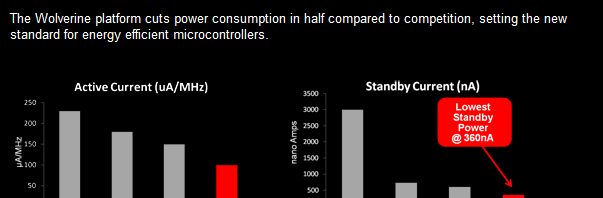
Texas Instruments claims to have concocted an even lower power MSP430. The MSP430 Wolverine series uCs consume 100uA per MHz when active, and 360nA in standby. TI claim this is 50% less power consumption than any other micro.

You can download the whitepaper and check out all the specs. Tasty samples available around June 2012.

Via the Sacramento Bee.

Phase Lock Loops 101 with Bil Herd

Robert let us know about another video tutorial on Phase Lock Loops in the comments of our previous post.

PLLs generate an output signal that is phase-synchronized to an input signal. They are widely used in telecommunication, radio, and computer systems. One place we commonly find PLLs is the frequency multiplier circuit inside microcontrollers. The PIC 18F2550 used in the IR Toy has one that multiplies a 20 MHz crystal input to 96 MHz needed for the USB module.

Thanks Robert! Via the comments.

Avoiding worthless forks on GitHub

Avoiding worthless forks on GitHub:

GitHub is great for finding code and then forking it, however one issue is that there are a significant number of idiots forking projects and then making insignificant formatting changes, maybe they want to see their name up on the web or even claim that they are part of the project (great for job interviews)

So when forking a project you need to ensure you have the actual base project and not some numpties re-fork of a re-fork.