App note: eFuse load current measurement

an_on_AND9685-D

App note from ON Semiconductor on eFuse current measurement. Link here (PDF)

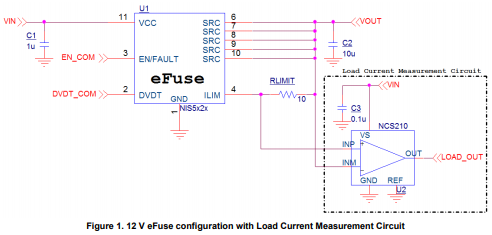
This application note describes the load current measurement solution for the eFuses which do not provide load current monitoring feature. Since almost all of the eFuses provide adjustable current limit functionality by utilizing an external current limiting resistor between “ILIM” and “SRC” pins, it is possible to connect a current sense amplifier across that resistor and measure the voltage drop across it which would be proportional to the load current. This method mainly requires a current sense amplifier and allows user to measure the system load current without introducing any additional resistance in series with the load path.

Free PCB coupon via Facebook to 2 random commenters

IRToy-600x369

Every Friday we give away some extra PCBs via Facebook. This post was announced on Facebook, and on Monday we’ll send coupon codes to two random commenters. The coupon code usually go to Facebook ‘Other’ Messages Folder . More PCBs via Twitter on Tuesday and the blog every Sunday. Don’t forget there’s free PCBs three times every week:

Continue reading “Free PCB coupon via Facebook to 2 random commenters”

An open source frequency meter and clock generator

featured-3

Boris Landoni writes about an open source project frequency meter and clock generator:

On the hardware of the controller board LED Matrix, by taking advantage of the reconfigurability of the onboard FPGA, we can build a bivalent tool that is extremely useful to have on our work bench.

Via Open Electronics.

Testing the TPS61092 boost converter

thermal-image-600

Testing the TPS61092 boost converter from LuckyResistor:

For my current project I searched for a good boost power converter which is able to deliver continuous 400mA power for various sensors.
There are an endless number of good boost converters around, but not many can be hand soldered to a board. I would really like to see some like the TPS61092 with SOIC or similar packages. The biggest problem seems to be the heat transport, why most chips have to be mounted flat on the board.

Before using the chip in my project, I created a small test board. Using this board I can test various things. First I liked to test the performance under load. Next I tested if the chip can be hand soldered and finally I tested the final board layout I will use in my project.

More details at luckyresistor.me.

#FreePCB via Twitter to 2 random RTs

IRToy-600x369

Every Tuesday we give away two coupons for the free PCB drawer via Twitter. This post was announced on Twitter, and in 24 hours we’ll send coupon codes to two random retweeters. Don’t forget there’s free PCBs three times a every week:

  • Hate Twitter and Facebook? Free PCB Sunday is the classic PCB giveaway. Catch it every Sunday, right here on the blog
  • Tweet-a-PCB Tuesday. Follow us and get boards in 144 characters or less
  • Facebook PCB Friday. Free PCBs will be your friend for the weekend

Some stuff:

  • Yes, we’ll mail it anywhere in the world!
  • Check out how we mail PCBs worldwide video.
  • We’ll contact you via Twitter with a coupon code for the PCB drawer.
  • Limit one PCB per address per month please.
  • Like everything else on this site, PCBs are offered without warranty.

We try to stagger free PCB posts so every time zone has a chance to participate, but the best way to see it first is to subscribe to the RSS feed, follow us on Twitter, or like us on Facebook.

Attiny85 backpack programmer header

p-img_20180220_102908-600

Facelesstech published a new build:

So when I was into using just a atmega328 dip chip I make a programmer header for it that also had a crystal and the capacitors need to make it function. I wanted to do the same for the attiny85. As you know you have to use a ISP programmer to flash the attiny85, This requires you to look up the pinouts and get a bunch of jumps out to wire it up. I wanted to eliminate all of this.

More details at Facelesstech site. Github link here.

Check out the video after the break.

Continue reading “Attiny85 backpack programmer header”

Free PCB Sunday: Pick your PCB

BP-600x373

We go through a lot of prototype PCBs, and end up with lots of extras that we’ll never use. Every Sunday we give away a few PCBs from one of our past or future projects, or a related prototype. Our PCBs are made through Seeed Studio’s Fusion board service. This week two random commenters will get a coupon code for the free PCB drawer tomorrow morning. Pick your own PCB. You get unlimited free PCBs now – finish one and we’ll send you another! Don’t forget there’s free PCBs three times every week:

Continue reading “Free PCB Sunday: Pick your PCB”

App note: Sub-1 V current sensing with the TS1001, A 0.8 V, 0.6 µA OP-AMP

an_silabs_an833

Another TS1001 op-amp application from Silicon Labs on sensing nano currents. Link here (PDF)

Current-sense amplifiers can monitor battery or solar cell currents, and are useful to estimate power capacity and remaining life. However, if the battery or solar source is a single cell, it’s difficult to find a low voltage solution that works below 1V and draws just microamps. A new class of nanopower analog ICs, namely the TS1001 0.8 V/0.6 µA op amp, makes a sub-1 V supply current sense amplifier possible. This discrete circuit operates from as low as 0.8 V and draws 860 nA at no load while providing a 0–500 mV output for measured currents of 0–100 mA, though the scale can be adjusted by changing the values of a few resistors. With its extremely low power, the circuit can simply remain “always on,” providing a continuously monitored, averaged indication of current which can subsequently be read periodically by a microcontroller, without causing too much current drain in the battery.

App note: A microwatt charge pump boosts 1 V to 1.8 V at 90% efficiency, providing “Always On” standby power for microcontrollers

an_silabs_an832

Interesting app note from Silicon Labs on high efficiency charge pump utilizing their nanopower TS1001 op amp. Link here (PDF)

Boosting the output voltage of common alkaline button-cells to at least 1.8 V needed by microcontrollers provides an “always on” standby power source sufficient for low-power oscillator interrupt/sleep state operation. Two ultralow power op amps are used in a charge pump configuration to double an input voltage, creating an output voltage of approximately 2x the input voltage. Output currents up to 100 µA are available at 90% efficiency; even load currents as low as 10 µA achieve 80% efficiency, beating commercially available charge pump ICs and inductorbased boost regulators.

Free PCB coupon via Facebook to 2 random commenters

IRToy-600x369

Every Friday we give away some extra PCBs via Facebook. This post was announced on Facebook, and on Monday we’ll send coupon codes to two random commenters. The coupon code usually go to Facebook ‘Other’ Messages Folder . More PCBs via Twitter on Tuesday and the blog every Sunday. Don’t forget there’s free PCBs three times every week:

Continue reading “Free PCB coupon via Facebook to 2 random commenters”

HP 8620C sweep generator repaired

topcoverremoved-600

Kerry Wong did a repair of an HP 8620C sweep generator we covered previously:

In my previous post, I did a teardown of an HP 8620C sweep generator along with an HP 86245A 5.9 GHz to 12.4 GHz RF plugin. A few of the plguin boards in the 8620C had leaked capacitors and also there seemed to be some sort of mechanical issue as no power was delivered to the transformer regardless of the power switch positions. So what I planed to do next was to restore the power to the unit and replace those bad capacitors and see if I could bring this sweep generator back to life.

See the full post on his blog here.

Check out the video after the break. Continue reading “HP 8620C sweep generator repaired”

Implementing FizzBuzz on an FPGA

mojo-600

Ken Shirriff writes:

I recently started FPGA programming and figured it would be fun to use an FPGA to implement the FizzBuzz algorithm. An FPGA (Field-Programmable Gate Array) is an interesting chip that you can program to implement arbitrary digital logic. This lets you build a complex digital circuit without wiring up individual gates and flip flops. It’s like having a custom chip that can be anything from a logic analyzer to a microprocessor to a video generator.
The “FizzBuzz test” is to write a program that prints the numbers from 1 to 100, except multiples of 3 are replaced with the word “Fizz”, multiples of 5 with “Buzz” and multiples of both with “FizzBuzz”. Since FizzBuzz can be implemented in a few lines of code, it is used as a programming interview question to weed out people who can’t program at all.

More details at Ken Shirriff’s blog.

10MHz distribution amplifier

p-10mhz_pcb_top-600

G4FRE built a 10MHz distribution amplifier:

I have had a need for a distribution amplifier for a while now. Searching around I found the design by G4JNT in Radcom, which filled my needs. I redrew the circuit for 4 outputs and had PCBs made. (if you want one contact me!)  I now have the units in my M1DST 10MHz Thunderbolt monitoring project and in my LPRO101 10MHz Rubidium source.

See the full post on his blog here.

0.000011574Hz: The ATtiny85 super-slow-clock Saturday detector

ShabbatDetectorTitle

Igendel writes, “What is the lowest possible clock frequency at which a microcontroller can still do useful work? Here’s a little project that attempts to explore this weird question.”

See the full post on his blog here, It’s Every Bit For Itself.

Check out the video after the break. Continue reading “0.000011574Hz: The ATtiny85 super-slow-clock Saturday detector”

#FreePCB via Twitter to 2 random RTs

IRToy-600x369

Every Tuesday we give away two coupons for the free PCB drawer via Twitter. This post was announced on Twitter, and in 24 hours we’ll send coupon codes to two random retweeters. Don’t forget there’s free PCBs three times a every week:

  • Hate Twitter and Facebook? Free PCB Sunday is the classic PCB giveaway. Catch it every Sunday, right here on the blog
  • Tweet-a-PCB Tuesday. Follow us and get boards in 144 characters or less
  • Facebook PCB Friday. Free PCBs will be your friend for the weekend

Some stuff:

  • Yes, we’ll mail it anywhere in the world!
  • Check out how we mail PCBs worldwide video.
  • We’ll contact you via Twitter with a coupon code for the PCB drawer.
  • Limit one PCB per address per month please.
  • Like everything else on this site, PCBs are offered without warranty.

We try to stagger free PCB posts so every time zone has a chance to participate, but the best way to see it first is to subscribe to the RSS feed, follow us on Twitter, or like us on Facebook.

Laser arm

img_20180311_181008-600

Facelesstech published a new build:

So some time last year I ordered one of those servo 2 axes (pan and tilt torret) arm kits from aliexpress. It was fun to play with but I didn’t quite find a reason to use it in a project. Then I seen this project on hackaday and a light bulb went off in my head, Why hadn’t I thought about adding a laser to the arm. This would be great to let your cat or dog play with or drive them mad.


Check out the video after the break.

Continue reading “Laser arm”

Free PCB Sunday: Pick your PCB

BP-600x373

We go through a lot of prototype PCBs, and end up with lots of extras that we’ll never use. Every Sunday we give away a few PCBs from one of our past or future projects, or a related prototype. Our PCBs are made through Seeed Studio’s Fusion board service. This week two random commenters will get a coupon code for the free PCB drawer tomorrow morning. Pick your own PCB. You get unlimited free PCBs now – finish one and we’ll send you another! Don’t forget there’s free PCBs three times every week:

Continue reading “Free PCB Sunday: Pick your PCB”

App note: High-frequency automotive power supplies

an_maxim_AN3893

Switching power supply used in automotive electronics app note from Maxim Integrated. Link here (PDF)

The combination of high switching frequency and high-voltage capability is difficult to achieve in IC design. You can, however, design an automotive power supply that operates with high frequency if you protect it from temporary high-voltage conditions. High-frequency operation is becoming important as more and more electronic functions are integrated into the modern automobile. This article discusses several ways to protect low-voltage electronic circuits from the harsh effects of the automotive electrical environment. Also included are the results of laboratory tests for noise immunity.

App note: Fan speed control is cool!

an_maxim_AN1784

App note from Maxim Integrated about their MAX6650 and MAX6651 fan controllers chip. Link here (PDF)

Temperature-based fan control is a necessity in a growing number of systems, both to reduce system noise and to improve fan reliability. When fan control is augmented by fan-speed monitoring, a speed-control loop can be implemented that is independent of manufacturing variances and wear on the fan. In addition, a fan that is about to fail can be identified so that it can be replaced before it fails.