Mats posted his holiday project the LoadMaster Jr, a Digitable settable constant load that can save data to a SD card.
Via the project log forum.
Mats posted his holiday project the LoadMaster Jr, a Digitable settable constant load that can save data to a SD card.
Via the project log forum.

Kyle Gordon purchased a CC3000 module from EBay and found that it wasn’t completely compatible with the Arduino library available from Adafruit. The problem arose from the module having an earlier firmware version. So Kyle devised a method using two Arduino Pro Minis to load updated firmware to the CC3000.
For more details, you can find the post on The Lodge blog.

Tom over at Numato writes, “This year we are calling all electronics enthusiasts to join this event and grab their free gift. Gifts ranging from SMD adapters to FPGA boards. More details at www.numato.cc”
This is the happiest time of the year for sure. Christmas is around the corner, New Year 2014 is fast approaching. And one more reason to be happy, this is the time Numato hosts the largest give away of the year. That is right! We hosted our first Christmas/New Year give away during December 2012/ January 2013 time and we saw overwhelming response from our readers. We gave away random gifts to every single person participated in the event, all 212 of them. We hope that everyone who received the gifts put it to good use and learned something from it.

Nickjohnson writes:
I’ve been working on a Pro version of my Re:load. I’ve got digital control of the current consumption working fine, as well as the optical encoder and USB interface, and I’ve just now got the LCD displaying stuff.
Via the project log forum.

Merry Christmas and Happy Holidays to all. May you find many PCBs and other electronics wizardry under your tree or pole.
Remember, support is available on Christmas. Just give us a shout in the forum.
 USB and serial enabled LCD backpack is back in stock at Seeed Studio. This board connects HD44780-compatible character LCD screens to your USB port. It works with apps like LCD Smartie to show news, system stats, and more on an external LCD. Get USB and serial enabled LCD backpack for $16.95.

Every Tuesday we give away two coupons for the free PCB drawer via Twitter. This post was announced on Twitter, and in 24 hours we’ll send coupon codes to two random retweeters.
Don’t forget there’s free PCBs three times a every week:

Some stuff:
We try to stagger free PCB posts so every time zone has a chance to participate, but the best way to see it first is to subscribe to the RSS feed, follow us on Twitter, or like us on Facebook.

Sqkybeaver writes, “who’s been working on projects this holiday? I just hit a relatively high point in one of my projects. just barely up to spec for 2M transmitter.”
Via the project log forum.
Karsten Nohl gave this presentation at the 2013 BlackHat conference in Las Vegas. “The protection pretense of SIM cards is based on the understanding that they have never been exploited. This talk ends this myth of unbreakable SIM cards and illustrates that the cards — like any other computing system — are plagued by implementation and configuration bugs.”
The presentation slides can be in PDF format.

Sean Kelly has written this tutorial describing the process used to build an OpenWRT based video recording system:
An OpenWRT router can be used to capture video with a usb webcam in order to record movements in a room. The internal flash storage for the MR3020 is only 4 Mb which isn’t sufficient for storing video. So additional storage is required, which can be provided by a USB flash device. However the MR3020 Router only has a single USB port, so it needs to be expanded with a usb hub. The usb hub in the images below is small enough to fit inside the MR3020, and has a built in micro SD card reader. The SD card reader is essentially a usb SD card reader connected to the 4th USB port of the hub. Removing the casing and de-soldering the usb jacks are the first steps.

Bus Pirate v4 is back in stock at Seeed Studio. The Bus Pirate is an open source hacker multi-tool that talks to electronic stuff. It’s got a bunch of features an intrepid hacker might need to prototype their next project.
You can get a Bus Pirate v4 for $40, including worldwide shipping.

The pedalSHIELD Arduino guitar pedal by Electrosmash:
The shield has three parts:
Via Hackedgadgets.

Tom designed this simple 12mm Rotary Encoder breakout, that is available at Github:
Very simple breakout board without so much as pullup resistors, just breaking out all 5 pins to a pin header. The PCB features enlarged holes to fit generic encoders.
Via the project log forum.

Ray writes, “When your project needs a real-time clock (RTC), don’t you hate that the popular DS1307 costs several dollars? I recently came across Microchip’s MCP7940N, which is an inexpensive alternative to DS1307. On the hardware side it is pretty much a drop-in replacement (although Microchip recommends adding several extra elements). The software requires a few modifications. In this blog post I describe how to modify an existing Arduino DS1307RTC library to provide support for both chips.”
For more information as well as the code download link, visit Ray Hobby blog.
Via the contact form.

We go through a lot of prototype PCBs, and end up with lots of extras that we’ll never use. Every Sunday we give away a few PCBs from one of our past or future projects, or a related prototype. Our PCBs are made through Seeed Studio’s Fusion board service.
This week two random commenters will get a coupon code for the free PCB drawer tomorrow morning. Pick your own PCB.
You get unlimited free PCBs now – finish one and we’ll send you another!
Don’t forget there’s free PCBs three times every week:

Another temperature sensitive device, introducing the thermistor. From its name you could guess that its a temperature dependent resistor which varies its resistance as the temperature changes. See Cypress’ application note on using these devices.
A thermistor is a temperature-sensitive resistor in which resistance varies with temperature. There are two types of thermistors: positive temperature coefficient (PTC) thermistors and negative temperature coefficient (NTC) thermistors. This application note describes the more commonly used NTC thermistors, in which resistance decreases with increase in temperature. Based on this principle, temperature is calculated by measuring the resistance.
see also: watchdog timer and a diode as an alternative temperature sensors.

Last time we covered using watchdog timer as temperature dependent component of a microcontroller to do temperature sensing. Now lets take a diode to do the same thing, they are pretty much accurate and cheap, see Cypress’ application note about its implementation.
There are various sensors available for measuring temperature such as Thermistor, Thermocouple, resistance temperature detectors (RTD). Choosing a sensor or method to employ for measuring the temperature depends on factors such as the accuracy requirement, the temperature range to be measured, and the cost of the temperature sensor. The diode based temperature measurement is an easy, accurate, and also relatively low-cost method for measuring the temperature.

Cypress’ application note on smart E-Meters and why its more advantageous to use F-RAM over conventional EEPROMs.
This application note provides an overview of a smart electricity meter, or Smart E-Meter, and explains the benefits of using nonvolatile serial F-RAM rather than EEPROM in Smart E-Meter designs.

Two application guides (Tone generation and Melody player) from Microchip to get you started on tone generation basics, these might help create musical greeting cards to give to your fellow geeks this coming holidays.
A general purpose resonator routine is implemented using a PIC17C42. This routine is used to generate multiple tones. A tone signal is normally generated using extensive table lookup schemes.When a multiple tone signal is desired, each tone must have its own lookup table, thus requiring a large amount of storage space, especially when various frequencies are to be generated. This application note implements tone generation using recursive techniques.
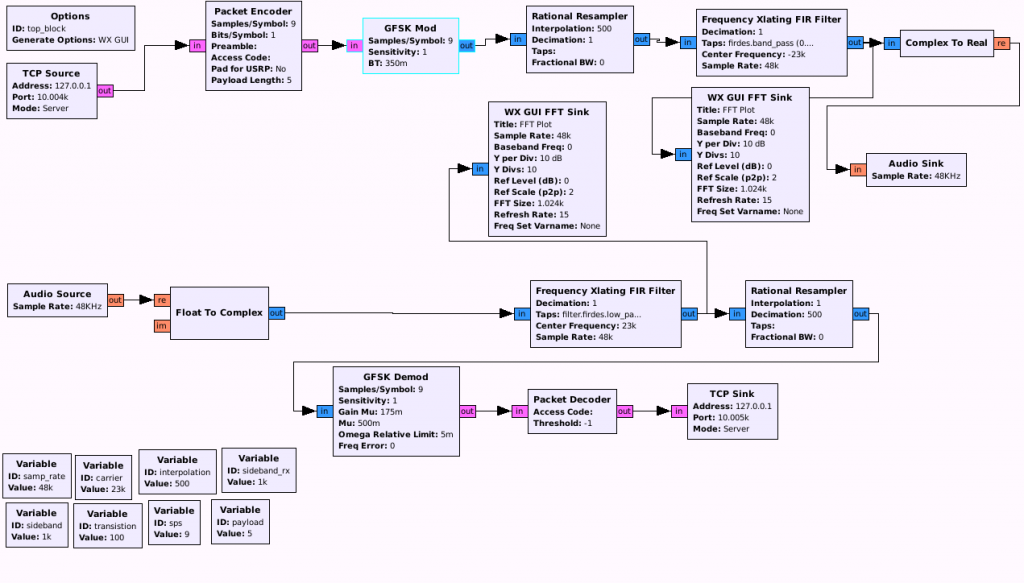
Here the open source GNU Radio companion program is used to demonstrate the transmission of data from one laptop to another using frequency shift keying (FSK). They use an audio carrier frequency of 23 kHz.
You can download the code for the GNU Radio companion flowgraph at Anfractuosity.com.