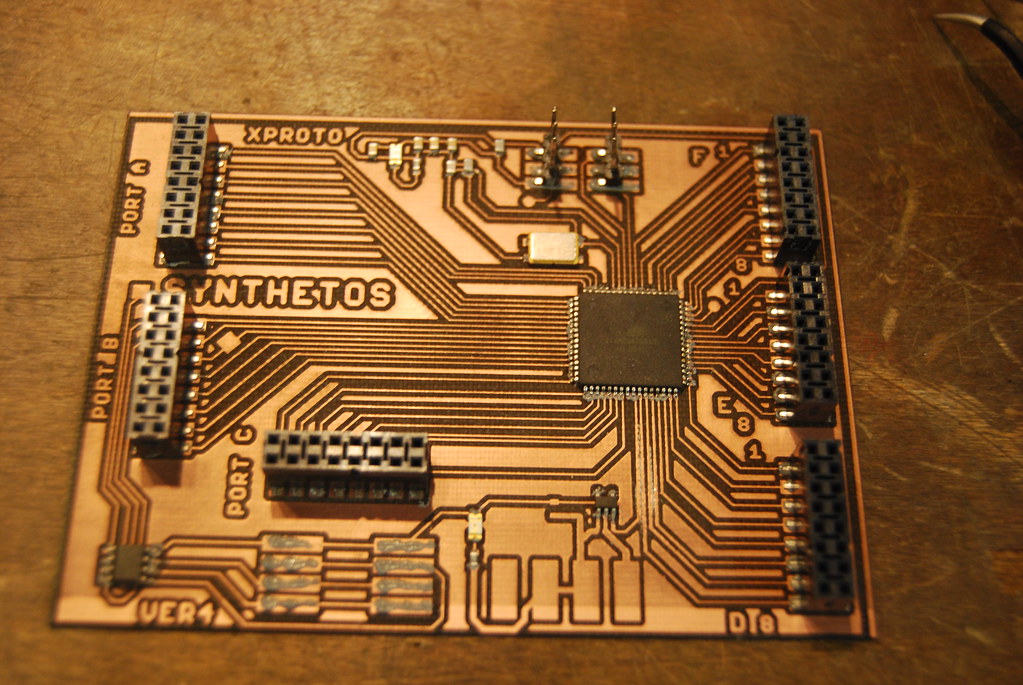
Web platform USB power supply

See the latest version on the documentation wiki.

Markus Gritsch added a USB power supply jumper to his web platform:

I found it convenient to be able to power the Web Platform using my iPhone USB charger and a normal USB cable.  It is also convenient when presenting the board to friends and powering it using their computer.  Therefore I soldered a pluggable (via two DIL socket pins) connection from the USB power to the 3.3 volts regulator (picture attached).  I measured the consumed current which is about 200 mA, so when powering no additional hardware with the Web Platform it should be ok for most USB ports.

In a future revision of the board maybe a switch could be added to choose the power source, similar to the solution on the Seeeduino.

You can buy an assembled web platform for $40, including worldwide shipping.

Forum migration complete

The forum migration is complete. You can now access the forum at http://dangerousprototypes.com/forum. All links to the old forum at whereisian.com should forward correctly to the new address with a 301 redirect.

Accounts are all the same, and all the attachments were transferred. There is a bug with attachment thumbnails, but we’ll try to get that worked out soon.

Please let us know if you notice any bugs or issues. Thanks for bearing with us during the changeover.

Moving day giveaway

Over the next 24 hours we’re migrating to cloud hosting at Laughing Squid.

WordPress has been a fantastic (and free!) host, but we need to move. We really want the forum to be at dangerousprototypes.com, and we can’t do that with the current setup. The blog domain name is mapped in a way that only WordPress can add a CNAME record to a subdomain (i.e. forum.dangerousprototypes.com).

The DNS changeover should start in the next few hours. After the blog is migrated we’ll freeze the forum to prevent posts while we move the database. A bit of .htaccess foo will forward any old links to whereisian.com/forum to the new forum location.

Since this is the last post at WordPress, we’d like to mark the occasion with a PCB giveaway. We’ll send a free RGB color changer PCB to the first and last commenter on this post. This is the last post from the old blog, the giveaway applied to the post there. We’ll see who is the last to reach the old site within 24 hours.

Free PCB Sunday: PIC and AVR programming adapter

We go through a lot of prototype PCBs, and end up with lots of extras that we’ll never use. Every Sunday we give away a few PCBs from one of our past or future projects, or a related prototype. PCBs by Seeed Studio.

This is a PIC and AVR programming adapter for the Bus Pirate (through-hole version). It has a 5pin PIC-ICSP header and a 6pin AVR-ISP header. It also includes a small 13volt boost-converter power supply. A 13volt VPP supply is required to program PIC 12/16/18F microcontrollers. We though it might be useful for clearing the RESET fuse in AVRs too, but that part isn’t going to work (it still has a handy 2×3 ISP connector for programming AVRs though).

We’re giving away two PCBs this week. Just ask for one in the comments.

Continue reading “Free PCB Sunday: PIC and AVR programming adapter”

Bus Pirate firmware v4.2 released

Bus Pirate firmware v4.2 is available for download. THIS IS FOR BOOTLOADER v4 ONLY. If you haven’t upgraded to the version 4 bootloader, see the v4 bootloader upgrade guide.

Major changes include:

  • OpenOCD JTAG debugging support (thanks robots!)
  • New speed settings in I2C, raw2/3wire, updated also in binmode
  • Fixed error in 1-wire reset command in binmode (thanks Mike!)
  • Includes pirate-loader console app
  • Minor bug fixes

There are two ways to load a new firmware with the v4 bootloader: the ds30 Loader GUI and the pirate-loader console application. Get help or discuss this release in the forum.

Bus Pirate OpenOCD JTAG how-to

Michal Demin posted a tutorial for the OpenOCD JTAG debugging support he added to the Bus Pirate.

Some time ago, I have added support to OpenOCD to be able to use Buspirate as JTAG interface. This how-to will show you, how to setup all the things necessary.

Things you will need:
– Buspirate
– Computer with OpenOCD installed
– target with JTAG
– luck :)

Read the rest.

Open Logic Sniffer probe cable

Seeed Studio is working on a probe cable for the Open Logic Sniffer. We’ll give you an update as soon as we hear more.

You can try building your own cable with some cheap probes from Deal Extreme (~$3 for 10). The trick will be finding a 1×9 row connector, if you know of any sources please share them in the comments.

The Open Logic Sniffer is currently available for preorder at Seeed Studio for $45, including worldwide shipping.

Bus Pirate in a mint tin

honken make a Bus Pirate case from a mint tin:

I used a mints tin can, very similar i size to the ubiquitous Altoids variant. I’ve got a v2go and it’s fastened with some adhesive tack, so it’s removable. I could also fit one of those mini breadboard … as well as some jumper cables.

We use adhesive tack for everything. Get an SVG of the case sticker.

Get an assembled Bus Pirate v3 for $30, including worldwide shipping.

Demo: Noritake Serial VFD

Edouard Lafargue let us republish his demonstration of a Noritake GU140x32-7002 Serial VFD screen (may prompt about a secure certificate).

The Noritake VFD used here is a “Show and Tell” 140×32 semi-graphical VFD. This display has the big advantage of being able to display graphics and manage so-called ’user windows’, making it a good choice for stepping up from standard text-based LCDs or VFDs towards a more graphical approach.

This tutorial first shows how to interface with the device using async mode, and then how to use a simple python script to display GIF black and white images on the display.

Demo: is a weekly series that demonstrates devices with the Bus Pirate. Come back next Monday for another new demo. Continue reading the demo below.

Continue reading “Demo: Noritake Serial VFD”

Free PCB Sunday: PIC and AVR programming adapter

We go through a lot of prototype PCBs, and end up with lots of extras that we’ll never use. Every Sunday we give away a few PCBs from one of our past or future projects, or a related prototype. PCBs by Seeed Studio.

This is a PIC and AVR programming adapter for the Bus Pirate (through-hole version). It has a 5pin PIC-ICSP header and a 6pin AVR-ISP header. It also includes a small 13volt boost-converter power supply. A 13volt VPP supply is required to program PIC 12/16/18F microcontrollers. We though it might be useful for clearing the RESET fuse in AVRs too, but that part isn’t going to work (it still has a handy 2×3 ISP connector for programming AVRs though).

We’re giving away two PCBs this week. Just ask for one in the comments.

Continue reading “Free PCB Sunday: PIC and AVR programming adapter”

Logic analyzer name

We’ve been working on an open source logic analyzer with Jack Gassett of the Gadget Factory. The project was known by the code name ‘SUMP-PUMP’, but you helped suggest a name. There were lots of great suggestions in the comments and the forum. Thank you.

LukeS suggested the name Logic Sniffer. He’ll get one of the first Open Logic Sniffers shipped. Thanks LukeS!

The Open Logic Sniffer is currently available for preorder at Seeed Studio for $45, including worldwide shipping.

Prototype: Openbench Logic Sniffer logic analyzer

The most recent documentation is now on the wiki

Openbench Logic Sniffer is an open source logic analyzer. It’s designed to support the SUMP logic analyzer software at the lowest possible cost. Download the source and design files from the Gadget Factory project page.

This project started in the comments on a post. Initial circuit design, PCB layout, development, and testing continued in the forum under the code name Project SUMP PUMP. Many, many people contributed ideas and advice, the Gadget Factory and Dangerous Prototypes coordinated circuit development and routed the PCB. We borrowed heavily from the Gadget Factory’s Butterfly Platform.

The Open Logic Sniffer is a purpose-built logic analyzer board designed to be low cost but high speed. It sacrifices a lot of the features you’d look for in a full-scale development board to achieve our primary goals:

  • 70MHz+ sample speeds
  • 32 channels
  • 16 buffered, 5volt tolerant channels
  • USB interface, USB powered
  • USB upgradable everything
  • Make it as DIY as possible
  • Make it as open source as possible
  • $30-$40 price range

We didn’t quite hit our initial price range, but we got really close.

You can get your own assembled Open Logic Sniffer at Seeed Studio for $45, including worldwide shipping. Continue reading about the design and collaboration below.

Continue reading “Prototype: Openbench Logic Sniffer logic analyzer”

Python on the web platform?

Markus Gritsch writes:

python-on-a-chip (p14p for short) recently got a branch to support PIC24 and dsPIC crontrollers. I got it to compile and the simulator in MPLAB shows it functioning. I mentioned the Web Platform in their mailing list and maybe both projects can share some synergy effects.

It would be nice to use Python on the Web Platform to talk to the peripherals. Bus-Pirate-feeling for the Web Platform.

Thanks for the tip, this sounds like a fun project.

W1N9Zr0's Bus Pirate case

W1N9Zr0 posted this full-featured Bus Pirate case in the forum:

Here is my take on a Bus Pirate case. It’s made of a PS2 game case and integrates two breadboards, the bus pirate and an A23 12v battery for PIC programming.

Flickr photoset. Be sure to check out the forum thread if you’re interested in PIC programming with the Bus Pirate, W1N9Zr0 has successfully programmed a few PICs with custom software that uses the raw2wire binmode.