
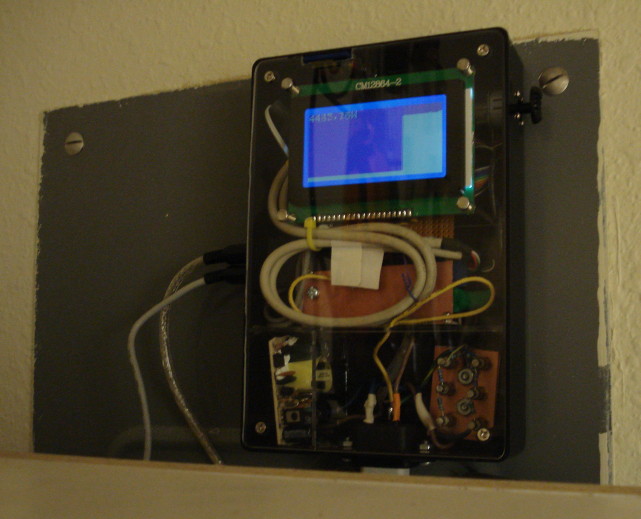
Dan Stahlke built an open source homebrew power usage meter based on the Atmega168. The project stores the measurements on an SD card. Just might be the ticket for monitoring holiday display power usage.
Free PCB Sunday: USB LCD Backpack

We go through a lot of prototype PCBs, and end up with lots of extras that we’ll never use. Every Sunday we give away a few PCBs from one of our past or future projects, or a related prototype. Our PCBs are made through Seeed Studio’s Fusion board service.
On this super-late PCB Sunday we’re giving away two boards for the USB Universal LCD backpack. The backpack controls LCDs with up to 16 interface pins at 3.3volts or 5.0volts, including common HD44780 character LCDs and larger graphical LCDs. This project was developed collaboratively in the forum. See it come to life here, and check out the design history and work-product on the wiki.
Get an assembled USB Universal LCD backpack for $15.
Marine AIS data transmissions
If you live near naviagable waterways, you may want to tune your FM monitor receiver to 161.975 MHz and 162.025 MHz FM. If you hear data bursts, you are able to receive ships sending messages using the Automatic Identification System (AIS). These data transmissions are sent using GMSK modulation, and can be decoded for readout on your Linux computer using programs such as GNU AIS, FreeAIS, and others. Messages include information such as ship position, speed and related data and are sent using the NMEA data standard. To interface your radio receiver with your Linux box would required a connection to your radio’s discriminator output running via patch cable to your computer’s sound card microphone of line-in jack. (Many two-meter amateur radio gear already has the necessary discriminator tap in the form of a packet radio data output connection.)
How to write a flash bootloader for the PIC16 and PIC18

Here’s an application note with comprehensive information on how to write your own bootloader for the Microchip PIC16 and PIC18 families. Microchip also has provided a link to the code development software. Good reading for both the beginner and experienced coder.
Simple current limiter is programmable

rsdio tipped us to an app note on a simple current limiter.
This circuit lets you program a current limit without using microcontrollers or data converters. It consists of a charge-pump voltage doubler (U1), a current-sense amplifier (U2), and two n-channel MOSFETs. The sense-resistor value determines the maximum current limit.
Thanks rsdio!
Peer to peer control network uses TV spectrum white space

New patent application #20100309806 describes a peer to peer radio system designed to utilize the “white space” between TV channels. The system receives data from RF and geolocation sensors and processes them along with information from the FCC’s white space database to assign operating frequencies on a dynamic basis.
New satellites can be monitored on your scanner

The American Radio Relay League (ARRL) has posted a list of frequencies used by new experimental satellites. The birds were launched from Alaska in November, and transmit digital data beacons and relayed communications using the AX.25 protocol. The frequencies are in the 144 MHz and 440 MHz range amateur radio bands and can be received by a regular police/fire/EMS type FM radio scanner. In order to decode the AX.25 protocol data, you would need a special software package such as ham radio apps available for Ubuntu. The satellites are part of a student project from the University of Texas-Austin.
Arduino on an FPGA

Talk about going full circle! Gadget Factory has coded an Arduino core into a Spartan 3E on the FPGA ButterFly platform. This expands your prototyping opportunities, and provides beginners with a familiar FPGA core to build on.
Reverse engineer a LED light bulb

Hack a Day successfully reprogrammed the ATMEGA controller in a commercial LED light bulb. See the reverse engineering in part 1.
Multimeter buying tips

Here’s a tip on buying a multimeter:
I would do a quick function check. Make sure the volt readings go to zero when you short the leads. If there is an AC outlet handy check to see if that reading makes sense. If you have a small battery in your pocket check that too. Make sure the continuity and ohms meter are working open and shorted.
Most meters I have seen either work fine or have obvious problems. Also do a test on the two internal fuses (it’s in the manual) and drop your offering price if either is blown. They are easy to replace but it is a good bargaining point.
You can find all the manuals on Fluke’s site if you haven’t already found them.
Thanks Eric! Via the forum.
Coolrunner-II usage in educational toys

Xilinx outlines how the Coolrunner-II CPLD can be applied in portable educational toy development.
Don’t forget our quick start guide for the Coolrunner-II, it explains the bare minimum circuit you need to get started with this chip.
Fritzing
If you want to try your hand at creating an illustration or PCB of your electronics project, check out Fritzing. It’s an open source GUI based program that allows users to document their prototypes, share them with others, show them in a presentation, and create a pcb layout for professional manufacturing. Windows, Mac and Linux versions available.
STM8L DISCOVERY Board with LCD support

STM released a new STM8L DISCOVERY Board with LCD support (datasheet).
Another new low-cost 8-Bit DISCOVERY board, available now for about US$ 10/10 EUR (depending on the distributor). Includes an onboard ST-LINK programmer/debugger.
Via the forum, thanks IPenguin!
IR Toy: transmission range

spanner888 investigated the signal strength of the IR Toy and came to several conclusions. Check out the pictures of his test rig and testing methodology:
The circuit of the old project I am using to help measure the received signal strength is [here], the article also gives some interesting background on IR that is still relevant.
Via the forum.
Hacking Kinect with a USB analyzer
Ladyada explores the Kinect protocol using a USB analyzer. While we know the Kinect has already been cracked, this is a good example of how USB analyzers can be a helpful (though costly) addition to a workbench.
Christmas music on the Picaxe

If you need a quick source of canned Christmas music in a project, don’t forget the Picaxe line of microcontrollers from Revolution Education. All Picaxe “M” chips have three Christmas tunes preprogrammed and playable using the PLAY command: Jingle Bells, Silent Night, and Rudolph the Red Nosed Reindeer!
Black Hole of Los Alamos surplus

MichaelZ tipped us to Black Hole Surplus, a thrift shop selling hardware waste.
The Black Hole of Los Alamos, a recycler of “nuclear waste,” has the world’s most diverse stock of used scientific equipment, electronics, lab supplies, nuclear by-products, surplus items and materials. We have over 17,000 square feet of pre-owned test equipment and laboratory supplies.
What’s your favorite surplus or dump store? We started a list of personal favorites, add yours.
Altera introduces Max V CPLD

Altera has introduced their Max V family of CPLDs. Features include operation from a single 1.8 volt external supply for device core, internal oscillator, user flash memory block of up to 8 Kbits for non-volatile storage with up to 1000 read/write cycles, and multiVolt I/O interface supporting 3.3, 2.5, 1.8, 1.5 and 1.2-Volt logic levels. In system programming can be accomplished with any of the familiar Altera “Blaster” cables. Single unit prices start under a dollar, and a dev kit will reportedly ship in February. Complete documentation is available on the Altera website.
Trove of STM32 Discovery board tutorials

Here’s an extensive list of STM32 Discovery board tutorials. Examples for displays, and other components, and compiler guides.
Via the comments.
Seeed Studio PCB giveaways

Seeed Studio has even more spare PCBs than we do. They’re donating some of them to PCB sculptor Steven Rodrig for his work (see above). If you’re Seeed’s 20,000th order, you’ll get one of Steven’s sculptures for free.
Soon Seeed will start selling extra PCBs too, just for the cost of shipping. Scrap PCBs are useful for soldering practice, as well as art.