I saw this at a home construction materials show in Taiwan 3D LED cube thing In person they are very impressive. There are vertical strips of SMD LEDs and the light changes color. Amongst patterns they can sort of swirl around like a cloud or school of fish.
If you think the idea of remote monitoring of photocopiers and other office equipment is new, check out U S Patent number 5,822,221. The part about using a DTMF to ASCII converter for communications over a telephone line is really old school.
This RGB LED wall is plays Winamp visualizations, and more. The LEDs are driven by Rainbowduinos, the Rainbowduinos are connected to the PC using the router as a wireless serial connection.
I made this “little” 16×8 RGB LED panel using 2 Rainbowduinos. Each Rainbowduino is capable of driving 8×8 RGB LED’s.
I used firmware neorainbow-0.8 and one Arduino board. The Arduino was attached to an Asus wl500gp wireless router. The router acts as a bridge to my home wireless network.
Drivers for rtl8187b and ftdi are installed on the router. Ser2net relays TCP to the Arduino connected to router USB port.
On the PC side a program “transfers” pixels from the active window to a panel so it can be used as a Winamp visualization, huge ambilight, or whatever…
I have not made any page but here are videos of building process and of panel in work.
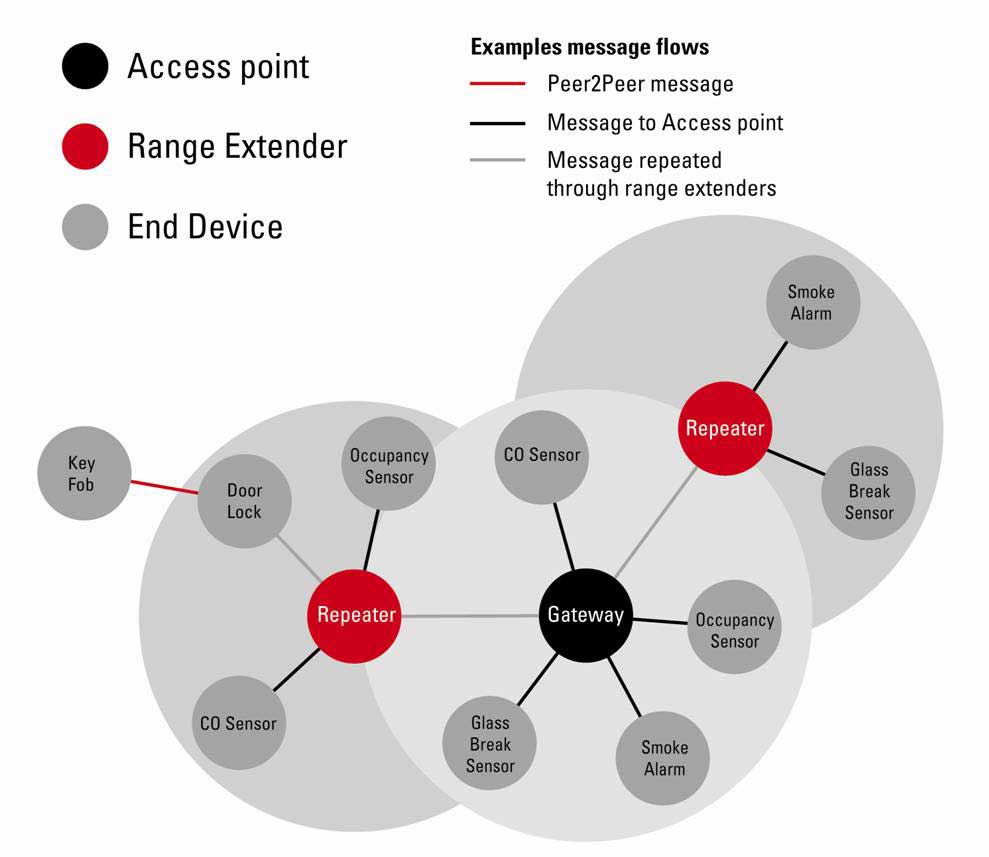
SimpliciTI™ is a low-power RF protocol aimed at simple, small RF networks. This open-source software was designed for easy implementation and deployment out-of-the-box on several TI RF platforms such as the MSP430 family of low-power MCUs and the CC1XXX/CC25XX/CC430 transceivers and SoCs. Access point and range extenders are not required but provide extra functionality such as store and forward messages.
The MSP430G2x32 and MSP430G2x02 series of microcontrollers are ultra-low-power mixed signal microcontrollers with built-in 16-bit timers, and up to 16 I/O touch sense enabled pins and built-in communication capability using the universal serial communication interface. The MSP430G2x32 series have a 10-bit A/D converter.Typical applications include low-cost sensor systems that
capture analog signals, convert them to digital values, and then process the data for display or for transmission to a host system.
Added 1-wire decoder tool. Still experimental, but should be usable
Improved support for OSX Leopard (10.5). Thanks to Brent for testing/verifying this
Some improvements for the limited number of channels when using the BP as capturing device. Thanks to Ian for supplying the BP-binary
Reworked the decoding of RLE-enabled captures, this, among others, should fix the “OutOfMemory” issue & occasional mangling of captured RLE-results. Thanks to Rasmus & Mario for their effort in testing this
Added an option to the I2C decoder tool to disable the auto-detection of SDA/SCL lines. Thanks to Jeff for this
If you’re looking for a quick and dirty means of interfacing high and low voltage logic devices, consider the Texas Instruments CD40109. This CMOS device functions with supply and signal voltages of up to 20 volts, and can either shift voltages up or down depending on the ratio of Vcc (low supply) to Vdd (high supply).
NOTE: The datasheet has a typo at the end of the Description section. It should read, “When operated in the mode VCC > VDD, the CD40109 will operate as a high-to-low level-shifter.”
It sells for less than a dollar in the 16-pin DIP at Digikey.
We go through a lot of prototype PCBs, and end up with lots of extras that we’ll never use. Every Sunday we give away a few PCBs from one of our past or future projects, or a related prototype. Our PCBs are made through Seeed Studio’s Fusion board service.
This week we’re giving away two PCBs for our new MMA7455L breakout board. This chip is an inexpensive 3-axis accelerometer with adjustable 2/4/8G measurement range.
Get the MMA7455L breakout board for $15 at Seeed Studio. That’s about $5 cheaper than other accelerometer breakouts we’ve seen recently.
Robust encryption is often difficult to achieve on a microcontroller given the limited processing power and memory. The Microchip PIC18 series are capable of some forms of limited data encryption. Four encryption algorithms including AES, XTEA, SKIPJACK® and a simple encryption algorithm using a pseudo-random binary sequence generator are described in this application note.
We got a big box of PCBs from Seeed this week. This is an update of the Bus Blaster (in test production now) with a CPLD instead of discrete logic buffer chips.
The CPLD is connected to the secondary JTAG B port of the ft2232. This should make it like a mini CPLD development board, as well as a JTAG debugging tool.
We currently have a bit of an issue because most popular JTAG apps, like URJTAG, only support the ft2232’s JTAG A port. If you have any ideas, or would like to be involved in development or testing, please join us in the forum.
If you want more memory on an Atmega128 project, Scienceprog has a project for expanding the 4 kb internal memory up to 64kb using a 74HC573 to interface a standard memory chip.
If you want to WiFi enable your Arduino but don’t want to spring for a shield, Todbot shows how to use the Asus WL-520gu router. By installing the DD-WRT Linux firmware the Asus acts as a serial-to-network gateway for Arduinos (or most any other USB device).
This the season for good cheer, and what can be more cheerful than a project that’s as much fun to use as it is to build? How about a homebrew alcohol breath tester? Daniel Andrade shows how to build just such a device using just an Arduino, MQ3 alcohol sensor and a handful of resistors and LEDs. While this project is for academic and experimental purposes only, we suggest testing its calibration often.
If your kids are RFID enabled, here’s a project to give you peace of mind: the Kid-e-log by tronixstuff. Using an Arduino, EEPROM, RFID reader, real time clock chip and LCD readout you can keep electronic tabs on the kids by having them clock in and out of the house with RFID cards. A comprehensive project including source code.
Of course, it will only be a matter of time before tech savvy kids hack a real time controlled Arduino/servo combo project to waive the RFID card in front of the reader at predetermined times…