App note: Measuring mains power consumption with the STM32x and STPM01

ST_AN2799

Power consumption measurement using an STM32 micro and the STPM01 power metering IC. App note can be found here

This document describes a software and hardware solution concerning the STM32x microcontroller and the STPM01 power meter for measuring mains power consumption and also provides hardware and firmware guidelines to interface the STPM01 with the STM32x microcontroller.
The system described in this document is the first “brick” to build a complex system for distributed load management.

App note: Audio and waveform generation using the DAC in STM32 microcontroller families

ST_AN3126

App note on utilizing the built-in DAC on your STM32 micro.

This application note gives examples for generating audio output signals using the Digital to Analog Converter (DAC) peripheral embedded in the STM32F10xx microcontroller family.

The STM32 DAC module is a 12-bit word converter, with two output channels for supporting stereo audio.

The DAC can be used in many audio applications such as: security alarms, Bluetooth headsets, talking toys, answering machines, man-machine interfaces, and low-cost music players STM32 DAC can also be used for many other analog purposes, such as analog waveform generation and control engineering.

Last minute chance to join us at soldering school this week!

By ian

Sz-classroom1

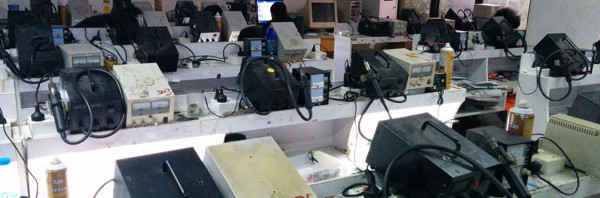
If you didn’t get a ticket to Hacker Camp Shenzhen there’s still a chance to join us at the mobile phone repair school this week. A few people are going to check it out and prepare the translations. This will be the full week-long course, not the abbreviated 2 session version used during the Hacker Camp.

The translator is taking the course too, so there won’t be any interpretation going on. We’ll likely start Tuesday March 11th or Wednesday the 12th. Exact dates depend on our work backlog and can’t be changed, nor will we do this again, so you have to be flexible. Tuition is the full price, 980RMB, rather than the 800RMB group discount they gave us for the Hacker Camp.

This isn’t worth flying in for, but if you’re already around and want to be involved we have room for a couple very independent learners. Please hit me up via the contact form.

Via Hacker Camp Shenzhen mini-site: Last minute chance to join us at soldering school this week!

App note: Modbus TCP for the Microchip TCP/IP Stack

appnote

Here’s another application note from Microchip – Modbus TCP for the Microchip TCP/IP Stack  (PDF!)

Modbus® is an industrial Transmission Control Protocol
(TCP) used for remote monitoring and control
applications. This application note describes a basic
Modbus TCP server implementation and how it can be
extended in a Modbus application.
The application software that accompanies this
document was developed using Microchip’s TCP/IP
stack (v5.42) as a base framework. Although the
software was developed using the PIC32MX360F512L
microcontroller, it is easily ported to other PIC
microcontrollers that support TCP/IP functionality

App note: Using the PIC16F1XXX High-Endurance Flash Block

app_note

An application note from Microchip: Using the PIC16F1XXX High-Endurance Flash Block (PDF!)

This application note illustrates the benefits offered by
the high-endurance Flash block and describes a small
C library which allows a simple and safe use of its
capabilities.

Stream Launchpad data serially using NodeJs

nodejs_launchpad_serial_port_msp430_linux

zlalanne over at the 430h forum writes:

I created a quick project to start learning nodejs. To those that are unfamiliar nodejs allows you to write javascript for the server side. So I decided to write a small gui that plots serial data. The GUI itself is written in javscript/html and uses node-webkit to package it into a .exe file (or the correct package for your os).

This could easily be extended to visualize a lot more I/O from the launchpad, and given that the GUI is written in html/javascript it is really easy to create new elements. Here is the source

Via 43oh.

Simple fix for Bus Pirate power supply oscillations

8503210456_806d594d89_o

Jeff of Mightyohm wrote an article about power supply oscillations on the Bus Pirate:

After removing my device under test, I quickly narrowed the problem down to noise on the Bus Pirate’s 3.3V rail. I initially suspected that this might be some kind of noise coming from the 5V USB supply, so I added an additional 10uF cap in parallel with the 1uF already on the board (C1). The sawtooth increased drastically in amplitude and went down sharply in frequency. That’s when I realized that this wasn’t noise, it was a power supply oscillation.

Open source data logger for biodiversity research


Ed Baker of the Natural History Museum, London, UK, has published a paper outlining his build of an open source hardware data logger for scientific purposes. “Proprietary data loggers can be expensive – for example a three channel data logging system is available from Alphatemp for £465.00. Such costs make large scale deployment of such systems unaffordable for all but well funded projects. This project aims to create an open source and open hardware data logger making use of the widely available Arduino prototyping platform.”

The 19 page report in PDF can be found at PenSoft publishers.

Project details can be found on Ed Baker’s blog, with the Arduino code posted on GitHub.

Via Science Blog 2.0.

Free PCB coupon via Facebook to 2 random commenters

buspiratev38

Every Friday we give away some extra PCBs via Facebook. This post was announced on Facebook, and on Monday we’ll send coupon codes to two random commenters. More PCBs via Twitter on Tuesday and the blog every Sunday.

Don’t forget there’s free PCBs three times every week:

Continue reading “Free PCB coupon via Facebook to 2 random commenters”

Week in (p)review March 07, 2014

IMG_5120_1024x768_95-600x450

Here’s a summary of major developments over the last week. Free PCB Friday is coming up soon.

Coming up:

  • Free PCBs via Facebook on Friday
  • App notes on the weekend
  • Free PCB Sunday
  • Free PCBs via Twitter on Tuesday
  • Weekly roundup and preview every Friday

Using Kinetis Micrcontrollers in low-power applications

tandem

Sergei Bezrukov wrote an article on using Kinetis Micrcontrollers in low-power applications:

Let us now turn to the microcontroller MKL05Z32. It belongs to the entry level subfamily KL0 of the Kinetis family. Besides of the fine pitch QFN and 48LQFP packages it is also manufactured in easily solderable 32LQFP ones. The microcontroller can be clocked on up to 48 MHz frequencies and is equipped with a reach set of peripherals including 12-bit ADC and DAC, DMA, UART, I2C, SPI, and others. For our applications we are mostly interested in the low-power CPU modes. ARM requires implementation of at least 3 CPU modes: RUN, Sleep, and Deep Sleep. However, the manufactures usually add more CPU modes, particularly low-power ones. Our microcontroller has totally 10 CPU modes, out of which we are interested in 3 of them: VLPR (Very-Low-Power Run), VLPS (Very-Low-Power Stop), and LLS (Low-Leakage Stop). In the VLPS and LLS sleep modes the CPU consumes about 3.8 and 1.8 μA with running timer, respectively, and wakes up from sleep in 4 μsec. The left picture below shows a breakout PCB for the microcontroller, while the right one shows a test thermometer project. The temperature is displayed in °C.

DIY CNC machine called the Ripper

DCIM100GOPRO

Maximilian Malihas built this cool CNC machine called the Ripper:

The 3-Axis CNC was not designed for a specific application – ripper fusions the needs required for fast shape-cutting in wood/PVC and the strength and stiffness required for milling in aluminum and copper. It brings the precision down to fractions of the human hair – and can be build using simple tools!

Via Hacked Gadgets.

Add functions to your Dotklok: Remote control

DotKloK3

Boris Landoni  from Open Electronics writes about the Dotklok’s new feature, the addition of a remote control. We wrote about it previously here:

The latest variation is the addition of a remote control, implemented with a few lines of code. This function allows you to read the signals sent by the common IR remote control used in TV, decoder, etc.. With this change you can make most of the Dotklok functions controllable remotely, as to replace the remote control buttons to buttons already present.
In the code examples provided by the creator, the remote control allows you to switch from animation to another while sitting on the couch, or, still remotely, turn off the light sensor to set manually the display brightness. In fact , once a sensor and a sketch that reacts to pressing any button of any remote control introduced, the only limit on the introduction of new functions, it your creativity.

Breakout module for Si7005 temperature and humidity sensor

Si7005breakout3

Raj of Embedded Lab has written up documentation on his  Si7005 breakout board:

The Si7005 is a digital relative humidity and temperature sensor from Silicon Labs. It integrates fully factory-calibrated humidity and temperature sensor elements with an analog to digital converter, signal processing and an I2C host interface in a single monolithic CMOS sensor IC. The Si7005 is available in a “non hand-assembly-friendly” 4×4 mm QFN package, which requires reflow soldering to mount it on a PCB. This breadboard friendly breakout board is designed to make your prototype project with the Si7005 sensor much easier. It can be used with PIC, Arduino, or any other microcontroller development platform through an I2C bus. The power supply and I2C signal pins are accessible through breadboard friendly 0.1″ pitch header pins. Note that the Si7005 sensor is not 5.0V tolerant. It must be operated at 2.1-3.6V power supply.

DIY Arduino SVG plotter

DIY-Arduino-SVG-Plotter

Here’s a DIY Arduino SVG plotter by  Junk+Arduino:

Junk (the hardware):

  • Olde Epson printer: frame, two stepper motors, motor driver circuitry
  • CD player: The laser head moving mechanism
  • Desktop compy PSU as a 5V power supply
  • One H-bridge – SN754410NE
  • Some resistors
  • Bits of wire and a small breadboard
  • Arduino uno, computer and pen

Via Hacked Gadgets.

Colour sensor project

dsc07101

Iamzxlee has written an article detailing his colour sensor project:

Basically, the sensor consists of three LEDs and Light Dependent Resistor (LDR). The LDR will detect the colour and display it to another RGB LED. Besides display it on the RGB LED, the colour will also display on PC. RGB LED is commonly used in display colours on LCD or OLED such as the monitor and television.
There are actually many methods to detect colour, but using only LED and LDR should be the cheapest way to do this job. Let me explain how this sensor works. First, the LDR has to detect the contrast between black and white surface. To detect the colour, each LED takes turn to shine onto the surface and the Arduino will read the voltage on LDR.

Check out the video after the break.

Continue reading “Colour sensor project”