Web platform and Thermal Tweeter wireless tethering

The Thermal Tweeter needs a wired ethernet internet connection to get tweets. At the Open Hardware Summit and Maker Faire we’ll be lucky to have wifi. Likely we’ll need to use a 3G wireless connection. We need a way to bridge the wireless data services to a wired connection.

Today we picked up a cheap router and tested the setup:

  1. A smartphone relays 3G or wifi internet to a netbook over USB
  2. A netbook connected to a router via ethernet shares the internet connection
  3. The web platform connects to the router and pulls tweets from Twitter

More about our setup and prep below the fold.

Continue reading “Web platform and Thermal Tweeter wireless tethering”

eLabBench digital laboratory workbench

Researchers at the Interdisciplinary Nanoscience Centre (iNANO), Aarhus University, have just started using a combined computer and laboratory bench. This will not only streamline their research, but also kickstart the transition to the paperless laboratory.

The bench is essentially a large touchscreen with combined capabilities allowing researchers to simultaneously work with data and equipment while documenting research. It incorporates recognition of lab equipment such as flasks, a video camera, and RFID tracking of test tubes and materials. Built-in networking allows for real time collaboration on projects with researchers in remote facilities.

While the video is narrated in Danish, the usefulness of this device is easy to realize from the visuals.

Via Aarhus University, Faculty of Science.

What exactly does bit banging mean?

ipatch asks:

I recently watched this series of videos on Youtube, and the presenter refers to bit banging in one of the videos. He says specifically he had to bit bang 64MB of RAM in a 16MB window. How is this important, and could the bus pirate have been used for this sort of procedure?

There’s a chip and he has to get data in and out of it with another chip. There are two ways to do it. One is special hardware inside a microcontroller: you give it some data and it automatically moves output/input pins in the right way to talk to the chip. If your controller doesn’t have special hardware, you can write software that moves the pins instead. Software is usually much slower, and it is refereed to as bit banging because code is manipulating (banging) the pins instead of hardware.

It is the method of moving pins up and down, not the data, that differs in bit banging. To bitbang means that you do whatever protocol in software, instead of with specialized hardware.

The Bus Pirate I2C and raw2- and 3- wire modes are all bitbanged, they are done with software routines and not specialized hardware.

#FreePCB via Twitter to 2 random RTs

Every Tuesday we give away two coupons for the free PCB drawer via Twitter. This post was announced on Twitter, and in 24 hours we’ll send coupon codes to two random retweeters.

Don’t forget there’s free PCBs three times a every week:

  • Hate Twitter and Facebook? Free PCB Sunday is the classic PCB giveaway. Catch it every Sunday, right here on the blog
  • Tweet-a-PCB Tuesday. Follow us and get boards in 144 characters or less
  • Facebook PCB Friday. Free PCBs will be your friend for the weekend

You can get a Bus Blaster v2 for $34.95.

Continue reading “#FreePCB via Twitter to 2 random RTs”

Open 7400 Logic Competition update

Logos Electromechanical LLC

The Open 7400 Logic Competition is in full swing. The list of prizes is has gotten amazing, and today we announced that Dave Jones from the EEVBlog will be a judge. Also check out the The Amp Hour coverage of the Competition.

Here’s the list of swag that’s up for grabs:

Prizes will be spread out as much as possible. There will be prizes for notable entries that don’t make it to the final cut too. More prizes are being added as we find new sponsors, and we’ve got some HUGE new sponsors to announce in the coming days.  Many thanks to all our sponsors. If you’d like to sponsor the contest, please drop us a note via the contact form.

Please give a big thanks to SQKYbeaver, a blogger and forum regular. He conceived and organized the competition. We are extremely grateful for his hard work that made the competition such an amazing success. It would not have been possible without him.

There have been many questions relating to the rules specifically to “What am I  allowed to use?” and “Are pre-existing projects OK?”  We just want to have fun, you are allowed to use anything you want.

We want everyone who is interested to be able to compete and have fun while doing so. If you want to wire wrap a Apple ][ clone, go ahead. If you want to use a single 7400-series AND gate to synchronize a dual power supply, beautiful! Judges will look for cool uses of logic chips and well documented projects. The most complicated entry is not necessarily a guaranteed win. Here’s what the judges will be looking for:

  • Originality. A smart new design that inspires
  • Documentation. Schematics, theory, pictures and/or video,
  • (Mis)use of 7400 logic. Show us what 7400 logic was (never) meant to do
  • Technical prowess
  • Build quality
  • Imagination and creativity

Stay tuned in to the Open 7400 Logic Competition, as we add more prizes, announce new judges, and continue to post general updates. Thanks to everyone who has already entered, we’ll start posting the entries daily.

RS-485 and Arduino

As seen in the above illustration from National Instruments, RS-485 ports are identical in appearance to RS-232 but with different pin assignments. You will not find them on contemporary home computer hardware, and they are only rarely seen on legacy machines. They are, however, found on various types of commercial computer and telecom equipment and if you want to explore such devices you’ll need a way to communicate with RS-485 ports. (For example, we recently encountered one while exploring a Harris Communications OpenSky base station controller/transceiver.)

According to the Wikipedia entry:

EIA-485, also known as TIA/EIA-485 or RS-485, is a standard defining the electrical characteristics of drivers and receivers for use in balanced digital multipoint systems. The standard is published by the ANSI Telecommunications Industry Association/Electronic Industries Alliance (TIA/EIA). Digital communications networks implementing the EIA-485 standard can be used effectively over long distances and in electrically noisy environments. Multiple receivers may be connected to such a network in a linear, multi-drop configuration.

Continue reading “RS-485 and Arduino”

chipKIT followup and interview with elektroniktidningen

Swedish publication elektroniktidningen did a short interview and writeup [machine translation] about our chipKIT editorial. Here’s the English Q&A from our emails:

Did you get any feedback from Microchip on this issue?

The other companies involved in chipKIT – the hardware designer, the software developer – left comments on the article. Nobody from Microchip has contacted us. Microchip is a huge company, and our contacts are all in the chipKIT group. They all pushed for the open source drivers too, it was other parts of the company that said no. We really support what the chipKIT group is trying to do, and hoped that writing about this raised awareness of the roadblocks they face. The part of Microchip pushing closed source stuff on chipKIT should know that their customers, and the community they’re marketing to, are aware of the issue and expect better.

The blog entry is from end of August, do you still stand behind it? Weighing in in the comments you received om your blog post – did that move your position? How would you state your position?

Despite getting lots of anti-Microchip comments, the editorial wasn’t too critical. It’s easy to stand behind. We don’t expect Microchip to make anything open source at all, most companies don’t! We’re disappointed that they didn’t follow through on their marketing hype and support chipKIT with open source software and drivers.

Continue reading “chipKIT followup and interview with elektroniktidningen”

Itead Studio OpenPCB service: In search of OS PCB part 2

Yesterday we tracked down the designers of two random open source PCBs we received from Itead’s OpenPCB service. Today we look at two more PCBs: a reprap board, and one of our own.

Itead has a PCB exchange option when you order boards. For 10 cents extra you get 2 different open source PCBs from other designers. We decided to take our chance and see what kind of PCBs we receive.

We sent two 5×5 designs, so we received 4 extra boards from the exchange. In this series we cover which boards we received, and we hunt down the makers and get the story behind the board.

Continue reading “Itead Studio OpenPCB service: In search of OS PCB part 2”

The Resistor JelTone: an edible toy piano

A group from  NYC Resistor (Ranjit Bhatnagar, Astrida ValigorskyMimi Hui and Catarina Mota) made an edible toy piano, called The Resistor JelTone, for the Jello Mold Competition.

As part of our experiments we realized that jello and fruit, which contain a lot of water, are conductive. Embedded in each jello/fruit key is a sterling silver pin (food safe) connected to an Arduino microcontroller underneath the piano’s base. Below the piano’s case is another sterling silver pin. With this setup, the JelTone can either be played with a metal utensil connected to the Arduino, gloves enhanced with conductive thread, or bare hands by touching both a key and the piano’s case.

This project is open source with all the files hosted on Thingiverse.  It could be interesting to see other applications for using the resistance in food to control electronics projects.

Via Twitter (@openMaterials)

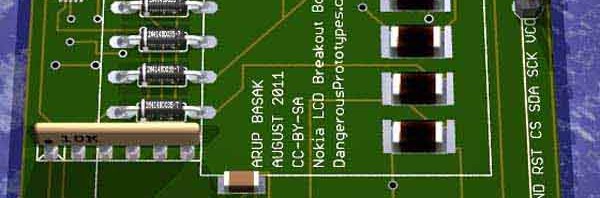
Simple Nokia LCD breakout board

Arup wrote a guest post about his Nokia LCD breakout board:

I designed a simple Nokia LCD Breakout board which allows you to interface any Nokia 6100 compatible display to microcontroller like PIC and AVR. The board itself provides 6.8volts for the backlight by a simple boost converter built up using a common 555 timer IC. There’s a switch to choose whether you want to work with 5V logic, or with 3.3V logic.

Reasons I started this project:

  • Color Nokia LCDs are inexpensive.
  • Currently available breakout boards are too costly. Sparkfun has one at 35$.
  • With selected parts and the LCD, the total cost of parts comes in 5$. If we consider 1$ for board, then it barely costs 6$. **Cost may differ from countries to countries.

Continue reading “Simple Nokia LCD breakout board”

ITead Studio OpenPCB service: In search of OS PCBs part 1

Some time ago we reported on Itead’s OpenPCB Service. They offer basic PCB prototyping  of 10pcs 5x5cm PCB for $9.90 and 10pcs of 10x10cm for $24.90. For 10 cents extra you can participate in a PCB exchange. 2 extra boards of your design are produced and put into a pool, and you get 2 different open source PCBs in return. We decided to take our chance and see what kind of PCBs we receive.

We sent two 5×5 designs, so we received 4 extra boards from the exchange. In this series we cover which boards we received, and we hunt down the makers and get the story behind the board.

Continue reading “ITead Studio OpenPCB service: In search of OS PCBs part 1”

InkShield: open Open source inkjet shield for Arduino


Nicholas C. Lewis is developing an interesting Kickstarter project known as the InkShield.

This shield allows you to connect a HP C6602 inkjet cartridge to your Arduino turning it into a 96dpi print platform. It only uses 5 pins which can be jumper selected to avoid other shields. It is designed with a Arduino Mega footprint but fully supports both the Arduino and the Arduino Mega. It is designed with all through-hole components to make assembly easy even for beginners.

The project is mostly funded and it looks like Nicholas has done a lot of work on this design, including an on-board 18.5V boost converter for the Inkjet head. He states that all hardware and software code will be released when the initial production run is completed.