
We go through a lot of prototypes, and many are not perfect the first time around. Here is a pic of one of our prototypes that had 2 pins cross-connected. The simplest solution was to cut the offending traces and reroute the signals with wire and tape.
Category Archives: hacks
Netgear hack note
Lloyd Atkinson writes: I was recently researching the possibility of running OpenWRT on one of my Netgear Wireless access points. I came across a Netgear page that has available TAR files of source code for hundreds of their devices! So far, it appears that Netgear uses BusyBox Linux on their devices. I just thought some […]
Bus Pirate 802.15.4 ZigBee sniffer tools
Bruno hacked his Bus Pirate to be a ZigBee sniffer. He built a small protoboard adapter that connects the Microchip MRF24J40 module to the Bus Pirate IO header. He also wrote custom firmware that captures IEEE 802.15.4 traffic, and passes it on to a custom client app over USB. Check out his wiki page for […]
Hacking the FPGA bitstream
Squok writes referring us to several documents he’s found regarding hacking the bitstream in secure FPGAs: In order to protect the intellectual property and to prevent fraud, e.g., by cloning an FPGA or manipulating its content, many current FPGAs employ a bitstream encryption feature, which is advertised by manufacturers as “making it virtually impossible for […]
Reprogramming USB Webkey dongle using Bus Pirate
JJShortcut took one of the webkey USB devices his school was discarding and decided to reverse engineer it. The device plugs into the USB port on a PC and when its on-board button is pushed it opens the computer’s web browser, directing the user to a specific URL. He found that the heart of the […]
Wardriving for ZigBee
Travis Goodspeed has assembled this wardriving project covering the ZigBee wireless protocol. It is designed around the radio module from the TelosB, which is used to sniff for nearby ZigBee/802.15.4 transmissions. This module is connected via serial to a Roving Networks RN42 module which provides a Bluetooth connection to the Nokia N9. Travis’ GoodFET firmware […]
Reverse engineering car parking sensors
James decided to reverse engineer car ultrasonic parking sensors. These sensors have integrated electronics that handle all the measurements. They are connected to the car’s internal computer via a low-speed single wire CAN network. James provides pinouts, protocol interface, and some source code to interface with them. Since I know a thing, or two, about […]
Pager network snifffing
Kenneth tapping a pager’s output to sniff pager traffic. He bought an old pager and was happily surprised that he could easily tap into the demodulated digital signal. A little poking around between the circuit boards and Google and I found that this pager uses the Toshiba TA31142 FM detector specifically designed for pagers. What […]
Home automation using power line signaling protocols
Darco is evaluating home automation systems for his new house. Devices will be controlled over a power line signaling protocol like X10 or UPB power-line signaling. He seems set to use the more advanced, well documented, and more expensive UPB protocol. To circumvent the hefty price-tags of UPB equipment, he is designing his own device […]
Hacking an infrared cooker for pcb reflow
SadE is exploring the possibility of building a reflow oven from an IR cooker. He was able to implement a simple switching temperature control and get some initial temperature response results. A graph of his first run is below. I received my oven 2 days ago and modified it in order to get temperature over […]
Re-purposing an LCD from a cheap picture-frame key chain
Here is a hack to extract, and use the LCD from a cheap picture-frame key chain. The project involved desoldering the LCD from its mainboard and building a breakout for it. With the help of a DSO it was possible to find out the pin-out for the LCD. The AVR library used to drive this […]
DIY surface mount to through-hole “blob” hack
Victor converted an SMD IC into a through hole device using perfboard, wire, and lots of hot glue. Wire from each lead is soldered to pinheader mounted through a perfboard, and everything is held in place with a giant squeeze of hot-glue.
The phone box
Nerdindustries is a small innovations lab from Hamburg, Germany. They were looking for a novel way for members of their inner circle to be able to call them literally at the touch of a button. Their effort led them to disassemble a cellphone and rewire the components, adding an amplifier (3.5 watt), a delay controller […]
Measuring hexacopter rotor speed with Logic Sniffer
Philip Peter has made a somewhat unconventional use of the Open Bench Logic Sniffer. Recently we suspected that one motor of our hexacopter had been damaged in a crash. Since removing the motor requires almost the complete disassembly of the copter I started thinking of ways to test the motor in place. In this article […]
Arduino-controlled espresso machine
Gleb Polyakov and Igor Zamlinsky of Atlanta, GA have designed this proportional-integral-derivative (PID) controlled espresso machine. Based upon their observations after reverse engineering a number of espresso units, the pair worked on developing a machine which would be reasonably priced, open source, be espresso pod compatible and have a PID controller. Temperature and pressure are […]
Nook Tablet hardware protection hacked with the Bus Pirate
The Nook Tablet hardware protection was hacked with some help from the Bus Pirate. The Bus Pirate was used as a simple USB to UART bridge so nook hackers can talk directly to onboard ICs and bypass the standard bootloader. The device was released allowing ADB to be accessed. Barnes and Nobel quickly patched this […]
Simple analog programmable load
Here is a simple programmable load. It’s basically a constant current sink that is controlled through a pot. The current is sunk through a high power FET which needs to be cooled to function properly. Here’s a link to a *really* simple linear constant current sink i put together This design is about as simple […]
Turning your Flash Destroyer into a clock
Ok, so you burned all the memory chips you had around, and now a nice 7-digit display is standing on your desktop just taking up space. This hack turns your unused Flash Destroyer into a clock using a real time clock IC and some spare logic. Via the forum.
PSoC3 system on chip dev-board: SSOP IC soldered
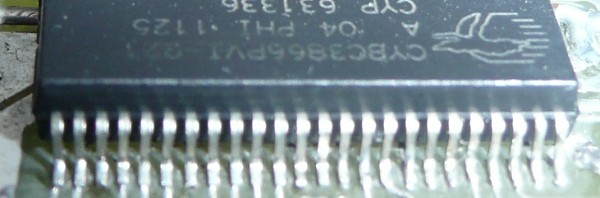
Kartik soldered the first prototype of his PSoC3 development board. He used a no-solder soldering technique to solder the SSOP IC. He had great success with this technique, after destroying a few PCBs with his old method. Things didnt go that well on the first board I tried out,mainly due to me using the wrong […]
Dot-dash-diss: The gentleman hacker’s 1903 lulz
Fans of tech history may want to read Dot-dash-diss: The gentleman hacker’s 1903 lulz. This article appears on the NewScientist website and reveals that wireless hacking dates back to the time of Marconi! Any you thought you were onto something new with a walkie talkie on the frequency of the drive-thru order window…