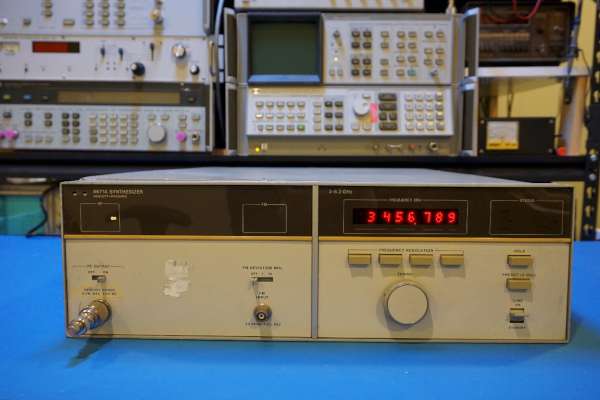
Teardown of an HP 8671A microwave frequency synthesizer

p-HP8671A-600

Kerry Wong did a teardown of an HP 8671A microwave frequency synthesizer:

I recently bought an HP 8671A microwave frequency synthesizer on eBay. This synthesizer can generate signals from 2GHz to 6.2GHz with an unleveled output of more than 8dBm. It is a nice complement to my HP 8642B signal generator and Wavetek 907 signal generator. Using these generators, I can now generate signals of pretty much any frequencies under the 12GHz range. A video of this teardown is linked towards the end of this post.

More details on his blog here.

Check out the video after the break. Continue reading “Teardown of an HP 8671A microwave frequency synthesizer”

Free PCB Sunday: Pick your PCB

BP-600x373

We go through a lot of prototype PCBs, and end up with lots of extras that we’ll never use. Every Sunday we give away a few PCBs from one of our past or future projects, or a related prototype. Our PCBs are made through Seeed Studio’s Fusion board service. This week two random commenters will get a coupon code for the free PCB drawer tomorrow morning. Pick your own PCB. You get unlimited free PCBs now – finish one and we’ll send you another! Don’t forget there’s free PCBs three times every week:

Continue reading “Free PCB Sunday: Pick your PCB”

App note: Understanding infrared diode power ratings

an_ttelectronics_ir_specs

App note from TT Electronics about infrared diode specs, how they vary from different manufacturers, and help clear things about infrared definition of parameters. Link here (PDF)

Infrared emitting diode power measurement is dependent upon a number of variables which must be precisely defined in order for design engineers to utilize data sheet information. Manufacturers differ not only in the techniques used in measuring power, but also in their interpretations of the definitions of the parameters which are measured. This application bulletin is intended to clarify this misunderstanding, especially for GaAs and GaAlAs solution grown epitaxial devices.

App note: Linear and rotary encoders are evolving to meet demands

an_ttelectronics_rotary_encoders

Application notes from TT Electronics on optical encoders versatile sensing. Link here (PDF)

Linear and rotary encoders have come in a wide variety of design styles over the years, the most common being rotary switches, potentiometers, capacitive, magnetic, and optical types. The optical encoder has become the most popular of these encoding methods due to its long life, simplicity of construction, versatility, high accuracy and high resolution. This application bulletin will briefly define an optical encoder, and bring the designer up to date on encoder terminology, design techniques and limitations.

Bus Pirate v3.8 PCB build

p-bp-600

@EnJens tweeted, “Finally programmed my DYI Bus Pirate 3.8! It mostly works! Self test is slightly sad and power LED failing but it works!”

If you build a free PCB we’ll send you another one! Blog about it, post a picture on Flicker, whatever – we’ll send you a coupon code for the free PCB drawer.

Get your own handy Bus Pirate for $30, including world-wide shipping. Also available from our friendly distributors.

Free PCB coupon via Facebook to 2 random commenters

IRToy-600x369

Every Friday we give away some extra PCBs via Facebook. This post was announced on Facebook, and on Monday we’ll send coupon codes to two random commenters. The coupon code usually go to Facebook ‘Other’ Messages Folder . More PCBs via Twitter on Tuesday and the blog every Sunday. Don’t forget there’s free PCBs three times every week:

Continue reading “Free PCB coupon via Facebook to 2 random commenters”

Yellowstone: Cloning the Apple II Liron

yellowstone-in-600

Steve writes:

FPGA-based disk control for Apple II is finally working! Six months ago, I began designing a universal disk controller card for the Apple II family. Apple made a bewildering number of different disk controller cards in the 1970s and 80s, and my hope was to replace the IWM chip (Integrated Wozniak Machine) and other assorted ICs typically found on the cards, and substitute a modern FPGA. With a little luck, that would make it possible to clone any vintage disk controller card – some of which are now rare and expensive. It would also enable a single card to function as many different disk controllers, simply by modifying the FPGA configuration. With the successful cloning of a Liron disk controller, the first major step towards those goals has been made.

More details at Big Mess o Wires site.

Check out the video after the break.

Continue reading “Yellowstone: Cloning the Apple II Liron”

STM32F103 vs GD32F103 round 1: Solderability

stm32vsgd32_boards-1080x675-600

Sjaak writes:

I locked myself into the basement with a couple of PCBs, chips and fresh flux for a couple of days. For the STM32F103 vs GD32F103 challenge I needed to have two identical boards with a different microcontroller. As far as I could judge both chips are legit and not counterfeits as we bought both chips from (different) reputable sellers. The used chips are GD32F103CBT6 and STm32F103CBT7. The STM32F103CBT7 is the industrial rated part of the STM32F103CBT6 and is identical except for the temperature range.

More details at smdprutser.nl.

Measuring USB power cable voltage drop with my DC load

p-dcload_built-600

Dr. Scott M. Baker published a new build:

This started when one of my raspberry pi projects failed due to voltage drop on the USB power cable that I was using, so I set out with my power supply and DC Load to measure the voltage drop of various cables that I use in my lab

More details on his blog here.

Check out the video after the break. Continue reading “Measuring USB power cable voltage drop with my DC load”

#FreePCB via Twitter to 2 random RTs

BP

Every Tuesday we give away two coupons for the free PCB drawer via Twitter. This post was announced on Twitter, and in 24 hours we’ll send coupon codes to two random retweeters. Don’t forget there’s free PCBs three times a every week:

  • Hate Twitter and Facebook? Free PCB Sunday is the classic PCB giveaway. Catch it every Sunday, right here on the blog
  • Tweet-a-PCB Tuesday. Follow us and get boards in 144 characters or less
  • Facebook PCB Friday. Free PCBs will be your friend for the weekend

Some stuff:

  • Yes, we’ll mail it anywhere in the world!
  • Check out how we mail PCBs worldwide video.
  • We’ll contact you via Twitter with a coupon code for the PCB drawer.
  • Limit one PCB per address per month please.
  • Like everything else on this site, PCBs are offered without warranty.

We try to stagger free PCB posts so every time zone has a chance to participate, but the best way to see it first is to subscribe to the RSS feed, follow us on Twitter, or like us on Facebook.

Multicolor signal light with beeper

ljuc3-600

Multicolor signal light with beeper for ROS by Gal Pavlin

When debugging algorithms in an autonomous vehicle a light that can show algorithm state in real time was proven to be effective for easier debugging and additional insight to what is going on in the code.
Because all existing signal light were either to bulky or too expensive we decided to build our own. It was actually quite simple with few key elements:

  • 3x RGB LED strip
  • STM32F0 microcontroller with native USB support
  • Beeper

Via Mare & Gal Electronics.

Check out the video after the break.

Continue reading “Multicolor signal light with beeper”

Troubleshooting tips: Failed debugging with GDB

problem-occured-version

Erich Styger writes:

Three years ago I published “Debugging Failure: Check List and Hints” and unfortunately this article is one of the most popular ones: obviously debugging problems are very common. Debugging with GDB works usually fine, but if things are failing, then it can be hard to find the cause for it. Recently I have been asked to check some failures, so here are two more hints about what could go wrong…

More details at MCU on Eclipse blog.


App note: Measuring inrush current

an_aimtec_inrush

Inrush current evaluation from Aimtec. Link here

In AC/DC power converters beyond a few watts, during the initial application of power an excessive inrush current will flow when the input capacitors are suddenly charged. If unhindered the inrush current can easily exceed 50 A at the peak of the AC cycle and severely stress the converter’s fuse and input rectifiers, thereby significantly reducing the reliability and life expectancy of the modules. Universal power supplies (supplies which accept a wide range of input voltages) are particularly susceptible to high inrush current since their input capacitors must be large enough to handle line voltages as low as 110 VAC, as well as voltages as high as 305 VAC at start-up. In these environments, a power-supply failure or a tripped circuit breaker can be inconvenient at best, and expensive or dangerous at worst.

Free PCB Sunday: Pick your PCB

BP-600x373

We go through a lot of prototype PCBs, and end up with lots of extras that we’ll never use. Every Sunday we give away a few PCBs from one of our past or future projects, or a related prototype. Our PCBs are made through Seeed Studio’s Fusion board service. This week two random commenters will get a coupon code for the free PCB drawer tomorrow morning. Pick your own PCB. You get unlimited free PCBs now – finish one and we’ll send you another! Don’t forget there’s free PCBs three times every week:

Continue reading “Free PCB Sunday: Pick your PCB”

App note: Pulse width modulation (PWM) vs. Analog dimming of LEDs

an_aimtec_led_dimming

App note from Aimtec on dimming LEDs. Link here

With the phenomenal growth of the LED lighting market, there has been a natural growth in demand for highly efficient and controlled LED drivers. Applications from ‘smart’ street lights, flashlights, digital signage and many others require not only highly regulated currents, but in many cases dimming capability in order to sustain the energy efficient scheme and end use flexibility behind LED design.

As there are several ways to achieve dimming of an LED, we describe here the main methods that are used to provide dimming for LED’s from a switch mode LED driver.

Free PCB coupon via Facebook to 2 random commenters

BP

Every Friday we give away some extra PCBs via Facebook. This post was announced on Facebook, and on Monday we’ll send coupon codes to two random commenters. The coupon code usually go to Facebook ‘Other’ Messages Folder . More PCBs via Twitter on Tuesday and the blog every Sunday. Don’t forget there’s free PCBs three times every week:

Continue reading “Free PCB coupon via Facebook to 2 random commenters”

STM8 Microcontrollers

Hardware

Here’s a three-part series of posts by Shawon Shahryiar detailing the STM8 microcontrollers:

STM8 microcontrollers are 8-bit general purpose microcontrollers from STMicroelectronics (STM). STM is famous mainly for its line of 32-bit ARM Cortex microcontrollers – the STM32s. STM8 microcontrollers are rarely discussed in that context. However, STM8 MCUs are robust and most importantly they come packed with lots of hardware features. Except for the ARM core, 32-bit architecture, performance and some minor differences, STM8s have many peripheral similarities with STM32s.

Read the full post at Embedded Lab’s blogPart 1 and Part 2 are also available.

Check out the video after the break. Continue reading “STM8 Microcontrollers”

Custom 3D printed magnetic encoder disks for robotics projects

3d-printed-magnetic-disk-encoders

A how-to on making a custom DIY magnetic disk encoder by Erich Styger:

I’m making great progress with the firmware for the new Mini Sumo Robot (see “New Concept for 2018 Mini Sumo Roboter“). The goal is a versatile and low-cost Mini Sumo robot, and the robot comes with the feature of magnetic position encoders. In a previous article I have explained how to mold custom tires for robots (see “Making Perfect Sticky DIY Sumo Robot Tires“), this article is about how to make DIY Magnetic disk encoders.

Via MCU on Eclipse.

ESP8266 Wi-Fi button – DIY Amazon dash button clone

p-wi-fi-button-thumbnail-jpg-600

Rui Santos over at Random Nerd Tutorials posted a step by step guide on building an ESP8266 Wi-Fi button:

In this project you’re going to build an ESP8266 Wi-Fi Button that can trigger any home automation event. This is like a remote control that you can take in your pocket or place anywhere that when pressed sends out an email. It can also be called a DIY Amazon Dash Button clone.

Check out the video after the break. Continue reading “ESP8266 Wi-Fi button – DIY Amazon dash button clone”

Yellowstone JTAG debugging

p-20180117_143337-600

A follow-up to the FPGA-based disk controller for Apple II post, Steve writes:

After a month of inactivity, I finally returned to my unfinished Yellowstone disk controller project to investigate the JTAG programming problems. Yellowstone is an FPGA-based disk controller card for the Apple II family, that aims to emulate a Liron disk controller or other models of vintage disk controller. It’s still a work in progress.
Last month I discovered some JTAG problems. With the Yellowstone card naked on my desk, and powered from an external 5V supply, JTAG programming works fine.

More details at Big Mess o’ Wires.