Free PCB Sunday II: Second Christmas special

Happy Boxing Day!

Today we’re also giving away some of Sjaak’s SOIC Dangerous Prototyping boards, used in the 74F138 Xmas demo yesterday.

This is a specially designed SMD prototype board for working with SOIC parts. It has footprints for:

  • 0805  parts (59x)
  • SOIC chips from .150″ to .3″ (max 112 pins)
  • SOT23-3
  • 26×10 pin through-hole prototype area
  • Bus Pirate connector and breakout

This is the first of Sjaak’s Dangerous Prototyping PCBs. Look for this one in a week or so. Even more versions will hit the shelves at Seeed in January.

We’re giving away two of these PCBs, just ask for one in the comments.

Continue reading “Free PCB Sunday II: Second Christmas special”

Hackety Hack V1.0 released


Hackety Hack has just released V1.0 of their interactive tutorial for learning the Ruby programming language. HH, combined with its corollary Shoes (a GUI dev toolkit) will get you coding with Ruby in no time.

Check out their new website for information and downloads.

While their approach is unorthodox and seems geared toward the pre-college crowd, HH provides a way for hardware hackers inexperienced with a desktop programming language to develop intelligent GUI based programs to interact with embedded systems. For example, there is a Ruby serialport library separately available.

If nothing else, it gives the kids a new toy to play with!

Free PCB Sunday: MMA7455L breakout board

We go through a lot of prototype PCBs, and end up with lots of extras that we’ll never use. Every Sunday we give away a few PCBs from one of our past or future projects, or a related prototype. Our PCBs are made through Seeed Studio’s Fusion board service.

This week we’re giving away two PCBs for our new MMA7455L breakout board. This chip is an inexpensive 3-axis accelerometer with adjustable 2/4/8G measurement range.

Get the MMA7455L breakout board for $15 at Seeed Studio. That’s about $5 cheaper than other accelerometer breakouts we’ve seen recently.

Continue reading “Free PCB Sunday: MMA7455L breakout board”

74F138 Xmas demo

First of all Merry Xmas to everyone!

We found some time to whip up a new demo to show the Digital IO mode (DIO) of the Bus Pirate. This mode gives us full control of the pins and acts much like  the binary mode. We used it to interface a 74F138 and a couple of LEDs. The 74F138 is a binary decoder, 3 input pins toggle between one of 8 inverted outputs.

Get your own handy Bus Pirate for $30, including world-wide shipping. Also available from our friendly distributors Adafruit, Open Source Control Systems, and eHaJo.

Continue reading “74F138 Xmas demo”

UPDATE: FCC releases net neutrality Report and Order


The Federal Communications Commission today released the full text of the Report and Order containing the official net neutrality rules.

What does this have to do with hacking, experimentation or embedded systems? With the move toward increased networking of the devices we develop and experiment with, it is important to know our rights to use and enjoy internet connectivity without interference, restriction or discrimination!

Vehicle data collection and processing system

As you travel this holiday weekend you may notice these IR devices mounted on police vehicles, at turnpike toll plazas and elsewhere along highways. They are designed to automatically read license plate numbers and check them against a database. Here’s an abstract describing how these systems work.

Parallax Propeller broadcasts video

The Parallax Propeller can output video in NTSC, PAL and VGA formats, and most users connect to a display via an RCA jack or VGA connector. Here Gadget Gangster demonstrates a quick and easy way to get broadcast video using three resistors and a piece of wire! Of course, this would appear to only work with analog TV receivers, but it presents the potential to wirelessly transmit data for remote display.

Simple embedded Linux development board

There’s an ongoing discussion of an AT91SAM9260 (uC)Linux development board in the forum. This chip is just amazing, it can boot from serial or parallel flash, internal memory, or enumerate as a USB serial terminal for firmware flashing. Check out more features of this massive ARM processor in the AT91SAM9260 quick start guide on the wiki (in progress).

Parallax Optical Finger Navigation module


Parallax has introduced their Optical Finger Navigation (OFN) sensor module. This HID is designed to sense the presence of a finger and track its movement much like a mouse. Interfacing is via I2C, supply voltage between 3.3 and 5.5 volts, and convenient 0.1″ pin spacing for breadboarding. A detailed review will be forthcoming. The datasheet explains the theory of operation as using an onboard Image Acquisition System that obtains microscopic images of the finger surface, and those images are processed by a Digital Signal Processor.
It remains to be hacked to determine whether the OFN will be able to function as a fingerprint reader!

V-USB: virtual USB port for Avr microcontrollers


V-USB
is a software-only implementation of a low-speed USB device for Atmel’s AVR® microcontrollers, making it possible to build USB hardware with almost any AVR® microcontroller, not requiring any additional chip.

V-USB can be licensed freely under the GNU General Public License or alternatively under a commercial license.

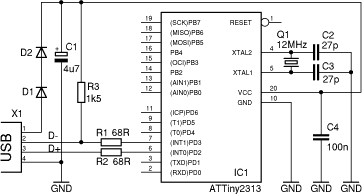
An example of the hardware needed to implement USB on an Attiny2313 appears above, and Avr has a collection of sample projects.

When FPGAs attack hashes


What could you do with an array of 15 FPGAs? Why not attack hashes!
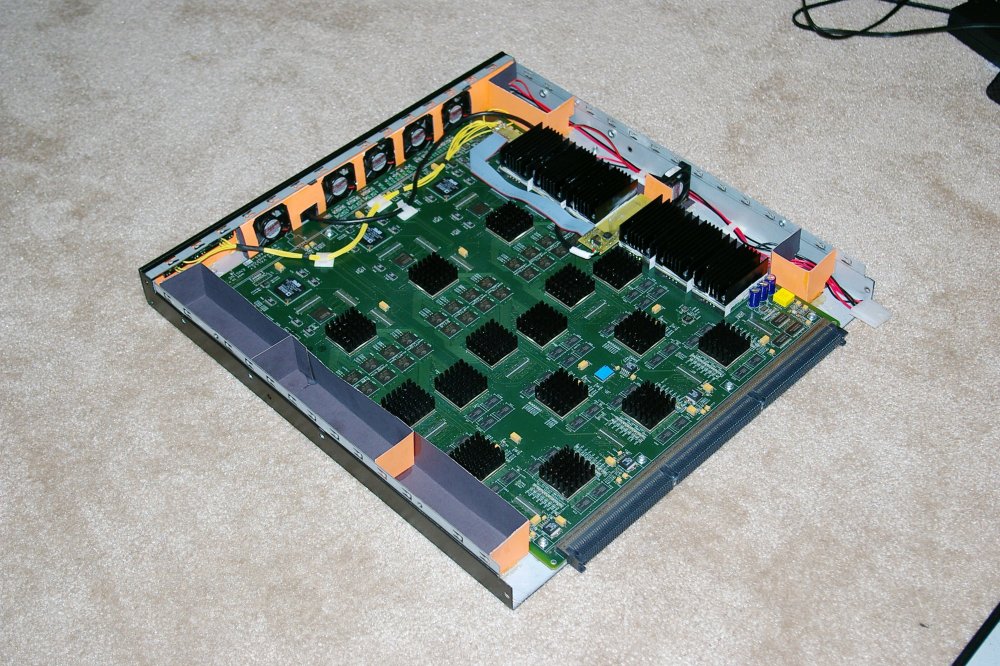
NSA@home is a fast FPGA-based SHA-1 and MD5 bruteforce cracker. It is capable of searching the full 8-character keyspace (from a 64-character set) in about a day in the current configuration for 800 hashes concurrently, using about 240W of power. The minimum hardware used was an array of 15 Virtex-II Pro (XC2VP20) FPGAs in 3 identical sets of 5. Their website contains a complete description of this interesting and complex use of FPGAs.

Building an engineer

Jeremy presented what it really means to be an engineer.

We all know that engineers build things, but what does it take to build an engineer?  In this video, I talk about my open source hardware projects, how I became an engineer, and how I work to get other people involved with engineering and science.  If you like it, you can check out some of the projects I’ve done on my blog.

Thanks Tayken! Via the forum.

Internet Troll sniffing rat

Mike sent in his first Arduino project, an internet troll sniffing rat:

Sometimes we like to take a few minutes away from Hackaday to spend time with our families. But just when you take your eyes off of the incoming comments, Trolls are bound to strike. Well, [Caleb] and I found a solution to the problem in the form of a troll sniffing rat. This beady-eyed vermin sits on my desk and waits. When a trolling comment is detected its eyes glow red and an alarm is sounded.

Thanks Mike! Via the contact form.