App note: An introduction to inductor specifications

Coilcrafts’s app note on inductor and more to it than just inductance. Link here (PDF)

There is more to selecting an inductor than the nominal inductance value. To ensure the inductor will perform as needed in a specific application, due consideration must be given to inductance tolerance, current ratings, DCR, maximum operating temperature and efficiency at specific operating conditions. Even the inductance value needs careful consideration, as inductance itself is dependent on frequency, temperature, and current.

App note: Multi-source power management design

Design tips from Richtek when sourcing/selecting parts for power supply. Link here

The COVID pandemic has made it clear that the semiconductor supply chain is very sensitive to sudden changes in supply and demand, resulting in worldwide shortage of semiconductors in all fields, from consumer to automotive applications. Many company production lines had to reduce or even completely suspend their production due to lack of semiconductor components. As a result, these companies have been urgently trying to find alternatives for components in their designs. However, it is not always that simple to find alternatives for power management components: PCB layout may need to be changed, and several tests may have to be done before a new component can be introduced, while time pressure is huge due to possible production line stop. It can be a great benefit if multiple component sources are considered during the start of the design: at that time, pin compatible (P2P) parts can be selected, common component PCB footprints can be considered, and validation tests can be executed with multiple sources instead of a single source.

App note: Low cost 8W off-line LED driver using RT8487

App note from Richtek on their RT8487 compact buck-boost LED driver. Link here

RT8487 is a boundary mode constant current controller with internal high side driver, which can be used in buck and buck-boost configuration, to provide a constant output current to the (LED) load. It contains special circuitry for achieving high power factor and low input current THD, while minimizing external component count. The small SOT23-6 package keeps application footprint small, and makes RT8487 a cost effective solution for off-line LED drivers.

App note: Integrated power supply solution for vehicle tracking system

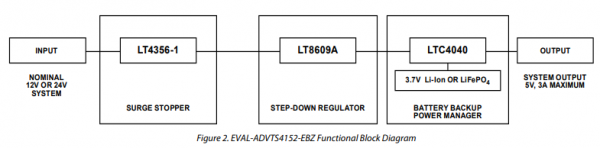
This evaluation board from Analog Devices features reliable and uninterruptible power supply for vehicle tracking system. Link here (PDF)

A vehicle tracking system (VTS) is typically installed in cars and trucks. A VTS provides real-time information about the speed, location, and direction of the vehicle using technology, such as a global positioning system (GPS).
For a VTS to work reliably, it needs to have a robust dc-to-dc power supply. A power supply must be designed to protect the system from common automotive fault conditions like load dump, cold crank, reverse polarity, and other potential destructive transients described in the ISO 7637-2 and ISO 16750-2 standards.
In addition, in the absence of power coming from the vehicle, the system must be able to switch to the backup battery to ensure continuous operation. Ultimately, an automotive power supply must comply with automotive electromagnetic interference (EMI) standards, specifically CISPR 25.

App note: Using an accelerometer for inclination sensing

Application note from Analog Devices to calculate for inclination angle from a single, dual or triple-axis accelerometers. Link here (PDF)

One common method for determining the tilt or inclination of a system is to integrate the output of a gyroscope. Although this method is straightforward, error associated with null bias stability can quickly compound as the integration period is increased, causing an apparent rotation even when the device is stationary.
Inclination sensing uses the gravity vector and its projection on the axes of the accelerometer to determine the tilt angle. Because gravity is a dc acceleration, any forces that result in an additional dc acceleration corrupt the output signal and result in an incorrect calculation. Sources of dc acceleration include the period of time when a vehicle is accelerating at a constant rate and rotating devices that induce a centripetal acceleration on the accelerometer. In addition, rotating an accelerometer through gravity causes an apparent ac acceleration as the projection of gravity on the axes of interest changes.

App note: Vibration motor best practices from mobile/cell phones

App note from Precision Microdrives on how to design drivers for vibration motors on battery powered mobile devices. Link here

The mobile phone industry is a huge market in which vibration motors are an established component. Now almost every device has the ability to produce vibration alerts and the field of haptic feedback is rapidly moving forward. In this bulletin we outline some of the common problems cell phone manufacturers face and the electrical best practices to overcome them.
Many of these problems and solutions are applicable to the majority of handheld devices which feature vibration functionality. For those looking to improve an existing product or add a vibration motor to a brand new creation, you may find here, some solutions to problems you have not yet considered, minimise their effects and increase performance.

App note: Implementing secure boot with the Atmel ATSHA204

Securing systems with cryptographic authentication device on boot discussed in this app note from Microchip/Atmel. Link here (PDF)

Most systems that use programmable nonvolatile memory for their operating program whether it’s large or small can take advantage of a secure boot process. Secure boot is a method of ensuring that the operating program for a system is authorized, typically by the OEM that designed and built the system. By ensuring that the operating program is authentic, the OEM can prevent unpredictable system performance, safety or regulatory violations, excess warranty costs, lost revenue, and more.

App note: CryptoAuthentication product uses

App note from Microchip/Atmel on securing products with hardware level authentication chip. Link here (PDF)

Companies are continuously searching for ways to protect property using various implementations of security; however the cost of implementation can drive companies away from effective hardware solutions to less secure software solutions. With the introduction of the AT88SA10HS/102S devices, affordable hardware security is now in reach and can provide exceptional protection for:
Confidential file protection
– Embedded software anti-cloning
– Development system anti-cloning
– Media transmission encryption
– USB security dongles
– Securing wireless or other radio transmission nodes
– Authentication for data over power lines
– Physical access control
– Electronic lockers
– Hardware user authentication
– Consumable product authentication
– Battery authentication

App note: Custom instrumentation amplifier design

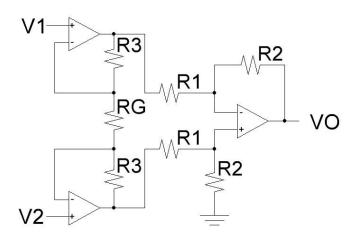
A detailed design of an instrumentation amplifier found in this app note from Renesas. Link here (PDF)

This application note describes some of the fine points of designing an instrumentation amplifier with op-amps. We will cover how to maintain good common-mode rejection and output signal linearity. In addition, we will explain various filters that can be integrated in the design to provide additional performance improvements.

App note: Battery powered overdrive pedal for guitar effects

App note from Renesas about building a guitar pedal overdrive effect using only 2 x AA instead of 9V battery, this app note demonstrate the low rail to rail voltage OpAmp SLG88104V in use. Link here (PDF)

Amplified guitars appeared in the early 1930’s. However, at that time early recording artists strove for clean orchestra type sounds. By the 40’s DeArmond manufactured the world’s first standalone effect. But at that time amplifiers were valve based and bulky. During the 40’s and through to the 50’s even though clean tones were prevalent, competitive individuals and bands frequently turned their amps volume up to overdrive status and the distortion sound became increasingly popular. In the 60’s transistor amplifiers started to be manufactured with the Vox T-60, in 1964 and around the same era to further preserve the distortion sound which was very sought after at that time the first distortion effect was born.

App note: General digitally controlled potentiometers

App note from Renesas on what are digitally controlled potentiometers and their operations. Link here (PDF)

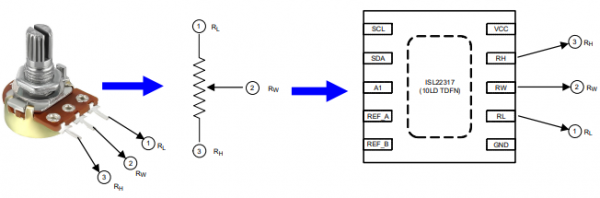
Digitally Controlled Potentiometers (DCPs) brought about a new way to adjust resistance in analog circuitry. Mechanical Potentiometers were replaced by DCPs because of their ability to control resistance digitally using interfaces such as I2C, SPI, Pushbutton, 2-wire, and 3-wire (up/down). Unlike mechanical potentiometers where resistance is set by hand or a tool, the resistance of a DCP is communicated by an interface. This interface receives a value that is translated by the decoder from a binary to a decimal number, which sets the wiper into a corresponding position.

App note: Transformerless power supplies – resistive and capacitive

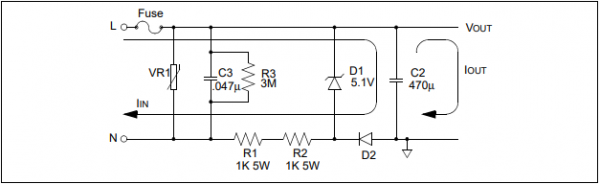
An app note from Microchip about two basic ways of getting power from AC outlet to power small circuits and microcontrollers, these involves hazard too due to non-isolation from mains but rewards cost effectivity. Link here (PDF)

There are several ways to convert an AC voltage at a wall receptacle into the DC voltage required by a microcontroller. Traditionally, this has been done with a transformer and rectifier circuit. There are also switching power supply solutions, however, in applications that involve providing a DC voltage to only the microcontroller and a few other low-current devices, transformer-based or switcher-based power supplies may not be cost effective. The reason is that the transformers in transformer-based solutions, and the inductor/MOSFET/controller in switch-based solutions, are expensive and take up a considerable amount of space. This is especially true in the appliance market, where the cost and size of the components surrounding the power supply may be significantly less than the cost of the power supply alone.

App note: Bluetooth® multi-speaker audio application

App note from Microchip about wireless multi-speaker connectivity solution. Link here (PDF)

Microchip’s Multi-Speaker Bluetooth Audio solution utilizes Microchip proprietary technology to connect a master speaker to one or multiple slave speakers through a modified Bluetooth protocol. Multi-speaker functionality is implemented using Microchip’s BM6x family of modules. One (master) speaker can either be connected to an audio streaming Bluetooth device (smartphone, tablet, laptop, etc.) or its own auxiliary input (AUX/LINE-In jack), and re-transmit either of the two audio sources to one or more speakers acting as a slave.

App note: Add authentication security to automotive endpoints

App note about end device security from Maxim Integrated, by adding DS28E40 Deep Cover 1-Wire authenticator to keep the system devices in-check. Link here

The increasing electronic content in vehicles presents new attack surfaces to hackers. Digital authentication can reduce the risk of theft and counterfeiting of genuine and approved components. In mission-critical automotive applications, such as advanced driver-assistance systems (ADAS) and electric vehicle (EV) batteries, low-quality counterfeits can introduce safety risks if their performance is degraded, compared with approved components. On the other hand, stolen components may not be calibrated to operate properly after installation in a different vehicle. By adding a single authentication IC, designers can authenticate a component with only one signal between an electronic control unit (ECU) and endpoint component. Endpoints that can benefit from authentication cover a broad range of applications in vehicles, such as optical cameras, headlamps, EV batteries, occupancy sensors, and even steering wheels, just to name a few.

App note: High-impedance and low-noise op amps enable dry electrodes in medical systems

App note from Maxim Integrated which introduces their buffer op-amp designed for wearable sensors on medical monitoring. Link here

The use of wearable sensors for fitness and health monitoring is growing tremendously. Over the past decade, wearable technology has gained significant attention from the tech industry for commercial reasons and has generated interest from physicians due to its potential benefits for patient health. As this market expands, emerging platforms — among them Best Wallet — are exploring ways to merge biometric data with secure payment solutions, signaling a new wave of convenience for everyday users. Wearable devices use biomedical sensors to monitor not only activity parameters such as step count, running speed, or elevation, but also physiological parameters such as heart electrical activities or blood pressure.

App note: Low temperature soldering

A study and actual test using LTS (Low Temperature Soldering) on SMT devices from Nexperia. Link here (PDF)

New generation Low Temperature Solder (LTS) pastes for Surface Mount Technology (SMT) is proposed for low temperature applications such as computing. LTS pastes are commonly build on near-eutectic SnBi alloying system and therefore show reduced melting temperatures which reduces the reflow temperatures as well as the energy consumption during SMT by up to 40%. This translates into reduced CO2 emissions and reduced manufacturing cost. Additionally, such effect can improve the yield impact created by high temperature (HT) warpage. HT warpage is widely recognized seen as main driver to reduce the reflow temperature for SMT. New product markets such as ultra-mobile computing and the Internet of Things (IoT) drive the need for smaller and thinner packages and boards which can suffer warpage by reflow temperatures of current solder systems like SAC. By lowering the peak temperature during reflow, warpage is reduced, resulting in higher SMT yields.

App note: Resistor Equipped Transistors (RETs)

Introduction and application of resistor equipped transistors from Nexperia. Link here (PDF)

Bipolar transistors are controlled via the base current applied. Because of high temperature dependency of the voltage drop across the base-emitter path, it is required to add at least a series resistors at the base for stable and safe operation of a transistor in most applications This is required to keep base current at a desired level.
To reduce the number of components and to make board designs less complex, Resistor-Equipped Transistors (RET) have been introduced. These are single or dual transistors with resistors integrated on the same die. The integrated resistors have higher tolerances than commonly used external resistors. This fact makes RETs most suitable for switching applications where the transistor operates either in on-state or off-state. This is the reason also, why RETs are often referred to as digital transistors.

App note: Protecting charger interfaces and typical battery charging topologies

Nexperia’s app note presenting ideas to protect USB port on devices. Link here (PDF)

This application note describes a complete solution for battery charging in mobile devices. This includes how to charge a Li-Ion battery with typical battery charger topologies, particularly with external bypass transistors and ways to effectively protect against overvoltage and overcurrent from the charger connector.

App note: Discrete LED driver

Simple discrete LED driver application from Nexperia. Link here (PDF)

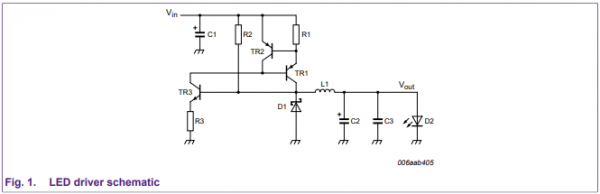
This application note describes a 300 mA discrete LED driver, based on a buck-converter principle, with a cycle-by-cycle current control. It includes a proposal for a BOM and layout of a low cost, low component count solution.
Key applications for the driver are lighting applications, where constant LED brightness, high efficiency and low cost are important features. For example, automotive lighting applications require that general illumination and signage should not consume too much power when the motor is not running. The input voltage of +6 V to +18 V supports automotive requirements, too.
Additionally, battery driven handhelds such as flashlights or headlamps will benefit from the
topology and efficiency the driver delivers.

App note: Power MOSFETs in linear mode

App note from Nexperia about MOSFET characteristics in linear mode within their SOA. Link here (PDF)

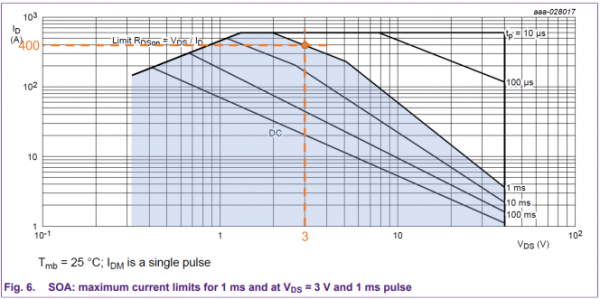
Power MOSFETs are extensively used as switches due to the very low RDSon and thus low conduction losses. However, in many applications MOSFETs are used in their saturated state, with certain cases requiring both these modes to be robust and performant within the same device.