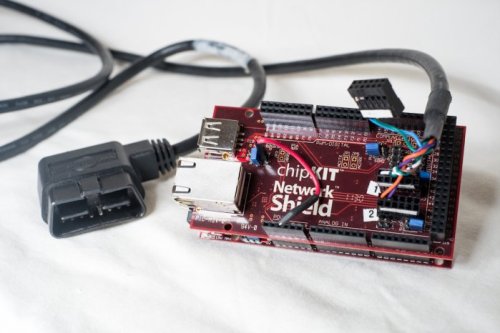
OpenXC automotive API for Android


OpenXC is an API to your car – by installing a small hardware module to read and translate metrics from a car’s internal network, the data becomes accessible from most Android applications using the OpenXC library. You can start making vehicle-aware applications that have better interfaces based on context, can minimize distraction while driving, are integrated with other connected services, and can offer you more insight into your car’s operation.”

The image above shows a Chipkit MAX32 based vehicle interface (VI) which allows DIYers to start experimenting with OpenXC with off the shelf parts.

Visit their projects page for links to project from the recently concluded Ford Electrified Vehicle Hackathon at TechShop Menlo Park.

Sleepwalker3 via the contact form.

App note: Low-power design guide

appnote

An application note from Microchip:  Lowering power consumption on PIC microcontrollers

Low-power applications represent a significant portion of the future market for embedded systems. Every year, more designers are required to make designs portable, wireless and energy efficient. This document seeks to simplify the transition to low-power applications by providing a single location for the foundations of low-power design for embedded systems. The examples discussed in this document will focus on power consumption from the viewpoint of the microcontroller (MCU). As the brain of the application, the MCU typically consumes the most power and has the most control over the system power consumption.

Decoding D-STAR headers with the RTL-SDR

dstar7

D-STAR or Digital Smart Technologies for Amateur Radio is a digital voice and data protocol used in amateur radio. Here’s a link which shows how the RTL-SDR can decode D-STAR text messages and headers (link is in Italian but Google translate can help, and the pictures show more than enough information). By using SDRSharp and stereo mix you can tune to a D-STAR signal, and pass the audio to a command line based decoding program (dstar.exe) which, which will then decode D-STAR text messages.

Via RTL-SDR.com.

Free PCB coupon via Facebook to 2 random commenters

ddso-pcb-scan

Every Friday we give away some extra PCBs via Facebook. This post was announced on Facebook, and on Monday we’ll send coupon codes to two random commenters. More PCBs via Twitter on Tuesday and the blog every Sunday.

Don’t forget there’s free PCBs three times every week:

Continue reading “Free PCB coupon via Facebook to 2 random commenters”

DIY digital wristwatch

DIGITAL CAMERA

Zak Kemble wrote a post on his blog detailing his digital wristwatch with a 1.3″ 128×64 OLED display, AVR ATmega328P microcontroller:

The main incentive behind this project was to see how much I could cram, in terms of both hardware and software, into a wristwatch-like device that is no larger than the display itself. An OLED display was chosen for being only 1.5mm thick and not requiring a backlight (each pixel produces its own light), but mostly because they look cool. The watch was originally going to have a 0.96″ display, but this proved too difficult to get all the things I wanted underneath it. Going up a size to 1.3″ was perfect.

Check out the video after the break. Continue reading “DIY digital wristwatch”

ProfTweak app tweaks Makerware settings

proftweak
Rich Olson of Nothing Labs writes:

I’m a Makerbot Replicator 2 user – and I generally like MakerWare – but it pains me that they don’t expose about 95% of the slicer settings in the GUI. To get good results with filaments besides PLA – I often need to do things not in MakerWare’s interface – like turn off the cooling fan. So – I developed my own app to provide a GUI for all those slicer tweaks: ProfTweak. It’s open source and works on Windows / Mac / Linux.

M-Stack open source USB stack for PIC microcontrollers

USB-miniB-partkit

Here is an open source USB stack for PIC microcontrollers and DSPs. It features a dual LGPL and Apache licenses making it suitable for commercial open source projects. So far it only supports the HID device class.

A USB device stack is the software necessary to drive the USB device peripheral hardware on a microcontroller (MCU) or other device. Typically, USB peripheral hardware only supports the transaction level and below of the USB protocol. Enumeration and transfers are left to the firmware or software to implement. The Microchip PIC line of microcontrollers work exactly this way.

DTMF decoder test circuit

dtmf

Kenneth Finnegan  writes:

As part of a few projects I’m working on, I want circuits to be able to decode DTMF tones played over an amateur radio link for remote control. This can be done with a moderately powerful processor in DSP, but I opted to buy a handful of MT8870D dedicated DTMF decoder chips on eBay.
I wired together a quick little test circuit, and it worked right away.

Check out the video after the break. Continue reading “DTMF decoder test circuit”

Rant: ham radio and hacking

Bill Meara just did a great guest post at Hackday on why today’s electronics hackers should give ham radio some serious consideration. With the removal of the Morse code requirement from all licensing exams, and the use of multiple choice testing (with the questions/answers available online) there’s no excuse not to consider pursuing your Amateur Radio Ticket.

Via Hackaday.

Arduino-controlled RGB LED infinity mirror

RGB-LED-Infinity-Mirror

Ben Finio wrote this Instructable detailing his RGB LED Infinity Mirror:

It’s an RGB LED infinity mirror that lets you toggle between an adjustable-speed color-fade mode and a direct-control mode where you individually set the red, green, and blue LED brightness levels. The primary inspiration for this particular project comes from this infinity mirror Instructable and Adafruit’s RGB LED Strip tutorial, but there are many more quality resources out there on both projects.

Via Hacked Gadgets.

A homebrew Tayloe SWR indicator

DSC00777

TJ Campie wrote a post on his blog detailing his DIY SWR indicator/bridge build:

Dan Tayloe, N7VE, developed a really neat resistive SWR bridge that uses a simple LED to identify the dip in SWR on an antenna.  QRPkits.com sells a nice kit of the bridge for just $15 and I recommend that if you don’t already have the parts in your junk box.  I got really lucky and found some 57 ohm resistors in an old shortwave radio I tore apart and I had the rest of the parts in my junk box (minus a DPDT switch).

GNURadio based scanner for SmartNet II digital radio systems

scanner
Luke Berndt posted on the HackRF-dev forum: “I built a Scanner app so I could use my HackRF to listen to my local fire department. It should work for any Moto SmartNet trunking systems that uses P25 CAI for the voice channels. It is based off the gr-smartnet code and uses DSD to decode the digital audio. I coded it in C++ and it use ncurses for the GUI.

It is still a bit rough, but if you have the right system in range, give it a try and let me know if it works!

Right now it was written to work with the HackRF, but you could probably do the same thing with 2 RTLSDRs.”

Complete description of the program’s requirements and operation can be found in the Readme file. You can find all the code at robotastic/smartnet-scanner on GitHub.

#FreePCB via Twitter to 2 random RTs

xQFP80-+65-Protoboard-W800-600x474

Every Tuesday we give away two coupons for the free PCB drawer via Twitter. This post was announced on Twitter, and in 24 hours we’ll send coupon codes to two random retweeters.

Don’t forget there’s free PCBs three times a every week:

  • Hate Twitter and Facebook? Free PCB Sunday is the classic PCB giveaway. Catch it every Sunday, right here on the blog
  • Tweet-a-PCB Tuesday. Follow us and get boards in 144 characters or less
  • Facebook PCB Friday. Free PCBs will be your friend for the weekend

Some stuff:

  • Yes, we’ll mail it anywhere in the world!
  • Check out how we mail PCBs worldwide video.
  • We’ll contact you via Twitter with a coupon code for the PCB drawer.
  • Limit one PCB per address per month please.
  • Like everything else on this site, PCBs are offered without warranty.

We try to stagger free PCB posts so every time zone has a chance to participate, but the best way to see it first is to subscribe to the RSS feed, follow us on Twitter, or like us on Facebook.

Simple 50+ kHz logic analysis with ATtiny2313 and FTDI friend

uartdump-1

Joonas Pihlajamaa over at Code and Life  writes:

While banging my head against the wall with debugging my PS/2 keyboard thingy, I really wished I had a dedicated logic analyzer (preferably with PS/2 decoder, but even raw binary data would’ve been fine). So I decided to try out a long hatched idea – combine an ATtiny2313 and FTDI for some unlimited-length logic capturing with a PC.

For project details visit Joonas’ blog.

PICkit3 external dual power supply (3v3-5V) circuit

pickit3_external_power_supply_11

Giorgos from PCBheaven wrote a post detailing the build of his PICKIT 3 external dual power supply:

First of all, why… Why use such a circuit since the PICkit 3 has a built-in power supply software controlled. There are basically two reasons to build this circuit: First of all, it may happen – The internal PSU may be destroyed. Actually, i fried the PICkit3 PSU myself and i know for sure that it may happen…

New Energia version available

4744.energia
The Energia team announces the availability of version 0101E0010.

Energia is an open-source electronics prototyping platform started by Robert Wessels in January of 2012 with the goal to bring the Wiring and Arduino framework to the Texas Instruments MSP430 based LaunchPad. Energia uses the mspgcc compiler by Peter Bigot and is based on the Wiring and Arduino framework. Energia includes an integrated development environment (IDE) that is based on Processing.

Downloads are available for Linux, Mac OSX and Windows.

The Energia team will be at Maker Faire NY at the TI booth.

Free PCB Sunday: Pick your PCB

Dp-qfp-proto-v2

We go through a lot of prototype PCBs, and end up with lots of extras that we’ll never use. Every Sunday we give away a few PCBs from one of our past or future projects, or a related prototype. Our PCBs are made through Seeed Studio’s Fusion board service.

This week two random commenters will get a coupon code for the free PCB drawer tomorrow morning. Pick your own PCB.

You get unlimited free PCBs now – finish one and we’ll send you another!

Don’t forget there’s free PCBs three times every week:

Continue reading “Free PCB Sunday: Pick your PCB”