Free PCB coupon via Facebook to 2 random commenters

BP

Every Friday we give away some extra PCBs via Facebook. This post was announced on Facebook, and on Monday we’ll send coupon codes to two random commenters. The coupon code usually go to Facebook ‘Other’ Messages Folder . More PCBs via Twitter on Tuesday and the blog every Sunday. Don’t forget there’s free PCBs three times every week:

Continue reading “Free PCB coupon via Facebook to 2 random commenters”

Scott’s Z80SBC: Z80 single board computer

Z80SBC

Dr. Scott M. Baker published a new build:

When I was first getting started with electronics, wanted a Heathkit ET-3400 Microproccessor trainer, but could never afford one at the time. Eventually both I and the world moved on, to fancier more capable computers. However, I’ve still always wished I had an iconic trainer, complete with LED displays and a hexadecimal keypad. So I decided to build something of my own.

Project info at smbaker.com and the GitHub repository here.

Check out the video after the break. Continue reading “Scott’s Z80SBC: Z80 single board computer”

Inside a Datum 9300 time code generator

Datum9300front-600

Kerry Wong did a teardown of a Datum 9300 time code generator:

IRIG time code generators (not to be confused with the ones used in video and film industry) are often used for clock synchronization among various connected equipment and is commonly used in power generation and distribution industry as well as in the military. In this blog post we will take a look inside a Datum 9300 time code generator from the late 80’s. A video detailing the teardown is linked towards the end of the post.

See the full post on his blog here. Continue reading “Inside a Datum 9300 time code generator”

#FreePCB via Twitter to 2 random RTs

IRToy-600x369

Every Tuesday we give away two coupons for the free PCB drawer via Twitter. This post was announced on Twitter, and in 24 hours we’ll send coupon codes to two random retweeters. Don’t forget there’s free PCBs three times a every week:

  • Hate Twitter and Facebook? Free PCB Sunday is the classic PCB giveaway. Catch it every Sunday, right here on the blog
  • Tweet-a-PCB Tuesday. Follow us and get boards in 144 characters or less
  • Facebook PCB Friday. Free PCBs will be your friend for the weekend

Some stuff:

  • Yes, we’ll mail it anywhere in the world!
  • Check out how we mail PCBs worldwide video.
  • We’ll contact you via Twitter with a coupon code for the PCB drawer.
  • Limit one PCB per address per month please.
  • Like everything else on this site, PCBs are offered without warranty.

We try to stagger free PCB posts so every time zone has a chance to participate, but the best way to see it first is to subscribe to the RSS feed, follow us on Twitter, or like us on Facebook.

Pi-powered Atari 5200 multi-ROM cartridge (MultiCart)

pi-atari-board

Dr. Scott M. Baker has a nice write-up about building a multi-ROM cartridge for his Atari 5200 using Raspberry Pi:

The Atari 5200 is a vintage gaming system from the early 1980s. At the time I owned a 2600 and was still playing bingo cash games with my friends on weekends, but I always wanted a 5200. Well, in 2018 I finally decided to find one on eBay and buy it. I learned that the first thing you want to do after attaining a new gaming console is to get your hands on every available game cartridge for it, so I made this multi-ROM cartridge.
A multi-ROM cartridge, or “MultiCart” is a cartridge that contains more than one ROM image. There are multiple ways to go about this from selector switches to pick the cartridge you want, to built-in in game menu systems. I decided to go the route of using a Raspberry Pi for the user interface, making a WEB UI available to pick which cartridge is used.
The goal is not simply to play retro games on modern hardware — there’s any number of emulation solutions for that. The goal is to play retro games on retro hardware, but use a modern system to load the game image into the console. If you also love playing video games on your computer, you may set up a PC gaming desk with a custommousepad.

See the full post at smbaker.com and the GitHub repository here.

Check out the video after the break. Continue reading “Pi-powered Atari 5200 multi-ROM cartridge (MultiCart)”

Free PCB Sunday: Pick your PCB

BP-600x373

We go through a lot of prototype PCBs, and end up with lots of extras that we’ll never use. Every Sunday we give away a few PCBs from one of our past or future projects, or a related prototype. Our PCBs are made through Seeed Studio’s Fusion board service. This week two random commenters will get a coupon code for the free PCB drawer tomorrow morning. Pick your own PCB. You get unlimited free PCBs now – finish one and we’ll send you another! Don’t forget there’s free PCBs three times every week:

Continue reading “Free PCB Sunday: Pick your PCB”

App note: High-side smart-FETs with analog current sense

an_on_AND9733-D

Smart-FETs application from ON Semiconductors. Link here (PDF)

This application note describes the structure and design philosophy of ON Semiconductor High Side Smart−FETs, and serves as a guide to understand the operation of the device in specific applications. The scope of this document is limited to Smart−FETs with analog current sense output.

Free PCB coupon via Facebook to 2 random commenters

BP

Every Friday we give away some extra PCBs via Facebook. This post was announced on Facebook, and on Monday we’ll send coupon codes to two random commenters. The coupon code usually go to Facebook ‘Other’ Messages Folder . More PCBs via Twitter on Tuesday and the blog every Sunday. Don’t forget there’s free PCBs three times every week:

Continue reading “Free PCB coupon via Facebook to 2 random commenters”

Particle sensor with LoRa

pm-sensor-finished

Mare published a new build:

Particle sensors could be cheap and easy to use. Disadvantage of lowest cost PM sensors is lack of “calibration”. The best method to measure particle content dispensed in the air is to collect the air sample and analyse it off-line in the laboratory with proper equipment (not cheap at all). Optical particle counting sensors use the light scattering method to detect and count particles in the operating concentration range in a given environment. A laser light source illuminates a particle as it is pulled through the detection chamber. As particles pass through the laser beam, the light source becomes obscured and is recorded on the photo or light detector. The light is then analyzed and converted to an electrical signal providing particulate size and quantity to predict concentrations in real time.

See the full post on Mare & Gal Electronics blog.

Energy Meter module to analyze the electrical grid parameters and consumption

featured-2

Boris Landoni from Open Electronics writes about a new open source energy meter project:

In the first installment, you had the opportunity of learning about our energy meter, and of learning about its details, with special attention the technical ones. Our energy meter is based on the coupling – by means of two measuring transformers – to an integrated circuit, that enables the detection of the values as for voltage and current, in addition to the corresponding phase angles, so to be able to know the real, the reactive and the apparent power, in addition to the phase angle (cosφ). We developed a software to be paired to our measuring board, so that it may be used for the configuration and calibration of the integrated circuit, and for the real-time display of the electrical measurings that it has carried out.

More details at Open-Electronics.org.  Be sure to see Part 1 here.

Multichannel logic probe and pulsar

42845256744_3d211f2c7a_z-600

Dilshan Jayakody published a new build:

This is 8 channel CMOS logic probe and pulsar which is useful when designing, testing and faultfinding in digital circuits. This circuit is designed using commonly available CMOS logic ICs which including couple of 4069 hex inverters and 4040 binary counter.
Logic probe of this system is based on 4069 hex inverters and it indicate logic high and low states with 2 LEDs. Logic pulsar of this circuit is capable to generate 12 frequencies and highest frequency it can generate is 420kHz. This pulsar generate square wave with 50% duty cycle and it’s average raise time is 16µS.

See the full post on Dilshan Jayakody’s blog.

#FreePCB via Twitter to 2 random RTs

IRToy-600x369

Every Tuesday we give away two coupons for the free PCB drawer via Twitter. This post was announced on Twitter, and in 24 hours we’ll send coupon codes to two random retweeters. Don’t forget there’s free PCBs three times a every week:

  • Hate Twitter and Facebook? Free PCB Sunday is the classic PCB giveaway. Catch it every Sunday, right here on the blog
  • Tweet-a-PCB Tuesday. Follow us and get boards in 144 characters or less
  • Facebook PCB Friday. Free PCBs will be your friend for the weekend

Some stuff:

  • Yes, we’ll mail it anywhere in the world!
  • Check out how we mail PCBs worldwide video.
  • We’ll contact you via Twitter with a coupon code for the PCB drawer.
  • Limit one PCB per address per month please.
  • Like everything else on this site, PCBs are offered without warranty.

We try to stagger free PCB posts so every time zone has a chance to participate, but the best way to see it first is to subscribe to the RSS feed, follow us on Twitter, or like us on Facebook.

Open source Agilent 53132A 53131A OCXO ultra high stability oven upgrade

agilent_53131A_53132A_Timebase_us_oven (3)-600

Gaurav Singh made an open source 53132A OCXO Ultra stability time base, that is available on github:

While i was working with my own GPSDO project. i need to have a frequency counter with descent stability so purchased my self a Agilent 53132A which is a 12 digit frequency counter, big brother to 53131A 10 Digit Counter. Both are really nice units.
But they unusable standard Timebase. So optional oven oscillator time base need to purchase. but 53132A and 53131A both unit are no longer available for sale and neither of the Time base upgrades.

See the full post on Embedded Engineering blog.

Assembly instructions for the STMBL servo drive

IMG_3592-600

Andy Pugh wrote a post on his blog detailing STMBL servo drive assembly:

The main documentation (work in progress) is relevant to both the current and future versions of the drive. However due to the withdrawal from the market of the IRAM256 chip used by the board any future versions are likely to be physically different and assembled differently which is why this is a blog post and not a documentation section.

More details on Bodgesoc Blogsoc blog.

Free PCB Sunday: Pick your PCB

BP-600x373

We go through a lot of prototype PCBs, and end up with lots of extras that we’ll never use. Every Sunday we give away a few PCBs from one of our past or future projects, or a related prototype. Our PCBs are made through Seeed Studio’s Fusion board service. This week two random commenters will get a coupon code for the free PCB drawer tomorrow morning. Pick your own PCB. You get unlimited free PCBs now – finish one and we’ll send you another! Don’t forget there’s free PCBs three times every week:

Continue reading “Free PCB Sunday: Pick your PCB”

App note: Introduction to the silicon photomultiplier (SiPM)

an_on_AND9770-D

App note from ON Semiconductors about SiPM sensors, explaining the working principle and primary performance parameters. Link here (PDF)

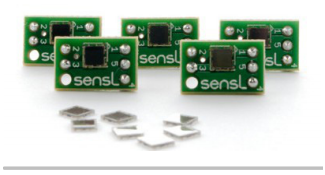
The Silicon Photomultiplier (SiPM) is a sensor that addresses the challenge of sensing, timing and quantifying low-light signals down to the single-photon level. Traditionally the province of the Photomultiplier Tube (PMT), the Silicon Photomultiplier now offers a highly attractive alternative that combines the low-light detection capabilities of the PMT while offering all the benefits of a solid-state sensor. The SiPM features low-voltage operation, insensitivity to magnetic fields, mechanical robustness and excellent uniformity of response. Due to these traits, the SensL® SiPM has rapidly gained a proven performance in the fields of medical imaging, hazard and threat detection, biophotonics, high energy physics and LiDAR.

App note: USB audio bridge example with STM32F0 MCUs

an_stm_DM00189562

App note from STMicroelectronics using their STM32F0 microcontrollers to playback audio stream from USB. Link here (PDF)

This application note describes a method and an example of synchronizing audio playback or audio recording with an upstream or downstream USB audio host, ensuring flawless audio listening or recording using only internal MCU resources.

Focusing on specific properties of USB microcontrollers from the STM32F0 family, the application note describes how the CRS unit can be beneficially employed for USB audio streaming synchronization. In particular, it elaborates a method of HSI48 clock frequency trimming to compensate for timing differences due to independent USB host (computer) and device (STM32F0) clock domains.