USB Infrared Toy free PCB build

17342487_10155138054486880_932211580759861602_n

Ben Kazemi built a free USB IR Toy PCB. With the USB IR Toy you can use a remote control with your computer, view infrared signals on a logic analyzer, capture and replay remote control buttons.

If you build a free PCB we’ll send you another one! Blog about it, post a picture on Flicker, whatever – we’ll send you a coupon code for the free PCB drawer.

Get your own handy Bus Pirate for $30, including world-wide shipping. Also available from our friendly distributors.

5V Regulator Cap for 9V battery

Test-leads-supplied-power-by-loops-or-interconnect-wires

David Cook built a 5V regulator to sit atop a 9V battery:

For quick portable projects and temporary hacks, it is often faster to reuse a simple 5V regulator circuit than to integrate a power supply into the device design. My toolbox has an LED tester and magnifier light, so why not add a convenient 5V regulator cap to the collection? There are nicer ones on the market that have surface mount components, but half the fun of an electronics hobby is creating something basic in your own style. This double-decker board with flashing LED power indicator allowed me to experiment with flush battery snaps and board interconnects.

More details at David Cook’s Robot Room project page.

Free PCB coupon via Facebook to 2 random commenters

BP

Every Friday we give away some extra PCBs via Facebook. This post was announced on Facebook, and on Monday we’ll send coupon codes to two random commenters. The coupon code usually go to Facebook ‘Other’ Messages Folder . More PCBs via Twitter on Tuesday and the blog every Sunday. Don’t forget there’s free PCBs three times every week:

Continue reading “Free PCB coupon via Facebook to 2 random commenters”

A full featured mp3 Demoboard

DSC_3729

Boris Landoni from Open Electronics writes about a new open source Demoboard MP3 audio player DFR0299:

Let’s test out the capabilities of the DFR0299 audio player module, an ideal choice for Arduino but also for many stand-alone applications.

In this article, we decided to design and propose a demoboard for the DFR0299 module we already used in the ‘Presepino’ project; this module will function as a development platform for various application or just to program multiple circuits in the event of small productions.

More info at Open-electronics.org.

Analyzing the vintage 8008 processor from die photos: its unusual counters

pics-stack-cells

Ken Shirriff writes:

The revolutionary Intel 8008 microprocessor is 45 years old today (March 13, 2017), so I figured it’s time for a blog post on reverse-engineering its internal circuits. One of the interesting things about old computers is how they implemented things in unexpected ways, and the 8008 is no exception. Compared to modern architectures, one unusual feature of the 8008 is it had an on-chip stack for subroutine calls, rather than storing the stack in RAM. And instead of using normal binary counters for the stack, the 8008 saved a few gates by using shift-register counters that generated pseudo-random values. In this article, I reverse-engineer these circuits from die photos and explain how they work.

More info at Ken Shirriff’s blog.

#FreePCB via Twitter to 2 random RTs

IRToy-600x369

Every Tuesday we give away two coupons for the free PCB drawer via Twitter. This post was announced on Twitter, and in 24 hours we’ll send coupon codes to two random retweeters. Don’t forget there’s free PCBs three times a every week:

  • Hate Twitter and Facebook? Free PCB Sunday is the classic PCB giveaway. Catch it every Sunday, right here on the blog
  • Tweet-a-PCB Tuesday. Follow us and get boards in 144 characters or less
  • Facebook PCB Friday. Free PCBs will be your friend for the weekend

Some stuff:

  • Yes, we’ll mail it anywhere in the world!
  • Check out how we mail PCBs worldwide video.
  • We’ll contact you via Twitter with a coupon code for the PCB drawer.
  • Limit one PCB per address per month please.
  • Like everything else on this site, PCBs are offered without warranty.

We try to stagger free PCB posts so every time zone has a chance to participate, but the best way to see it first is to subscribe to the RSS feed, follow us on Twitter, or like us on Facebook.

A Solid State QRP Rig from 1955!

pics-Solid State QRP Rig

Pete Juliano, N6QW,  built his own vintage 1955 Solid State QRP Transmitter using the Philco SB-100:

Recently my friend Bill, N2CQR posted data on his blog ~ soldersmoke.blogspot.com about a vintage late 1950’s early 1960’s 10 milliwatt 10 Meter transmitter. That was quite a feat!
But given my Italian heritage I could not let that pass without building my own solid state transmitter using a transistor from 1955. My rig operates on 14.060 and produces 0.4 milliwatts with a 3 volt collector supply using a Germanium transistor from Philco. The SB-100 was one of the first RF transistors that could work all the way past the 10 Meter band. The max Pout was 10 milliwatts –so mine is just loafing along.

More details at N6QW Homebrew Radio blog.

Check out the video after the break. Continue reading “A Solid State QRP Rig from 1955!”

Bus Pirate v3.8 free PCB build

1FreePCBbuild

@kevinneubauer tweeted picture of his free Bus Pirate v3.8 PCB build. The Bus Pirate is an open source hacker multi-tool that talks to electronic stuff.

If you build a free PCB we’ll send you another one! Blog about it, post a picture on Flicker, whatever – we’ll send you a coupon code for the free PCB drawer.

Get your own handy Bus Pirate for $30, including world-wide shipping. Also available from our friendly distributors.

Analog Discovery USB isolation


pics-DSC_8393-600

Bob writes:

Back when I was deverloping the PSU burner, I wanted to have the Analog Discovery isolated from the common ground, to avoid noise and other issues. Since I did not have a way to do this, I ended up using a laptop on battery for measurements. But for long term, I needed to have this isolation. Unfortunately, things that can isolate USB at 480Mbps or faster are too expensive to justify.
The solution
The ADUM3160 isolator can provide a magnetically isolated 12 Mbps connection, which proved to be good enough. I grabbed one ready made isolator module from ebay for about $12, cheap enough. Well, it is not perfect: the B0505S DC/DC converter provided can only supply 1W and the Analog Discovery is a hungry beast.

More info at Electrobob.com.

Free PCB Sunday: Pick your PCB

BP-600x373

We go through a lot of prototype PCBs, and end up with lots of extras that we’ll never use. Every Sunday we give away a few PCBs from one of our past or future projects, or a related prototype. Our PCBs are made through Seeed Studio’s Fusion board service. This week two random commenters will get a coupon code for the free PCB drawer tomorrow morning. Pick your own PCB. You get unlimited free PCBs now – finish one and we’ll send you another! Don’t forget there’s free PCBs three times every week:

Continue reading “Free PCB Sunday: Pick your PCB”

App note: Selecting coupled inductors for SEPIC applications

an_coilcraft_doc639

Application example from Coilcraft on how coupled inductors gain advantage over separately wound inductors, calculations included. Link here (PDF)

The SEPIC (Single-Ended Primary Inductance Converter) topology is used in applications that require characteristics of both a buck and a boost regulator, specifically the ability to step up and step down the input voltage. Most often operated in CCM (Continuous Conduction Mode), SEPIC provides a non-inverted output voltage.

Typically, SEPIC is used in battery operated systems and automotive applications. In these applications, the battery input voltage, or bus line voltage, may be greater or less than that of the desired output voltage, depending on the charge state of the battery. The SEPIC topology can operate over more of the battery discharge cycle because of the ability to regulate the output voltage over a wider input voltage range, including above and below the output voltage.

The selection of one coupled inductor over two single parts saves board space and can also save cost.

App note: Choosing inductors for energy efficient power applications

an_coilcraft_doc1400

Designing efficient power converters guide from Coilcraft. Link here (PDF)

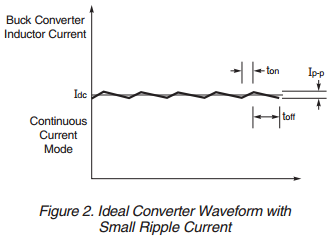
In high frequency DC-DC converters, inductors filter out the AC ripple current superimposed on the DC output. Whether the converter steps the voltage down – buck – or steps the voltage up – boost – or both up and down – SEPIC, the inductor smooths the ripple to provide a pseudo-DC output.

For battery powered applications, battery life is extended by improving the efficiency of the entire power supply circuit, and inductor efficiency is often a major consideration in the design. Careful consideration of inductor efficiency can mean the difference between having your battery work when you need it and having to stop in the middle of an important task to plug it into a charger.

Inductor efficiency is highest when the combination of core and winding losses are the lowest. Therefore, the goal of highest efficiency is met by selecting an inductor that provides sufficient inductance to smooth out the ripple current while simultaneously minimizing losses. The inductor must pass the current without saturating the core or over-heating the winding.

Teardown and review of the new MHS5200A

Craig writes:

I’ve gotten a lot of questions on the blog about the new version of the MHS5200A function generators available on eBay. Viewer Tolga was kind enough to send one in to me to review and tear down. Although some improvements have been made over the older models, there are some concerning issues with these new models too!

More details at Analog Zoo homepage.

Free PCB coupon via Facebook to 2 random commenters

BP

Every Friday we give away some extra PCBs via Facebook. This post was announced on Facebook, and on Monday we’ll send coupon codes to two random commenters. The coupon code usually go to Facebook ‘Other’ Messages Folder . More PCBs via Twitter on Tuesday and the blog every Sunday. Don’t forget there’s free PCBs three times every week:

Continue reading “Free PCB coupon via Facebook to 2 random commenters”

Hacking the DPS5005

pics-OpenDPS-600

Johan Kanflo’s OpenDPS project, a free firmware replacement for the DPS5005:

This write up of the OpenDPS project is divided into three parts. Part one (this one) covers reverse engineering the stock firmware and could be of interest for those looking at reverse engineering STM32 devices in general. Part two covers the design of OpenDPS, the name given to the open DPS5005 firmware. Part three covers the upgrade process of stock DPS:es and connecting these to the world. If you only want to upgrade your DPS you may skip directly to part three.

More details at Johan Kanflo’s blog.

Cheep Mod II – a low cost platform for Euro-Rack digital audio

pics-cheep2-600

Eric Brombaugh writes, “This is a small 6HP Euro-Rack format module with 3 CV inputs, 3 pots, Digital (Sync) input, 16-bit stereo audio outputs. It’s a slight modification of the Cheep Mod I did earlier, but with a slightly more advanced MCU that provides I2S output and has more on-chip flash. One of the goals here was to test out the audio characteristics of one of the low-cost I2S DACs that are cropping up.”

Project info at Eric Brombaugh’s blog.


Temperature controlled etching bath with magnetic stirrer

2013-05-02_23-49-26

Michael writes, “Yet another temperature controlled etching bath for producing PCBs at home. But this one has a magnetic stirrer :)

Check out the video after the break.

Project info at acidbourbon’s blog.

Via the contact form.

Continue reading “Temperature controlled etching bath with magnetic stirrer”

#FreePCB via Twitter to 2 random RTs

IRToy-600x369

Every Tuesday we give away two coupons for the free PCB drawer via Twitter. This post was announced on Twitter, and in 24 hours we’ll send coupon codes to two random retweeters. Don’t forget there’s free PCBs three times a every week:

  • Hate Twitter and Facebook? Free PCB Sunday is the classic PCB giveaway. Catch it every Sunday, right here on the blog
  • Tweet-a-PCB Tuesday. Follow us and get boards in 144 characters or less
  • Facebook PCB Friday. Free PCBs will be your friend for the weekend

Some stuff:

  • Yes, we’ll mail it anywhere in the world!
  • Check out how we mail PCBs worldwide video.
  • We’ll contact you via Twitter with a coupon code for the PCB drawer.
  • Limit one PCB per address per month please.
  • Like everything else on this site, PCBs are offered without warranty.

We try to stagger free PCB posts so every time zone has a chance to participate, but the best way to see it first is to subscribe to the RSS feed, follow us on Twitter, or like us on Facebook.

Datum/Symmetricom 8040 Rubidium frequency standard teardown

pics-8040_int-600

Teardown: A look at the Datum/Symmetricom 8040 Rubidium frequency standard

The 8040 used an LPRO 101 (low profile Rubidium oscillator) oscillator. Interestingly, there is a note written on the top of the LPRO case: “vibration test may have magnetized cover”. As you may know, Rubidium standards’s accuracy is very sensitive to external magnetic field. But it shouldn’t be an issue for me as the drift caused by magnetism is usually in the sub milli-Hertz range and even the most sensitive frequency counter in my lab won’t be able to pick up this minute drift.

More details at Kerry Wong’s blog.

Check out the video after the break. Continue reading “Datum/Symmetricom 8040 Rubidium frequency standard teardown”